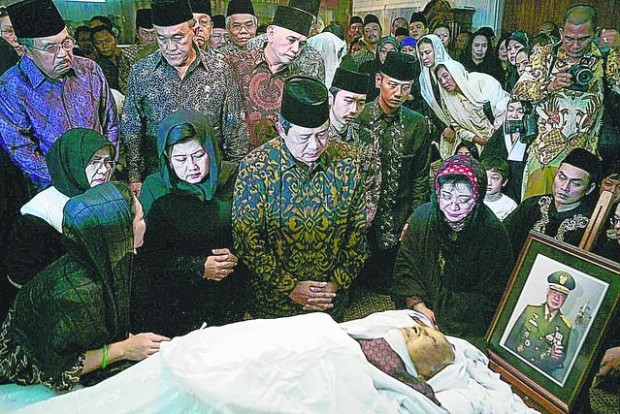
JAKARTA, Indonesia — Former Indonesian President Suharto, a Cold War ally of the United States whose brutal military regime killed hundreds of thousands of left-wing political opponents, died Sunday. He was 86.
Although he oversaw some of the worst bloodshed of the 20th century, Suharto is credited with developing the economy and will be buried with the highest state honors today at the family mausoleum.
President Susilo Bambang Yudhoyono declared a week of national mourning and called on Indonesians "to pay their last respects to one of Indonesia's best sons."
Suharto loyalists, who run the courts, called for forgiveness. But survivors want those responsible for atrocities to be held accountable.
"I cannot understand why I have to forgive Suharto because he never admitted his mistakes," said Putu Oka Sukanta, who spent a decade in prison because of left-wing sympathies.
People are also reading…
Suharto was finally toppled by mass street protests in 1998 at the peak of the 1997-1998 Asian financial crisis.
His departure from office opened the way for democracy in this predominantly Muslim nation of 235 million people, and he withdrew from public life.
Suharto ruled with a totalitarian dominance that saw soldiers stationed in every village, instilling a deep fear of authority across this Southeast Asian archipelago that stretches across more than 3,000 miles.
Since being forced from power, Suharto had been in and out of hospitals after strokes caused brain damage and impaired his speech. He died of multiple-organ failure after more than three weeks on life support at a hospital in the capital, Jakarta.
Poor health — and continuing corruption, critics charge — kept him from court after he was chased from office.
The bulk of killings occurred in 1965-1966 when alleged communists were rounded up and slain during his rise to power. Estimates for the death toll range from a government figure of 78,000 to 1 million cited by U.S. historians Barbara Harff and Ted Robert Gurr, who have published books on Indonesia's history.
Over the next three decades, a further 300,000 people were killed, disappeared or starved in the independence-minded regions of East Timor, Aceh and Papua, human rights groups and the United Nations say.
Suharto's five successors as head of state all vowed to end the graft that took root under his regime, yet it remains endemic.
With the court system paralyzed by corruption, the country has not confronted its bloody past. Rather than put on trial those accused of mass murder and multibillion-dollar theft, some members of the political elite consistently called for charges against Suharto to be dropped on humanitarian grounds.
Some noted Suharto also oversaw decades of economic expansion that made Indonesia the envy of the developing world. Today, nearly a quarter of Indonesians live in poverty, and many long for the Suharto era's stability, when fuel and rice were affordable.
On Sunday, hundreds of mourners — some weeping — flocked to the family home in downtown Jakarta.
"I felt crushed when I heard he had died. We have lost a great man," said Mamiarti, a 43-year-old housekeeper. "It used to be easy to find jobs. Now it is hard."
But critics say Suharto squandered Indonesia's vast natural resources of oil, timber and gold, siphoning the nation's wealth to benefit his cronies, foreign corporations and family like a mafia don.
Jeffrey Winters, associate professor of political economy at Northwestern University, said the graft effectively robbed "Indonesia of some of the most golden decades, and its best opportunity to move from a poor to a middle class country."
"When Indonesia does finally go back and redo history, (its people) will realize that Suharto is responsible for some of the worst crimes against humanity in the 20th century," Winters said.
President Bush sent his regrets over Suharto's death. "President Bush expresses his condolences to the people of Indonesia on the loss of their former president," said Gordon Johndroe, spokesman for the White House's National Security Council.