


LA PAZ, Bolivia — From his penthouse office in a tightly guarded, nine-story building here, where architects designed the watchtowers to look like small lighthouses, Vice Adm. Jose Alba Arnez oversees a military force with more than 5,000 sailors, cadets and officers.
His waiting room has oil paintings depicting men-of-war in choppy waters, an old wooden ship's wheel and waiters clad in bow ties who serve coca tea on fine china.
All that is lacking for Alba, commander-general of the Bolivian navy, is a sea.
"We've been in this unfortunate condition since the late 19th century," he said in an interview, gesturing toward a wall map from 1859 showing Bolivia with almost twice its current territory and a swath of Pacific coastline.
Situation dates to 1879
People are also reading…
Today's maps show that coast as part of Chile, thanks to the 1879 conflict known as the War of the Pacific, or the Saltpeter War, which helped cement Chile as a regional power and, some here say, put Bolivia on the path to becoming South America's poorest nation.
In a diplomatic push combining nostalgia and shrewd nationalist politics, President Evo Morales has begun lobbying to regain a small part of that coastline for Bolivia.
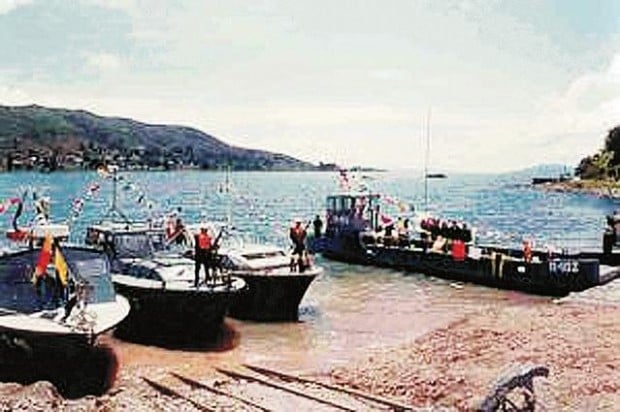
The navy, which patrols Bolivia's rivers and the waters of Lake Titicaca, finds itself in the middle of this quest.
Morales took the spotlight at the meeting of the Nonaligned Movement of countries this month in Havana, where he led a parallel meeting of a 31-member organization called the Group of Landlocked Developing Countries. Members include Bhutan, Burkina Faso and Moldova.
"We hope in the near future to be able to leave this group," Morales told delegates in Havana.
Notwithstanding Chile's historic intransigence to cede even one inch of its territory to Bolivia, such comments play well in Bolivia, where textbooks portray that 1879 war as a Chilean land grab, and where each May the nation commemorates a Day of the Sea.
Naval officers, meanwhile, pine for a corridor to the Pacific.
"We don't want it all back," said Alba, clad in dress uniform. "All we want is a 10-kilometer strip to call our own."
The current navy, though ensconced in society, is a relatively recent creation. In a fit of nationalism in 1963, President Victor Paz Estenssoro decreed it back into existence.
Lake Titicaca outpost
Military officials were sent on educational exchanges to naval schools in Argentina, Brazil and the United States, institutionalizing Bolivia's wish for a coastline.
Now the navy patrols Amazonian rivers, assists in efforts to limit contraband and distributes medicine to remote communities. An elite unit formed to combat drug trafficking, the Blue Devils, operates near the border with Brazil.
The navy's proudest outpost is found on the southern banks of Lake Titicaca, more than two miles above sea level.
"Exercising sovereignty"
A monument near the entrance to the Titicaca Naval Base depicts a Bolivian soldier thrusting his bayonet into the throat of a Chilean soldier beside the words, "What once was ours, will be ours once more."
The base's commander, Capt. Carlos Vallejo Crespo, said in an interview that the naval base's purpose was to "exercise sovereignty."
Carefully choosing his words, Vallejo said Bolivia was not mediterraneo, Spanish for something that is surrounded by land, but was instead enclaustrado, or forcibly cloistered.
On touring the base, he pointed to a fleet that included two rusting patrol boats donated by China and a hospital boat to take government pediatricians, gynecologists and dentists to far-flung villages on the lake.
Watching recruits, mainly Aymara-speaking Indians, emerge shivering after a swim in the lake's 46-degree water as part of a punishing high-altitude diving course, he explained, "We now guarantee that almost all of our sailors learn how to swim."
Though they swear off any involvement in politics, naval officers closely follow every ripple in Bolivia's effort to regain access to the Pacific, a prickly issue that has grown more serious in recent years.
In 2003, President Gonzalo Sanchez de Lozada, already unpopular for yielding to U.S. pressure to eradicate coca, pushed for plans to export Bolivian natural gas to North America through Chile. Protests forced him to flee the country.
Morales, elected late last year on a platform of protecting coca farming for nondrug use, has reaffirmed his support for a "gas for sea" policy.
That conditions the possible supply of Bolivian gas to Chile or its export through Chilean ports to winning access to the sea.
But Bolivia and Chile have not had full diplomatic relations since 1978.
Morales has appealed to the Organization of American States to help broker a solution, but he received a tepid response, even though his ally, President Hugo Chavez of Venezuela, has said he longed to swim on a Bolivian beach.
Some Chilean legislators and Jorge Arancibia, former commander in chief of the Chilean navy, have supported finding a resolution with Bolivia, but polls show that most Chileans oppose a settlement.
Still, Morales recently told people attending the commemoration of the 43rd anniversary of the re-formation of the navy that they should be prepared "to return at any moment to the Pacific Ocean."
"Part that Chile took away"
Though Morales remains popular here, strikes and road blockades by groups dissatisfied with the pace of his government's changes have grown more common.
Such unrest, though, does not seem to have affected sentiment at the Museum of the Coast, a collection here of old maps, war correspondence and books by marologos, or sea specialists, on the consequences of the War of the Pacific, which was fought over control of nitrate deposits in the form of guano and saltpeter.
"This is about part of us," said Mauricia Yapura, an attendant at the museum for 10 years, "a part that Chile took away."


 $25M distribution center to be built in Tucson


