

Certain patients who have coronary-bypass surgery in Tucson will no longer need to go through the trauma of having their chests cracked open.
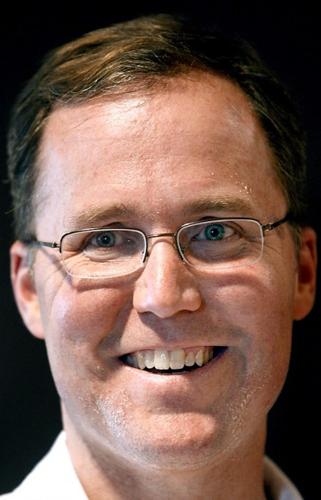
Renowned cardiac surgeon Dr. Robert S. Poston began work at Tucson's University Medical Center in late January, bringing to Southern Arizona a method of minimally invasive, robot-assisted heart surgery that dramatically decreases recovery time and pain for patients.
He's performed three such surgeries here so far. The first was on 56-year-old Rhode Island resident Larry Fish, who flew across the country for his Feb. 9 surgery.
Poston is the new chief of cardiovascular and thoracic surgery at the University of Arizona's College of Medicine. The addition of Poston is part of a plan to have UA's Surgery Department grow by 20 more surgeons by mid-2012.
UA surgery department chairman Dr. Rainer Gruessner said he hired Poston because of the benefit he'll bring to local patients. Poston has performed about 350 of the robot-assisted surgeries during his career and plans on doing 100 to 150 annually in Tucson. He does the robot-assisted surgery for other procedures too, such as heart-valve repair.
People are also reading…
Normally, a coronary bypass requires undergoing what's called a sternotomy, in which the sternum is split midline to give surgeons access to the heart. The resulting incision is so prominent that it's referred to by many patients as "the zipper" and the healing time is a minimum of eight weeks, more typically three months.
"You take a saw. You could cut wood with it. You split the sternum in two," Poston said. "And at the end you put wires back. It will heal like any broken bone if you put it back together and keep it still for six weeks; the bone bridges the gap and heals. So that's not really the issue. The healing and getting infected is a minor concern.
"The major concern is that you have now had two operations - you've had your heart operated on and you've had a major orthopedic operation. That's as big as any orthopedic operation would be. ... It takes a long time to heal," he added.
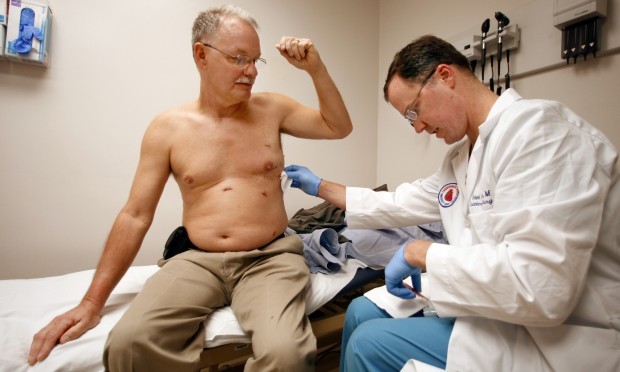
But Poston performs the robot-assisted surgery from a console and is able to direct the DaVinci robot's tiny instruments around the bone. There's no sternotomy, and patients have minimal scarring. The recovery time is three weeks.
On Feb. 9, Poston performed the first such operation to occur at UMC. Fish wanted Poston to perform his surgery, but his decision to come to Tucson was also based on the reputation UMC gained in the aftermath of the Jan. 8 shooting rampage.
"It's 2,602 miles from my house to this medical center. I have no roots here or relatives. The only thing I knew about UMC was the tragedy," Fish said. "Seeing where he (Poston) was going, I had no qualms about waiting another three weeks."
Fish, a father of four and busy business owner, has a lot going on this year - one daughter is having a baby in July, and two more of his children will have weddings this summer.
"I knew I couldn't wait until the summer to get surgery. I couldn't walk up the stairs without getting out of breath," said Fish, who had suffered two heart attacks, the most recent one last fall.
But he was fearful about the recovery time - his normally tough brother's experience with heart-bypass surgery was grueling. Just coughing required holding a pillow and brought tears to his brother's eyes, Fish said.
Fish's cardiologist in Rhode Island recommended Poston, who had been the chief of cardiac surgery at Boston Medical Center and Boston University and is one of about 15 doctors in the country who perform robot-assisted heart surgery.
But Poston left Boston in August to take a job as a cardiac surgeon at the University of Chicago Medical Center. Five months later he left for Tucson. Two moves in less than a year was a strain on his family, but the position in Tucson was the job he'd wanted all along, he said.
"Gruessner has a real vision for innovation, and knows how to support people that are trying to get that done," Poston said. "There's a team of people that believe in doing things cutting-edge. And that also has paid off because I now have done three robotic cases and it's clear that they get it. This fires them up. A lot of places you go, and you know, if a case is done differently they don't like it. It demoralizes them. You want to go to a place where it helps morale when you are doing things new and interesting."
Fish tracked Poston down in Chicago and scheduled his surgery for Jan. 19. But then Poston contacted Fish in early January to say he was moving again, this time to Tucson. He'd be leaving Chicago shortly after Fish's scheduled surgery date and didn't think that would work. He recommended a colleague in Maryland.
Poston said "he didn't want to operate on me and then leave two days later," Fish said. "That told me everything I needed to know. It wasn't about the almighty buck. If someone is that classy to think of me and not just do the operation and leave, I'll stick with him."
When Poston called to say he'd be leaving Chicago for Tucson, it was in the week following the Jan. 8 shootings. UMC had been in the national news, so Fish was already familiar with the hospital.
"How the community and the medical center handled that tragedy was just so phenomenal," Fish said. "It put me at ease about where I was going."
Fish had his surgery at 9 a.m. Feb. 9, and was released from the hospital Feb. 12.
On Wednesday he walked through UMC for his final appointment with little difficulty except for some shortness of breath.
He's flying home today. He has no bandages on his body, and his only scars are four small holes in his chest. His insurance paid for the surgery, and frequent-flier miles and Marriott points covered most of his travel costs.
"I was walking three hours after the surgery," said Fish, who stayed in a local hotel with his wife and mother-in-law. "I'll be able to do stuff in a month as opposed to three months. I'll be able to hold my first grandchild. ... I'm just enjoying the hell out of Tucson right now. I walked in that Park Place mall. I've been out by the pool in my bathing suit. ...
"It's not only that I've recovered a lot quicker, but I've got 10 percent of the pain."
Poston said he is excited not only about performing the robot-assisted surgeries in Tucson but also doing academic research to advance the method.
"Medical students take right to the electronic stuff. It's going to be phenomenal. It's another reason to keep an eye on this technology," he said.
Contact reporter Stephanie Innes at sinnes@azstarnet.com or 573-4134.


