Australian scientists have begun vaccinating wild koalas against chlamydia in an ambitious field trial in New South Wales.
The aim is to test a method for protecting the beloved marsupials against a widespread disease that causes blindness, infertility and death.
"It's killing koalas because they become so sick they can't climb trees to get food, or escape predators, and females can become infertile," said Samuel Phillips, a microbiologist at the University of the Sunshine Coast who helped to develop the vaccine.
The scientists' initial goal is to catch, vaccinate and monitor about half of the koala population in the Northern Rivers region of New South Wales — that means vaccinating about 50 animals.

Samuel Phillips poses for a photo Nov. 15, 2022, in the Laboratory making UniSC koala chlamydia vaccine doses for wildlife trials at the University of the Sunshine Coast in Sippy Downs, Queensland, Australia.
The safety and effectiveness of the single-shot vaccine, designed specifically for koalas, previously was tested by vaccinating a few hundred koalas brought to wildlife rescue centers for other afflictions.
People are also reading…
Now scientists want to understand the impact of vaccinating wild koalas. "We want to evaluate what percentage of the koalas we need to vaccinate to meaningfully reduce infection and disease," Phillips said.
The first koalas were caught and vaccinated in March, and the effort is expected to last about three months.
Researchers use binoculars to spot koalas in eucalyptus trees, then construct circular enclosures around the tree bases with doors leading into cages. After a few hours or days, the koalas eventually climb down from one tree to seek tasty leaves on another, and wander into the harmless traps.
"It's hard to confuse a koala with any other animals — they're pretty easy to spot," said Jodie Wakeman, veterinary care and clinical director at Friends of the Koala, a nonprofit that runs a wildlife hospital where the koalas are being brought for vaccination.
After a check-up to make sure the animals are in good condition, researchers administer anesthesia and shots of vaccine, then keep them under observation for 24 hours after they wake up to confirm there are no unexpected side effects, Wakeman said.
Before release, the researchers mark the koalas with a dab of pink dye on their backs to ensure the same animals aren't vaccinated twice.
When the first vaccinated koala was returned to her habitat March 9, the scientists placed her cage at the base of a tree and opened the door. She quickly emerged and bounded up the tree trunk.

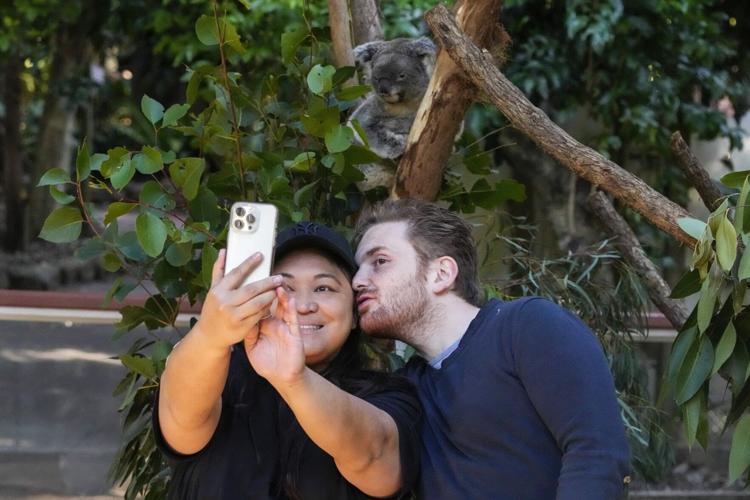
Visitors take a selfie with a koala May 5 at a koala park in Sydney, Australia.
Koalas are iconic Australian marsupials that spend most of their time eating and sleeping in eucalyptus trees, and their paws have two opposing thumbs to help them grasp and climb up trunks.
Australia's wild koala populations have declined steeply in the past two decades.
Last February, Australia's federal government declared koalas endangered in the eastern regions of New South Wales, Queensland and the Australian Capital Territory.
Facing threats from disease, habitat loss and road collisions, koalas could become extinct by 2050, according to a 2020 assessment from the New South Wales government.
About half of wild koalas in Queensland are infected with chlamydia, scientists estimate.
In deciding to vaccinate, the scientists are balancing the risk of disturbing the animals against the danger of allowing the disease to spread. The trial was approved by multiple government bodies.
The origins of chlamydia in koalas aren't confirmed, but scientists believe it's likely the marsupials initially caught the disease from exposure to the feces of infected sheep and cattle. Then it's spread sexually, or passed from mother to offspring.

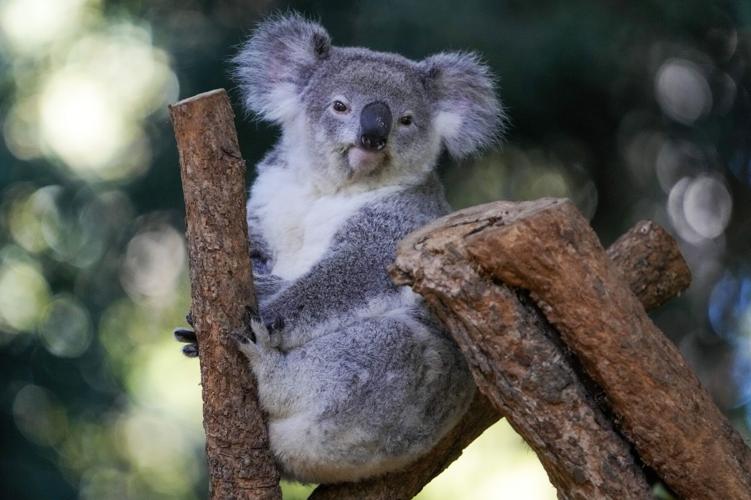
A koala sits in a tree May 5 at a koala park in Sydney, Australia.
While humans and livestock infected with the bacteria that causes chlamydia can be treated with antibiotics, it's not so simple for koalas.
The "complex" microbes inside the stomachs of koalas are designed to neutralize toxins in eucalyptus leaves that are their main food source, said Mathew Crowther, a conservation biologist at the University of Sydney. Their digestive systems can also neutralize some medicines, so "that means they don't respond well to antibiotics treatment," he said.
Crowther has been monitoring a population of koalas in northern New South Wales for more than a decade. In 2008, 10% of animals tested there were infected with chlamydia. Today that rate is 80%.
"It's been devastating — there's very, very low fertility," he said. "You hardly see any babies."
The other threats koalas face — including habitat destruction from land clearing and climate-enhanced wildfires — may increase their stress levels, weakening their immune systems and making them more susceptible to diseases including chlamydia, Crowther said.
There are only a handful of other examples worldwide of scientists attempting to catch and inoculate wildlife for conservation. In 2016, scientists began to vaccinate Hawaiian monk seals against a deadly strain of morbillivirus. Two and a half years ago, biologists in Brazil began to vaccinate golden lion tamarins against yellow fever.
"Vaccination for wildlife is certainly not routine yet," said Jacob Negrey, a biologist at Wake Forest University School of Medicine. "But whether it should be used more often is a fundamental question that conservation biologists are really wrangling with right now."
Photos: Race is on to vaccinate rare wild monkeys in quest for survival

Marcos da Silva Freire, who led the work of experimental vaccination of golden lion tamarins for yellow fever, walks on a dirt road on his family’s property in the Atlantic Forest region of the Silva Jardim region, in Rio de Janeiro state, Brazil, Saturday, July 9, 2022. The first monkeys were released near here, behind that hill,” he said, recalling the afternoon nearly 40 years ago of one of the first successful reintroductions of golden lion tamarins. (AP Photo/Bruna Prado)

A golden lion tamarin sits in a tree in the Atlantic Forest region of Silva Jardim, Rio de Janeiro state, Brazil, Friday, July 8, 2022. A campaign to vaccinate these endangered monkeys in Brazil against yellow fever may help save them from extinction. (AP Photo/Bruna Prado)

A golden lion tamarin sits in a cage after it was captured in order to be vaccinated against yellow fever, in the Atlantic Forest region of Silva Jardim, Rio de Janeiro state, Tuesday, July 12, 2022. The pioneering inoculation campaign started last year. The first such effort in Brazil, and one of the first worldwide. (AP Photo/Bruna Prado)

A golden lion tamarin that has been vaccinated against yellow fever is transported in a cage, to be released in the Atlantic Forest region of Silva Jardim, Rio de Janeiro state, Brazil, Tuesday, July 12, 2022. Around the 1960's, before conservation efforts were put into effect, habitat loss and poaching for the pet trade had reduced the number of golden lion tamarins to as low as 200 in the wild. (AP Photo/Bruna Prado)

Research assistant Ademilson de Oliveira uses a telemetry device to locate golden lion tamarins in the Atlantic Forest region of Silva Jardim, Rio de Janeiro state, Brazil, Friday, July 8, 2022. Many golden lion tamarins are descendants of animals carefully released in 1984, in cooperation with local landowners. That effort and subsequent campaigns to replant and connect parcels of rainforest, has seen the population of tamarins slowly recover. (AP Photo/Bruna Prado)

A golden lion tamarin is handled by researchers after it was vaccinated against yellow fever in a lab run by the nonprofit Golden Lion Tamarin Association in the Atlantic Forest region of Silva Jardim, Rio de Janeiro state, Brazil, Monday, July 11, 2022. Scientists in Brazil adapted a human yellow-fever vaccine to inoculate these endangered monkeys after yellow fever began to spread among the human population in Brazil in 2016, which quickly killed a third of the highly vulnerable tamarins, the majority of them in just a few months. (AP Photo/Bruna Prado)

A vehicle drives under an ecological corridor that allows animals to cross over a highway in Silva Jardim, Rio de Janeiro state, Brazil, Sunday, July 10, 2022. The bridge connects the Poco de Dantas biological reserve with a farm that the nonprofit Golden Lion Tamarin Association acquired to transform into an ecological park. (AP Photo/Lucas Dumphreys)

Golden lion tamarins, vaccinated against yellow fever, are carried in cages to be released, in the Atlantic Forest region of Silva Jardim, Rio de Janeiro state, Brazil, Tuesday, July 12, 2022. The effort to save the charismatic monkeys has led to a pioneering captive breeding program, coordinated among around 150 zoos worldwide, including the Smithsonian National Zoo in Washington, DC. (AP Photo/Bruna Prado)

Carlos Ramon Ruiz Miranda, right, president of the Golden Lion Tamarin Association, talks with field coordinator Andréia Martins, while logging in information, in their lab in the Silva Jardim region, Rio de Janeiro state, Brazil, Monday, July 11, 2022. Martins has been tracking golden lion tamarins in the rainforest for nearly four decades. (AP Photo/Bruna Prado)

A golden lion tamarin is examined before it is inoculated with a yellow fever vaccine in a lab run by the nonprofit Golden Lion Tamarin Association, in the Atlantic Forest region of Silva Jardim, Rio de Janeiro state, Brazil, Monday, July 11, 2022. When the golden lion tamarin population was being decimated by yellow fever, conservationists who had toiled for decades to protect the monkeys were sharply divided over whether to inoculate the tamarins. Some were hopeful, at first, the virus wouldn't impact the monkeys; others worried that any kind of novel intervention would be too risky. (AP Photo/Bruna Prado)

A golden lion tamarin sits in a tree in the Atlantic Forest region of Silva Jardim, Rio de Janeiro state, Brazil, Friday, July 8, 2022. The little primate, whose name derives from the shock of orange fur that frames its face like a mane, has watched its habitat shrink over decades — even centuries -- of rampant deforestation. Animal traffickers have also targeted the brightly colored monkeys. (AP Photo/Bruna Prado)

A golden lion tamarin is measured before it is inoculated with a yellow fever vaccine at a lab run by the Golden Lion Tamarin Association, in the Atlantic Forest region of Silva Jardim Rio de Janeiro state, Brazil, Monday, July 11, 2022. While authorities elsewhere have inoculated animals to safeguard human health – vaccinating feral dogs and wild animals such as raccoons for rabies and other diseases – it's still very rare for scientists to administer vaccine injections to directly protect an endangered species. (AP Photo/Bruna Prado)

Field coordinator Andréia Martins releases a golden lion tamarin after it was inoculated against yellow fever, in the Atlantic Forest region of Silva Jardim, Rio de Janeiro state, Brazil, Tuesday, July 12, 2022. The longtime biologist for the nonprofit Golden Lion Tamarin Association can spot the tiny shimmer of golden fur among a green canopy and recognize more than 18 distinct vocalizations – from the specific calls of alpha males to their mates, to varying sounds to alert young monkeys to different types of food and predators. (AP Photo/Bruna Prado)

Research assistant Ademilson de Oliveira wraps sheets of newspapers around a cage holding a golden lion tamarin as a way of reducing stress for the animal, before it is vaccinated against yellow fever in a lab run by the nonprofit Golden Lion Tamarin Association, in the Atlantic Forest region of Silva Jardim, Rio de Janeiro state, Brazil, Monday, July 11, 2022. While authorities elsewhere have inoculated animals to safeguard human health, it's still very rare for scientists to administer vaccine injections to directly protect an endangered species. (AP Photo/Bruna Prado)

Veterinarian Suelen Sanches Ferreira, left, inoculates a pregnant golden lion tamarin with a yellow fever vaccine, in a lab run by the nonprofit Golden Lion Tamarin Association, in the Atlantic Forest region of Silva Jardim, Rio de Janeiro state, Brazil, Monday, July 11, 2022. Conservationists who had toiled for decades to protect the monkeys were sharply divided over whether to inoculate the tamarins. Some were hopeful, at first, the virus wouldn't impact the monkeys; others worried that any kind of novel intervention would be too risky. (AP Photo/Bruna Prado)