

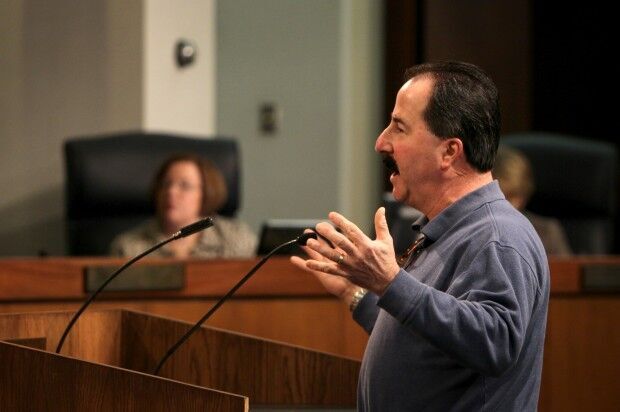

CLAYTON • Strong opinions that have smoldered since St. Louis County voters enacted a smoking ban two years ago flared up on Tuesday night before the County Council over a proposal to eliminate exemptions to the ban.
About a dozen speakers weighed in regarding Councilman Mike O’Mara’s bill, introduced at the council’s regular meeting in Clayton, to permanently remove almost all exemptions to the ban.
Exemptions are currently held by 135 establishments and the county’s two gambling venues, River City Casino and Hollywood Casino St. Louis.
O’Mara, D-Florissant, said his proposal was designed to “level the playing field” for businesses that don’t have the exemptions.
After introducing the bill, O’Mara referred it to committee for study.
“We’ll work out some differences and then bring it back to the council in a few weeks,” he said.
People are also reading…
In its current form, the bill leaves in place exemptions for private residences; private clubs; performers on stage in theatrical productions; nursing homes and similar institutions; retail tobacco businesses; and permanently designated smoking rooms in hotels.
Most of those who spoke Tuesday pleaded with the council to keep the exemptions.
Jim Pepper, a councilman from O’Fallon, Mo., claimed that his city’s no-exemptions smoking ban, enacted in 2010, had hurt businesses there.
“When St. Louis County businesses are forced to close because you removed voter-approved exemptions from the ban, you will be held responsible at the ballot box,” Pepper said.
Bill Hannegan, who has campaigned against the smoking ban for years, suggested that the council tweak the current ordinance to make exemptions available only to businesses that cater to those over 21.
Opponents of smoking encouraged the council to make the ban more complete.
Ken Grober, of Wildwood, said he had not received any complaints since his three businesses — the Original Pancake House in Chesterfield, and two Java Plus shops in Clayton and downtown St. Louis — went smoke-free.
“If you’re doing a bad job in your business, that will influence your success more than whether (the business) is smoking or nonsmoking,” he said.
Pastor Bryan Mann, with the Northside Seventh-day Adventist Church in north St. Louis County, said exemptions to the ban held by several bowling alleys in the area were ruining his new hobby.
“I recently took up bowling, and if you don’t think that smoke comes out of those (alley) bars — it comes out heavily,” Mann said.
Voters approved the ban by a two-thirds majority in 2009, and it took effect Jan. 2, 2011. Establishments are eligible for exemptions if food sales total less than 25 percent of the annual total sales of food and beverage.
The ordinance also exempted gambling floors at casinos.
The County Council can change the ordinance without submitting it to another public vote.
County Executive Charlie A. Dooley has said he favors removing all exemptions to the ban.
Also Tuesday, the council approved placing on the April ballot a sales tax to generate $760 million for revitalizing parks, building trails and improving the Gateway Arch grounds.
The tax increase was approved by the Missouri Legislature in May but will take effect only if passed by voters in St. Louis County, which has the largest tax base, plus those in either the city of St. Louis or St. Charles County.
However, the plan appears dead in St. Charles County. The St. Charles County Council took no action on the issue Monday night and isn’t scheduled to hold any more meetings before next week’s deadline for qualifying an issue for the ballot.
If passed, the bills would increase sales taxes by three-sixteenths of 1 cent, or less than 2 cents on a $10 purchase, and together raise about $38 million a year over the next 20 years.
Thirty percent of the increase would go toward expanding the Arch grounds, 30 percent for the Great Rivers Greenway trail system and 40 percent for parks in each county.
The city of St. Louis and St. Charles County would get about $2.5 million a year for their parks. About $10 million would go to St. Louis County and its municipalities.
If voters in individual counties don’t pass the tax, their parks won’t get funding.
Mark Schlinkmann of the Post-Dispatch contributed to this report.
Paul Hampel covers St. Louis County for the Post-Dispatch.


