

SIALKOT, Pakistan — The ceaseless sound of tapping metal echoes through these muddy, garbage-strewn alleys where thousands of workers in crumbling brick hovels churn out one of Pakistan's most successful exports — surgical instruments.
Home to more than 2,000 instrument makers, this city is one of the world's top producers of high-precision scalpels, forceps and retractors, almost all of which are bound for emergency rooms in the United States and other rich countries, where they help to save lives.
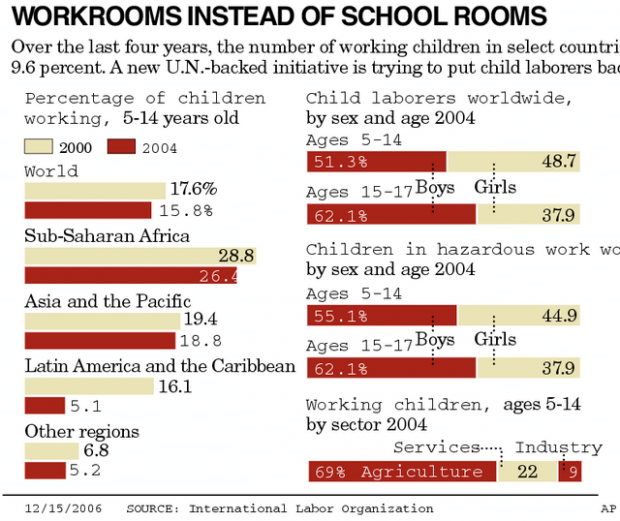
Yet, most patients a world away are unaware that these tools are tarnished by the toil of children working in dank workshops clouded with metal dust and earning just a few dollars a month. That is starting to change, thanks to a U.N.-backed initiative to put child laborers back in school.
Although the program underlines Pakistan's growing determination to tackle one of its biggest social scourges, it highlights how difficult eradicating child labor can be in a country where per capita income is $736 a year.
People are also reading…
"I like to work," says 12-year-old Kabir Qadeer, who has done odd jobs at a dental instrument maker for the past year-and-a-half for $18 a month. "I had no interest in school and quit. So my mother told me to get a job."
Today, Qadeer is back at school — albeit for only two hours a day after his seven-hour shift — under a program sponsored by the U.N. International Labor Organization and the Surgical Instrument Manufacturers Association of Pakistan.
Launched in 2000, the program is modeled after a similar initiative that has won international acclaim for reducing child labor in Sialkot's booming soccer ball and sports equipment industry, which supplies such companies as Nike and Adidas.
Three phases target kids
When the program wraps up its second phase at the end of this year, it will have taken more than 2,600 of an estimated 5,000 child laborers out of the surgical tool industry.
The next phase, through 2008, will target the remainder.
"We felt it was our responsibility to do something," said Syed Waseem Abbas, senior vice chairman of the surgical instrument manufacturers association and chief executive of Professional Hospital Furnishers.
No children are employed by the group's 2,300 members, according to the U.N. International Labor Organization.
The problem, however, lies with subcontractors that do as much as 70 percent of the finished product for bigger companies.
There are 2,000 of these tiny workshops, sometimes employing only a couple of people each and often operating below the radar of monitors.
Precision work on heavy equipment, including lathes, is not usually done by children, but they are routinely employed in such jobs as cleaning and sorting.
Tools' origins often hidden
Nike's recent clash with its Sialkot supplier of hand-stitched soccer balls shows how child labor often slips through the cracks.
Last month, Nike canceled orders from Saga Sports after accusing the company of farming out work to subcontractors that used underage workers.
International outcry about surgical instruments is quiet, by contrast, partly because Sialkot's medical goods are resold countless times by international wholesalers.
Sometimes equipment made here is even stamped "Made in Germany" at the request of middlemen worried about Pakistan's image — further obscuring their origin.
Sialkot's roots in surgical instruments stretch back centuries to the Punjabi swordsmiths of the Mogul empire.
But it got its modern boost during World War II, when British colonial authorities called on the city's craftsmen for badly needed medical supplies.
Nowadays, the city pumps out 100 million instruments a year, and the United States and Germany are its biggest markets.
International buyers may pay Sialkot suppliers $2 for forceps that eventually fetch upward of $60 when sold to a hospital, Abbas said.


