

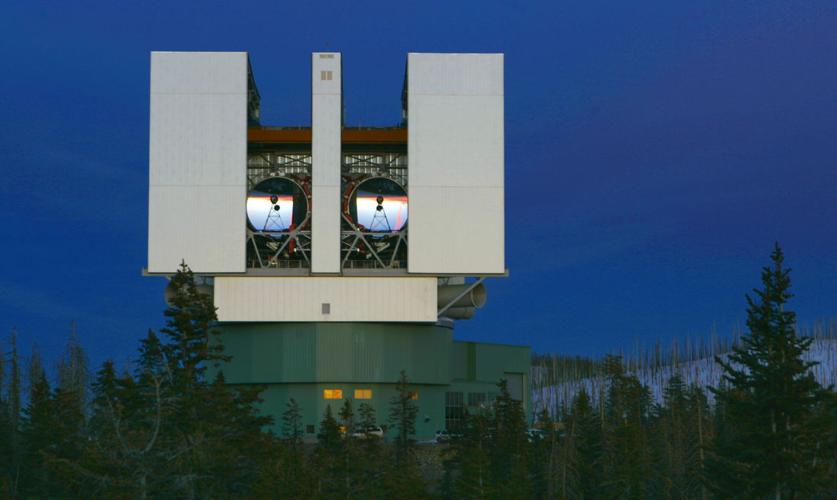

It’s no secret that under the football stadium on campus, inside the Richard F. Caris Mirror Lab, the University of Arizona makes the world’s largest astronomical mirrors. But did you know that this enterprise has resulted in the world’s largest telescope, which is located on Arizona’s Mt. Graham?
The Large Binocular Telescope, as it was named by the astronomers who collaborated to build it, consists of two 28-foot-diameter telescopes arranged in a way that look, as you might expect, like a pair of binoculars.
The astronomical community has a growing number of telescopes of a similarly large size, including the 27-foot Gemini Telescope and the twin 33-foot Keck Telescopes on the peak of Mauna Kea, Hawaii.
Astronomers have pushed to these large apertures for two related reasons: first, to make it possible to see fainter objects (just as your pupils dilate to see in the dark), and second, to form sharper images.
People are also reading…
Unless you have a bigger optic, any images seen through it are blurred and cannot be sharpened beyond a certain limit.
So what’s so special about the two LBT telescopes?
The key is the binocular arrangement, allowing them to both be pointed at the same object. An additional important component is a light combiner that takes the light from the two telescopes and merges it to form a single image.
The telescopes are separated by 48 feet. The engineering magic of the light combination “fakes” the light into thinking it came from a single 66-foot optic.
The results can be dramatic. Images 2.7 times as sharp as those from other telescopes can be formed. Of course, to do so, effects of atmospheric turbulence must be removed — a technique called adaptive optics. But why bother to build such a machine?
Let me give you two reasons.
The first involves imaging. LBT is monitoring one of Jupiter’s moons, Io.
This moon is constantly being reformed due to active volcanoes on its surface. The exquisite resolution of the LBT allows us to map the changes in these volcanoes over time.
A more conventional telescope would see the moon blurred by the atmosphere, so that no features are observable.
With adaptive optics, most other telescopes can see the brightest volcano, called Loki, and hints of other features. But with the LBT, we can detect more than 15 distinct volcanoes. In addition, the brightest volcano is found to be in a ring of lava surrounding the main peak.
The second reason involves the formation of planets. Astronomers know that planets form in disks of material around a star early in the star’s lifetime.
Recently, two UA graduate students, Stephanie Sallum and Kate Follette, used the LBT, along with additional observations from the Magellan AO system, to capture snapshots of a planetary system in formation.
Their results are providing key details for how planetary systems are assembled and what our own solar system went through early in its lifetime.
The LBT holds a unique place in the astronomical community, but perhaps not for long. Another project, the Giant Magellan Telescope, will use seven 28-foot mirrors in a similar way that LBT does, which means the mirror lab will be busy for years to come, with new astronomical discoveries on the horizon.


 As water lifeline evaporates, Arizona faces a cultural change over water use


