

SANTA FE, N.M. — Here's the latest buzz on detecting explosives: bomb-sniffing bees.
A study at Los Alamos National Laboratory has found that honeybees can be trained to detect explosives, even in tiny quantities.
"These bees really perform," said bee biologist Timothy Haarmann, the study's leader.
Whether honeybees will ever be enlisted in the war on terrorism looks doubtful at this point.
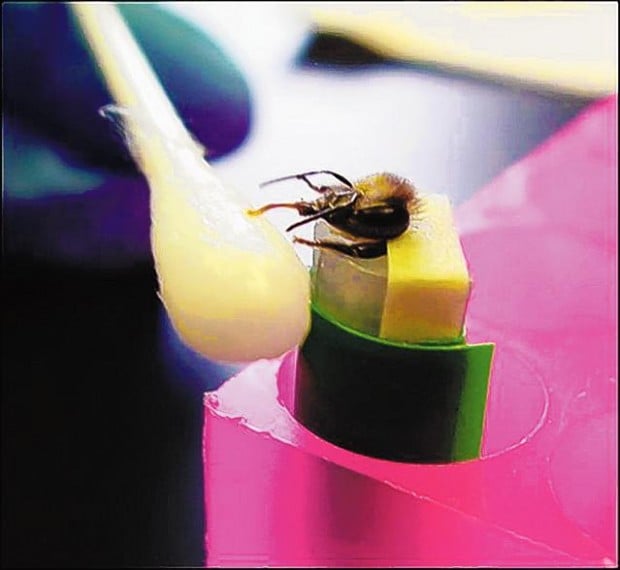
In thousands of trials conducted over the past 18 months at the nuclear-weapons lab, bees stuck out their tongues when they smelled explosives. The bees even underwent field trials, successfully sniffing out explosives in a simulated roadside bomb, in a vehicle, and on a person rigged like a suicide bomber.
The insects have a phenomenal sense of smell, rivaling that of dogs, Haarmann said.
People are also reading…
"The beauty of the bee is that when it has a sugar water reward, it sticks out its proboscis," the scientist said. "It's not a little tiny tongue. It's bigger than the antennae."
The study was funded by a grant of about $1.5 million from the Department of Defense's Defense Advanced Research Projects Agency, which studies innovative and sometimes positively strange technology that could yield national security benefits.
Despite the positive test results, DARPA said it does not see a future for bomb-detecting bees in the military.
"Bees are not reliable enough for military tactical use at this point," the agency said in a statement this week. "We see no clear pathway to make them reliable enough to make it worth risking the lives of our service men and women."
In a follow-up interview, DARPA spokeswoman Jan Walker said: "We're done in this research area. We don't plan any further investment."
Haarmann said that does not preclude another federal agency, or a private company, from refining the technology and developing other uses for bomb-sniffing bees — at airports, for example, or at the nation's borders.
"It's not far off in the future, if somebody decides to do it," he said.


