

PHILADELPHIA - Saturday, Dec. 6, 1941, was payday. By the time various deductions were made, John Joniec and his Army buddies in Schofield Barracks had little mad money left.
So they spent the day hanging out, shooting the breeze. About 11 p.m., they hit the sack.
At 5 a.m. the next day, they were awakened by a squawking loudspeaker summoning them to regular anti-sabotage duty. They were told to dress in their field uniforms, draw their rifles and ammo, eat breakfast, and be ready to depart by 8 a.m. There was much grumbling and griping.
Shortly before 8 a.m., the 22-year-old Joniec and his fellow soldiers were sitting on the porch of the barracks when they heard a loud boom.
"Damn Navy on maneuvers," Joniec thought.
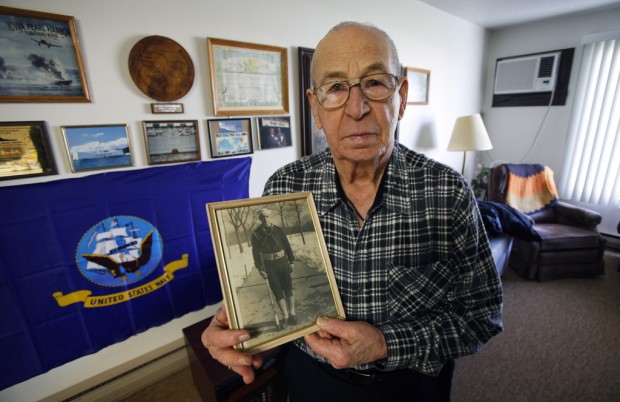
John Joniec's brick rowhouse in Port Richmond, Pa., today is distinguished by the small flags propped in the living room windows and a sticker on the front door that reads: "Remember Pearl Harbor."
People are also reading…
Joniec can never forget. He is reminded of it every waking moment by constant ringing in his ears. "The Bells of St. Mary's is how he refers to his ailment, a play on the title of the 1945 movie starring Bing Crosby and Ingrid Bergman.
The everlasting ringing is a souvenir of the Japanese surprise attack Dec. 7, 1941, 68 years ago Monday. "Roosevelt called it a day that will live in infamy, and I have never forgotten it," says Joniec.
Memory is vivid at 90
Joniec (pronounced JONE-yak), a retired maintenance man and building superintendent, is a life member of the Pearl Harbor Survivors Association. Membership in the group reached a peak of about 13,500 in 1993. It has dwindled to about 3,500 today.
Last month, Joniec turned 90. He is increasingly hard of hearing, and, in his words, "my mind is slipping away." Yet when it comes to recalling Pearl Harbor, his memory is as vivid as if the events occurred yesterday.
It began at a party in March 1941, when Joniec and neighborhood buddy Bill Matrasek impulsively decided to join the Army infantry. "We were single and energetic and looking for adventure," Joniec explains. "We wanted to see the world."
After enlisting in April, Joniec was sent to Fort Slocum, N.Y., then by troop train to San Francisco, where he boarded a ship for Hawaii. He was quartered in Schofield Barracks, about 10 miles from Pearl Harbor.
Within seconds of the loud boom that Joniec mistook for naval exercises that Sunday morning, a squadron of planes swooped down through a mountain pass and over the palm trees. Painted on the underside of the wings were red circles.
"Japs!" someone shouted.
With rifles and ammo in hand, Joniec and his fellow soldiers reacted instinctively. With no officer present to authorize retaliation, they shot at the bombarding planes.
"They say that 'at dawn we slept.' That's just not true. We were awake and fought back with everything we had."
After the attack, Joniec remembers weeping civilians flocking to the base hospital, soldiers and officers racing back to the post in commandeered vehicles. Later that day, he was sent to Wheeler Field, where rows of parked airplanes had been bombed. There, in pouring rain, he dug ditches and foxholes, helping set up a perimeter guard.
More than 84,000 service personnel were within three miles of the island of Oahu on that terror-filled day. The attack destroyed or grounded nearly 350 aircraft, and 21 ships were sunk or badly damaged. More than 2,400 Americans were killed, including 68 civilians.
Joniec later shipped out to Australia and pursued Japanese troops on several South Pacific islands, including New Guinea, where, during an ambush, for the first and only time in his life, he saw a man drop and die from bullets fired from his own rifle.
Discharged from the Army in 1945, Joniec married Anne, the neighborhood girl who caught his eye at a church bazaar before the war. He became president of his union local and a member of the executive board of the Service Employees International Union. He and his wife reared three children.
On Feb. 24, 1969, Joniec spotted an item in The Philadelphia Inquirer stating that the U.S. Naval Institute in Annapolis, Md., was planning to welcome as "a distinguished visitor" Gen. Minoru Genda, who had planned the air attack on Pearl Harbor.
Incensed, Joniec immediately began lobbying against what he perceived as a grievous insult and dispatched a telegram to the U.S. Naval Academy:
"IT IS ALRIGHT TO FORGIVE AND FORGET BUT NOT TO TOAST AND HONOR THE COWARD GEN MINORU GENDA WHO PLANNED THE SNEAK ATTACK ON PEARL HARBOR. THE MEMORY OF THOSE WHO DIED DEC. 7, 1941 WILL REMAIN WITH US SURVIVORS FOREVER."
The institute was unaffiliated with the Naval Academy, Joniec was informed, and Genda was invited as part of a 21-day lecture tour without military honors.
Nevertheless, such was his outrage, and devotion to those who had perished, that Joniec persisted in protesting. On March 1, 1969, Joniec and Cornelius Maartense, Pennsylvania state chairman of the survivors association, took a train to Washington to deliver a letter to the secretary of the Navy.
At the Pentagon, a security guard at first tried to shoo them away. Joniec was indignant. "Don't give me that B.S.," he said. "I fought in the war. Either call this guy, or I'll make a big fuss."
Word was relayed to the secretary's office and an aide appeared and accepted the letter.
A few days later, Joniec received a letter from the Navy acknowledging his concern.
"General Genda is not coming here to be honored, but simply to give talks on his military experiences," the letter said. "He is in a unique position to stimulate our military thinking."
Joniec was unimpressed and unappeased. In the weeks that followed, he savored news articles about how Genda's visit was shadowed by threats. "I was elated," Joniec says, "because he did not deserve respect."


