

The city lights are a gorgeous sight from Tumamoc Hill after sunset — if you don't think too much about the impact of that horizon-spanning glow on the natural habitat.
It was difficult not to think those thoughts Tuesday night, after listening to Melanie Culver talk about how human habitation affects the ability of mountain lions to range freely and keep their genes flowing.
Culver is a conservation geneticist and assistant professor in the University of Arizona School of Natural Resources and the Environment.
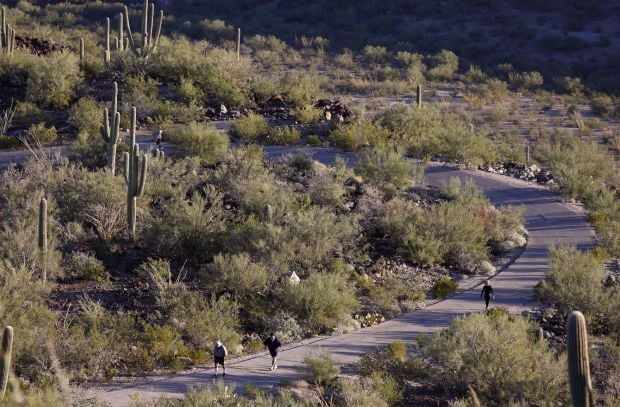
She spoke Tuesday as part of the Science Cafe series of the UA's College of Science in the historic library midway up the hill, which is a popular run/walk route.
It was a good excuse for a little exercise and a convenient cop-out for not completing the mile-and-a-half trek, which gains 730 feet in elevation.
People are also reading…
The library is a charming, slightly disheveled building, built of lava rock in 1903 as the headquarters of the Carnegie Desert Laboratory.
Culver studies cats, focusing on the apex predator of our region, the mountain lion, or puma — a term she prefers because it derives from the Mayan name for the beast.
Culver spoke about two recent studies that combined camera traps and analyses of scat to discover whether populations of mountain lions and other cats, like the bobcat, are becoming genetically isolated because of that built environment.
The results are not conclusive, but they are cautionary.
Interstate highways and other busy roads form boundaries between genetically distinct populations of pumas. Bobcats, meanwhile, seem to range freely despite the obstacles.
The Tucson Mountains, in particular, seem encircled by Interstate-10 and the Central Arizona Project canal, though the small numbers of pumas there make it difficult to draw any grand conclusions.
Tumamoc, itself a part of that small mountain range on the west end of Tucson, is not great habitat for puma, though there have been sightings, said Michael Rosenzweig, director of Tumamoc.
In his introduction, Rosenzweig called pumas the "just right" animal in the "Goldilocks" sense.
It's scary but its human interactions are rare. It doesn't over-populate an area; neither is it endangered.
Its fitness is remarkable, said Culver. It ranges from just below the Arctic Circle to the tip of Argentina and lives at altitudes ranging from high mountains to sub-sea-level deserts.
It is returning to places from which it had vanished — Florida, where it is called "panther" and parts of New England, where it is called "catamount."
Walking down, I fantasized it watching from the darkness.
I might have better luck after the next talk March 10, when UA research scientist Matt Goode talks about "Living with Rattlesnakes."
"Luck" is probably not the correct term.
Perhaps I'll take the shuttle.


