

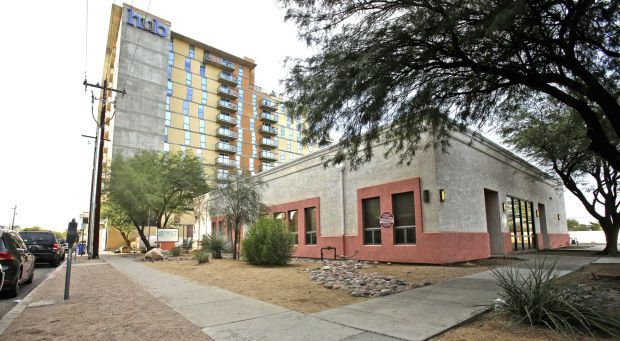
A recent city real estate deal has paved the way for more multi-story student housing in the West University neighborhood.
Tucson sold a .84 acre lot on North Tyndall Avenue to Core Campus, a private dorm developer, for $3.5 million, which includes the cost of the property and relocating the former tenants, a nonprofit that provides services to people with disabilities.
Tucson Real Estate Program Director Hector Martinez called the deal a “win-win-win.”
The nonprofit gets an upgraded headquarters worth about $2 million; the city gets a $1.5 million boost to its general fund and the developers get a prime piece of real estate.
The Tucson City Council approved the sale in December 2013, but the two-year process wasn’t completed until last week, when the Direct Center for Independence moved into its new digs at 1001 N. Alvernon Way.
People are also reading…
Not everyone is excited about the prospect of more student housing on the edge of the historic neighborhood. The three nearby complexes have generated more than 45 calls to police, said Councilman Steve Kozachik earlier this year.
The nearby Islamic Center of Tucson has complained of bottles and other trash falling from high-rise balconies on to its parking lot.
In part, the potential for this type of conflict is why Direct elected to leave the area.
“With the coming of those high-rises, it was almost like our missions were going to clash,” said Executive Director Wendy Dewey.
A neighborhood changes
The Direct Center for Independence offers services that help people with disabilities live independently. The city gave the organization a 99-year, dollar-a-year lease for the property on Tyndall Avenue, south of Speedway Avenue, in 1983.
Even though the building predated the Americans with Disabilities Act, the accessibility was state of the art, Dewey said.
The surrounding area changed dramatically after the city of Tucson approved a new zoning overlay district in February 2012.
A Chinese restaurant and a fraternity house were among the properties replaced by three high-rise student housing complexes up to 14 stories. The previous limit was four stories.
The first complex, Level, opened in fall 2013 at 1020 N. Tyndall Ave. and was followed by nearby Next and Hub, which is owned by Core Campus. Together the three units can accommodate about 1,500 residents.
The vehicle, pedestrian and construction traffic generated by the projects made Direct’s facility less accessible to its clients.
Dewey estimated Direct Center for Independence serves about 1,400 people annually.
“It was like the writing on the wall,” Dewey said. ”Imminent change was there and it was big change.”
Direct approached the city in late 2012 to ask about options for relocating. The City Council opened a request for proposals to sell the property in June 2013.
In addition to paying a cash sum, the winning bidder would need to find a new home for Direct and pay to relocate the organization.
Direct wanted a visible location easily accessible by public transportation, explained CBRE First Vice President Buzz Isaacson. His firm was tasked with helping Direct find a replacement building.
“There wasn’t anything on the market that fit the bill,” Isaacson said. “We found a building owned by an architecture firm that wanted a lease. We converted it into a sale.”
Direct’s new headquarters is about 2,500 square feet larger than its former center and has 42 parking spaces.
The new location puts it not far from compatible organizations, such as a University of Arizona health and wellness center and nonprofit Our Family Services.
It’s also the confluence for several city bus routes, Dewey said.
“It’s awesome — people could get to us from any part of the city,” Dewey said. “We are right where we need to be.”
Core Campus, the dorm developers, ended up paying about $1.4 million for the Alvernon Way property, plus an additional $560,000 to renovate the building to Direct’s requirements by adding improvements such as wider door openings. The company also paid the city $1.5 million.
Martinez said, “The total package is a great community return.”
Student housing a boon for real estate
Core owns Hub at Tucson, 1011 N. Tyndall Ave., a 14-story student housing tower serving almost 600 residents.
The complex, which is adjacent to Core’s new purchase, opened in 2014.
“Core was presented with the opportunity to own a piece of real estate in a top market, at a tier-one university, right next door to our current development,” said Chief Operating Officer Benjamin F. Modleski in an emailed statement. “We couldn’t pass that up. ... Our niche in student housing is really infill, vertical development near strong universities.”
The proposed Hub II would be six stories and house nearly 300 students and there would be no retail element.
Core has filed permits with the city to begin the project and expects the development will be completed by July 2016.
Kozachik said he would prefer the area be used to build something that would benefit the whole community, like a grocery store.
He voted with the council to approve the sale of the property in December 2013, but does not support the planned development.
His opposition may not matter, however, as the proposed complex is considered a “group dwelling,” which is an allowed use of the property within overlay district so Core doesn’t have to go through a rezoning process.
The news of the development comes on the heels of complaints filed by the nearby Islamic Center of Tucson about liquor bottles, produce and obscenities that have been thrown from the adjacent student housing complexes for more than a year.
Four residents of the adjacent complex, Level, were evicted in November in connection with the incidents. A forum was held at the UA Monday night to discuss student behavior.
Kamel Didan, the vice chairman of the board of the mosque and community center, said they are worried efforts to educate current residents and stem the problems will ultimately fail because of the resident turnover in the complexes.
No decisions have been made, but one option would be for the Islamic Center to sell their property and leave, much like Direct.
“We don’t want to be perceived as people putting a stop to investment or an influence of money,” Didan said. “We want to be seen as a community of people who care about the city of Tucson.”


