

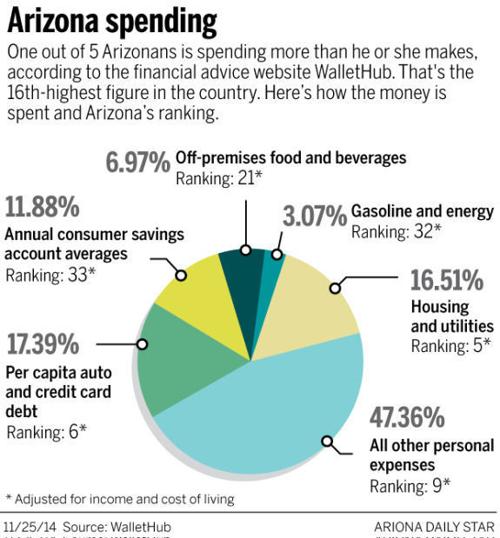
PHOENIX — With the holiday shopping season about to kick off, one 1 of 5 Arizonans is already overextended, according to the financial advice website WalletHub.
The site defines people who are overextended as being those who are spending more than they make. The 1-in-5 ratio places the state at 16th-highest in the country.
Among the biggest culprits: credit cards and auto loans.
WalletHub figures the average credit card and auto debt for Arizonans at more than 17 percent of what we make — the sixth-highest rate in the country. Topping the list are New Mexico and Utah.
On the other side of the financial management equation, Arizonans are not putting a lot aside.
The study shows that the average Arizonan has less than 12 percent of his or her annual income socked away in savings. That’s 33rd in the nation.
People are also reading…
So what are Arizonans spending all that money on?
A lot of it is keeping a roof overhead, along with staying cool in the summer and warm in the winter.
WalletHub figures Arizonans probably spend $1 out of every $7 on housing and utilities. After adjusting for income and cost of living, only New Mexico, Idaho, Utah and Virginia residents spend more.
Some of that may be a simple function of size. WalletHub says the average residence in Arizona is 1,846 square feet, in the top 10 nationwide.
At the other end of the scale on housing and utility costs is Alaska. But that’s after adjusting for the higher salaries there and the fact that lots of stuff costs more.
We’re also above the national average in what we spend at grocery stores.
In fact, in the broad category of all other personal expenses, Arizonans manage to spend close to half of what they earn, ranking residents here No. 9 in the nation.
If there’s a bright spot in the study, it’s that Arizonans spend far less on gasoline than a lot of other folks.
Maybe that’s because we’re just not as car-crazy as we think. WalletHub says the average Arizonan has just 1.7 vehicles, putting the state among the 10 with the fewest cars and trucks per person.
WalletHub spokesman Raz Daraban said the purpose and timing of the report was not specifically to find out which states have the biggest holiday spenders.
“Rather, in the context of this one-month spending madness called the ‘holiday season,’ we wanted to provide an overall picture regarding the spending habits of the consumers living in the 50 states and the District of Columbia,” he said.
Daraban said the figure was adjusted to take into account the different salaries and costs of living throughout the country.
“The aim was to raise awareness about America’s addiction to debt and spending, not just on holidays but all year round,” he said.
Follow Howard Fischer on Twitter at @azcapmedia


