

Boomers beware: Financial scams abound.
They are increasingly sophisticated, increasingly prevalent and can derail lives and retirements, but Resources/Outreach to Safeguard the Elderly (R.O.S.E.) is working to change that.
“Scammers don’t discriminate. They don’t care what your IQ is, how educated you are or how much money you have. They are casting a wide net,” said Joyce Petrowski, who came out of retirement herself to start the nonprofit in 2021.
Dedicated to prevention of the financial exploitation and defrauding of older adults through advocacy and education, R.O.S.E. came into being after Petrowski had a loved one who lost resources through a romance scam.
“I started doing research and talked to family members and found out how difficult it was to break that absolute trust that forms between these predators and their victims. I found organizations helping people after they had been victimized, which is a good thing, but I looked at it more from a prevention perspective: Let’s try to bring education and awareness to older adults about the scams out there and why they are being targeted and how they can protect themselves,” said Petrowski.
People are also reading…
More than 88,000 victims over age 60 nationwide lost $3.1 billion; in Arizona alone, more than 3,500 victims lost more than $82 million, according to the 2022 IC3 Elder Fraud Annual Report by the Federal Bureau of Investigations,
Petrowski emphasized that these statistics are not comprehensive, since many people never report that they have been victimized.
“Even if they don’t lose all of their financial savings, it is still very embarrassing for them. They feel a sense of shame. And while everyone thinks about the financial aspect, which is devastating, you also have to consider the emotional and psychological impact on these older adults. That can be just as devastating, if not more so,” said Petrowski.
Criminals target people to get access to their money and personal identifiable information not only on the phone and through the mail, but by email and over the internet.
“The Baby Boomers grew up with very limited technology and are very trusting and philanthropic, and when they carry that into today’s world with all of the technology, that creates a perfect storm. We need to understand the scams that are out there and realize that we can’t trust everyone,” Petrowski said.
R.O.S.E. Community Outreach Specialist Brian Watson echoes that sentiment.
Watson spent 28 years as a Special Agent investigating financial crimes with Internal Revenue Service Criminal Investigation, which is the sixth largest federal law enforcement agency. He emphasized that people of all ages can be susceptible to scams, including those who are independent and routinely make their own financial decisions.
“I have learned scammers target older adults the most. They are very smart, capable, educated people who may still work and volunteer. They live on their own and have accumulated wealth and handle their own finances. The problem is that they get in over their heads when they are dealing with a professional predator,” Watson said.
He detailed numerous types of scams, including online romances that have resulted in victims being forced to sell homes and other assets; and imposters pretending to be from the IRS, Social Security, Medicare and other government agencies so they can attain personal information and steal identities or access bank accounts. A current scam called “pig butchering” entices victims into buying what they believe is cryptocurrency.
“One woman in northern Arizona was convinced it was a great investment. She put $700,000 into it and never had control of it. These scammers are smart and savvy, so if we can get people to tell their stories, it will help others. Our passion is prevention,” Watson said.
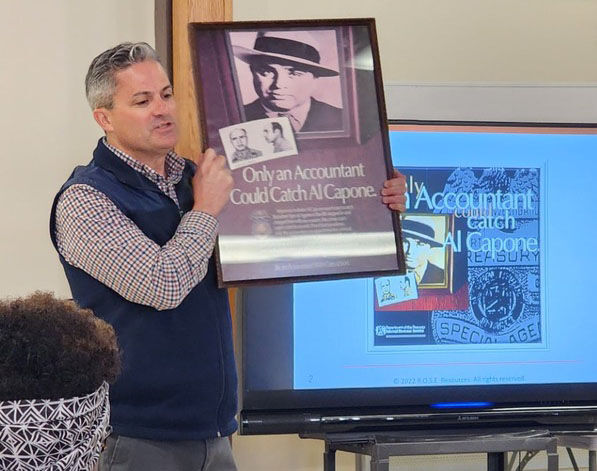
Through R.O.S.E., Watson works with victims and the media to promote awareness about these fraudulent schemes; he also offers free presentations through community organizations, social groups, churches, senior centers, law enforcement agencies, and other venues including the University of Arizona Osher Lifelong Learning Institute.
Petrowski outlined several tips that can be helpful to people of all ages in deterring fraud.
“First, it is OK to be skeptical when someone wants your personal information or is asking for money, no matter what their excuse as to why they need it,” she said.
Predators are skilled at playing on emotions of their victims and often push them to move quickly, according to Petrowski. She said that whenever someone requests personal information or money through any platform — in person, by phone, online, or through email — the best strategy is to stop and resist the urge to act immediately.
“People need to slow down and take the time to think. When they get into an emotional state for any reason and want to act immediately, it is a bad combination. Take the time to contact a trusted person about what is going on before you give any personal information or money out,” she said.
Ultimately, the consequences of fraud can be far-reaching and R.O.S.E. seeks to protect quality of life for seniors and their families.
“I started this nonprofit not only because of the experience of my loved one, but because I think about all the older adults who have worked their whole lives to save for retirement. It is supposed to be their best years. We are trying to preserve that so they can live retirement the way they want to live retirement,” she said.
Got to https://roseadvocacy.org/ for more information. Contact R.O.S.E. at info@roseadvocacy.org to schedule a free presentation.


