

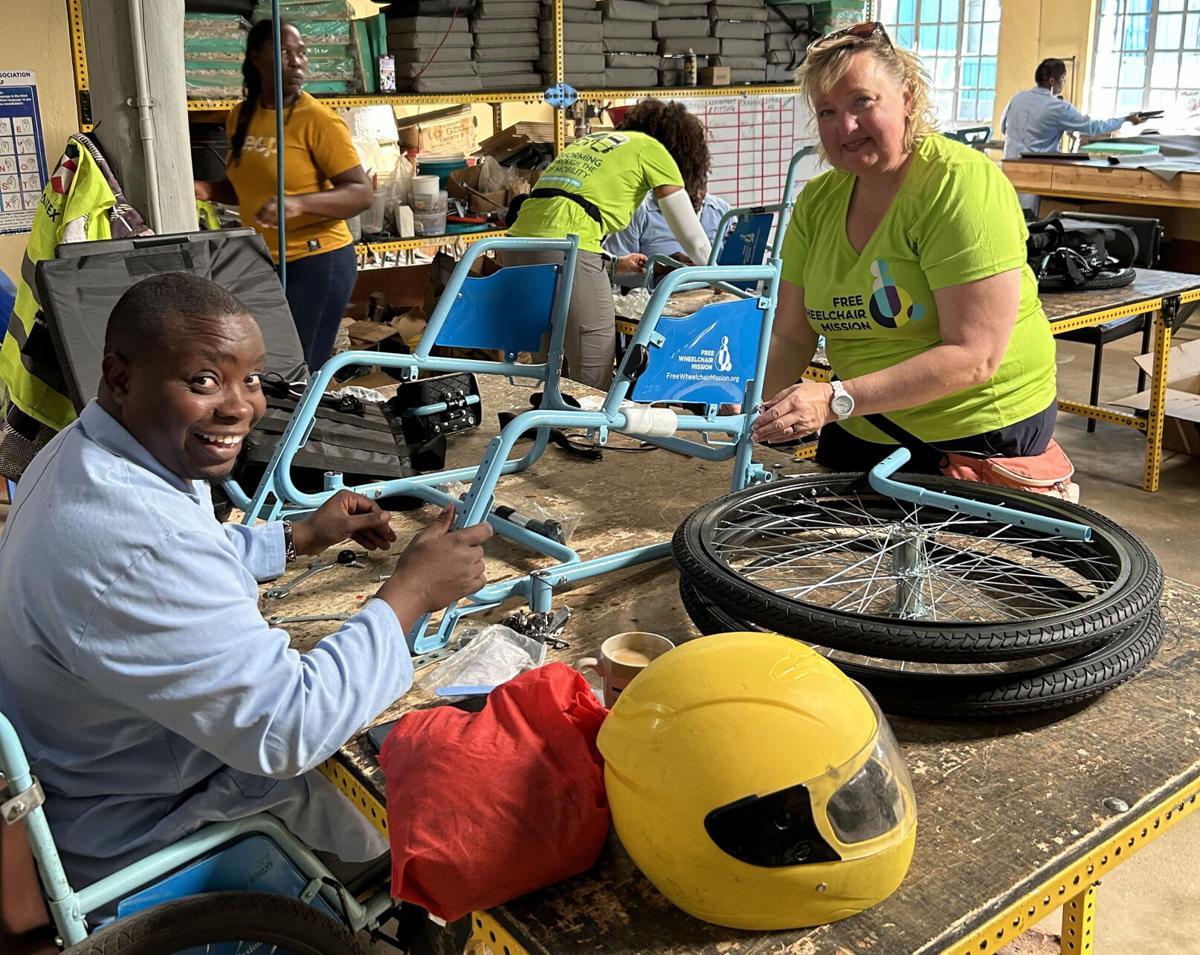
A Tucson couple is changing the world one wheelchair at a time.
In March, Adam and Kola Bliss traveled to Kenya and spent a week helping to build 53 wheelchairs with the nonprofit Free Wheelchair Mission (https://www.freewheelchairmission.org/), which provides the gift of mobility to people with disabilities around the world.
“When you think about 53 wheelchairs, it is not a really big number, yet most of the ways we make a difference in the world are not through some huge thing that impacts the lives of millions at once. It is really one by one,” said Adam, who tries to walk that talk with Kola every day at work in Tucson.
For the past decade, the husband-wife team has owned a franchise of Right at Home in Southern Arizona, which offers non-medical, in-home care to seniors and adults with disabilities who want to live independently.
People are also reading…
They learned of Free Wheelchair Mission through Right at Home, and quickly realized the philanthropic mission to improve quality of life aligned with their professional vision. Since 2001, Free Wheelchair Mission has provided more than 1.4 million wheelchairs free of charge to those in need in 95 developing countries, including Brazil, Columbia, Ethiopia, India, Senegal, South Sudan and more. The need is far greater: The World Health Organization estimates that 80 million people worldwide are in need of wheelchairs. Fewer than 10 percent have access to wheelchairs, and children and adults with disabilities are often confined to their homes or forced to crawl or be carried by others.
Adam said the nonprofit is working hard to make wheelchairs more accessible to people living in poverty and unimaginable circumstances.
“Free Wheelchair Mission has done so much work over last several years to identify simple engineering to build wheelchair that are sturdy and stable at minimum cost,” said Adam. “They use donations to purchase materials and have wheelchairs manufactured and distributed to countries around the world, primarily in developing nations. The cost to manufacture, ship and distribute one wheelchair is $96.”
When the couple arrived in Kenya, they assisted with building different models and conducting assessments and fittings to ensure that the wheelchairs were tailored to the needs of individuals. Much of the work was done in small villages around Nanyuki.
The need was crushing: In one instance, 27 people of all ages traveled from far away by bus to receive assistance. Kola said that it was beyond gratifying to facilitate substantial life changes for them.
“Just to see the smiles on people’s faces when they were in their wheelchairs — they were so grateful,” said Kola. “One gentleman was a double amputee who taught Sunday school. His wife carried him on her back to church every Sunday. It is a kilometer away from their house, and after church, she carried him back home. Providing him with a wheelchair changes not only his life, but also his wife’s life.”
Ultimately, Adam said that wheelchairs represent more than just the power of mobility to people in these situations, many of whom are cared for by family members who earn livings through small businesses.
“This gentleman that Kola was speaking of was a farmer who got a sore on his foot in 2018,” Adam said. “That progressed to an infection that became gangrenous and required amputation, and then it happened to his other foot in 2021. For the last three years, he has not been able to work on his farm, so a wheelchair gives him the opportunity to have dignity and independence and feel pride in being able to do a little bit more for his family.”


