

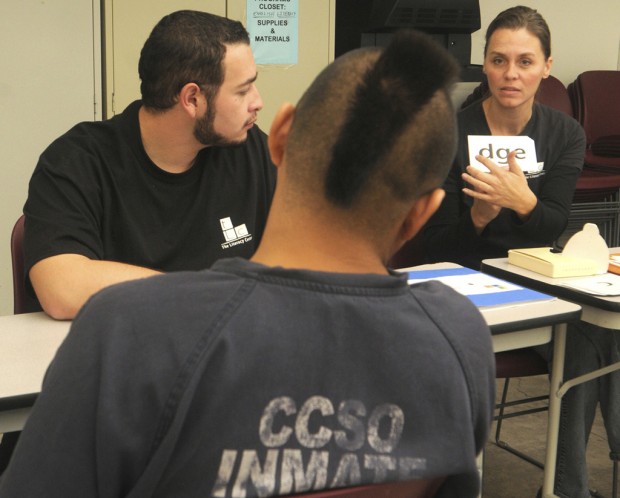
FLAGSTAFF - The inmate squared off across a table from Alfredo Cruz.
Cruz, a smiling literacy volunteer, began asking questions.
The questions started forming a framework for approaching the inmate's difficulty with reading and what he would like to do with improved reading skills.
His answer: He'd like to be able to read better to help him get a job, maybe continue his education.
"It's been eye-opening," Cruz said. "I've learned so much."
Cruz, 22, is a student at Northern Arizona University studying sociology. He volunteers as an intern with Literacy Volunteers of Coconino County, mainly with the Partnership to Literacy Rehabilitation Program.
The program offers literacy assistance to incarcerated and recently released adults and juveniles with low reading levels.
People are also reading…
Cruz had his first meeting for one-on-one tutoring with the inmate, who is not being identified at the request of jail officials.
Cruz had the inmate read a story, and followed along to get a sense of the inmate's ability to read "high-frequency" words.
Carynn Davis, executive director of Literacy Volunteers in Coconino, said high-frequency words are words most people have seen thousands of times during their reading lifetimes - words like "the, ran, some, sing, sleep." The words increase in difficulty through ranges to help the volunteers determine where to start with instruction.
Included in the hourlong session are sounding out parts of words that form a multitude of other words - like "eigh" and "dge."
Cruz grew up on the streets of Los Angeles, where he had to look over his shoulder on his way to school, wary of any unfamiliar vehicle or person. He had a mountain of disadvantages to overcome.
He had reading and math problems.
Then, in fourth grade, he came across Ms. Taylor, and she offered to tutor him.
"She taught me a lot," Cruz said. "She didn't make any money, but she taught me a lot."
His mission: to give back what was given to him.
"I feel blessed being able to give back what I've received so far," Cruz said.
In college and working toward a possible goal of becoming a youth probation officer, Cruz said he needed experience. The inmate literacy program was the ticket.
"As soon as I came around (to The Literacy Center), I realized what their goal was," Cruz said. "It's a wonderful gain. Nobody's losing."
Jim Bret, inmate program coordinator at the Coconino County Detention Facility, said jails and prisons are filled with people who are illiterate or have low levels of literacy.
According to the 2003 National Assessment of Adult Literacy, about 60 percent of prison inmates and 85 percent of juveniles are estimated to be functionally illiterate.
Thus was born the Partnership for Literacy Rehabilitation. The hoped-for outcome: "To have people leave our facility, go back into the community and be viable citizens," Bret said.
And not come back.


 Faculty concerned about changes to U of A admissions policy


