

Billy "Sol Man" Cirrito was a pioneer in solar energy.
He was an idea man and his concepts were cutting-edge: solar-powered bus stops, solar-powered billboards, solar-powered irrigation.
"Bill had a true interest in the environment and he was in love with the concept of clean energy way before it got popular," said former colleague Bob Kauffman, of Scottsdale.
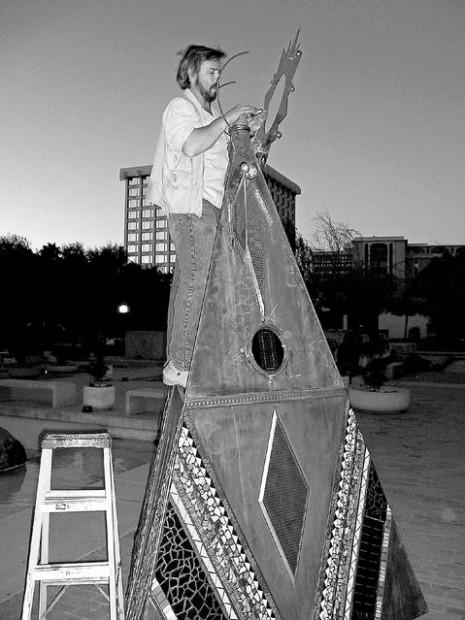
Cirrito had another burning desire: the need to create art. Often, he found ways to combine his passions, building kinetic sculptures powered by the sun.
"Billy was famous for breaking the rules, and we loved him for that," said former colleague Kevin Conlin, of Texas.
Cirrito had very little, if any, training in the interests he pursued. But he had an intuitive sense of how things worked.
People are also reading…
Cirrito was single-minded when he adopted a new interest, and eager to share his knowledge with family and friends. But his enthusiasm was steeped in bipolar disorder, which plagued him for years.
Cirrito was in the midst of a "long, dark period," his family said, when he died in the desert of unknown causes June 1. He was 52.
Cirrito grew up in the Bronx and Woodstock, N.Y., fishing, boating and daydreaming.
"When Billy was in Little League, he picked more daisies than any five teams," said his father, William Cirrito.
"He was a free spirit," said his sister, Lauren Bosmeny. "Billy always had his own things going on."
After high school, Cirrito went to work at an avant-garde custom furniture studio in Upstate New York. At 18, he was designing furniture for well-heeled New Yorkers and celebrities, including Robert De Niro, Henry Winkler and Debbie Harry.
"He was totally undisciplined, but whatever he tried to do, he did well," said his mother, Joan Cirrito.
She and and her husband, who worked for IBM, moved to Tucson in 1980 when he accepted a temporary assignment in Arizona. Their three children all came to visit and decided to trade in the East Coast winters for Southern Arizona's climate.
In Tucson, Billy Cirrito quickly realized the potential for sun-powered energy.
"He truly was one of the pioneers of solar energy. Bill had a true interest in the environment and he was in love with the concept of clean energy way before it got popular," said Kauffman, the former CEO of Photocomm, which bought out Cirrito's company, Electra Sun Systems, in the mid-1980s and hired him as a vice president.
During Cirrito's 10 years at Photocomm, he developed solar-powered lighting for street lamps and bus shelters and solar-lit billboards.
"He came up with a lot of innovative ideas and came up with ways to make solar power accessible to a lot of people," said former Photocomm colleague Ron Kenedi, of California. "He was an innovator. He did the first floating solar panel array over at the university."
Wanting a way to keep the solar panels cool, Cirrito devised a system to float them on water.
In the late-1980s, Cirrito teamed with friend Tom Wuelpern, of Rammed Earth Development, to design a house for a couple who wanted an energy-efficient abode.
Cirrito boosted output of the solar panels he installed by mounting them on tracking units that followed the sun.
"The stuff Billy was doing back then was ahead of his time," Wuelpern said. "He was sort of a Renaissance solar guy. He had this sort of youthful passion about everything he did. That's something I always admired about him."
Cirrito obtained numerous patents for his ideas and was a three-time winner of the U.S. Department of Energy's National Innovation Award.
His success in the early development of solar power products wasn't instantaneous, however.
His first job in the field was as a lab tech for a solar panel manufacturer. He took self-study college courses in electrical engineering and photovoltaic systems, then went out on his own.
He then spent a few years selling solar panels out of his truck at the swap meet.
It was there, in 1981, that he met his future wife, now an ex, with whom he had a daughter, Elizabeth.
"That was Billy's second home," ex-wife Margaret Connelly said. "He spent so much time at the swap meet selling solar (panels)."
The couple wed in 1983 and was married for 14 years.
"I spent more times on roofs, more time at swap meets and learned more about solar than I ever thought I would," Connelly said. "Our backyard was one big scientific experiment. He put solar on the lawn mower. Anything he could solarize, he would."
Cirrito combined his artistic vision with his solar know-how and fondness for metal sculpture to produce his first piece, "Sol Man," in 1997.
The 8-foot-tall fixture was a stick figure, arms stretched skyward, holding a rectangular solar panel that powered the white, globe-shaped lighting element that served as the figure's head.
Two of his kinetic sculptures reside at his parents' Northeast Side home. The tall, geometrically shaped metal pieces are topped with designs that rotate with the help of solar panels.
Many of the iron gates along South Meyer Street are the product of Cirrito's imagination. Some include mosaic work by his artist sister.
"What I'm doing on South Meyer is educational and allows me to further my goal, which is creating art that brings happiness and introduces people to the magic power of the sun," Cirrito said in a 2004 article in the Downtown Tucsonan.
"Most people don't understand the efficiency of using alternative technology like solar to deal with the energy crisis we're continuing to face."
A few years ago, Cirrito collaborated with his sister on "Goddess of the Sun," a piece commissioned for the 2005 Luminarias del Pueblo exhibition of solar-powered sculptures.
"I believe science and art are intertwined," Cirrito once wrote. "Each one reflects and inspires the other."
"Goddess" stands 10 feet tall. She is wrapped in a serape of mosaic tiles, her crowned head looking heavenward as her wings gently fan onlookers.
Peering through a metal grate into the "Goddess," spectators see a glowing red heart beating rhythmically to the flapping of the wings.
"I stay up late at night just thinking about the possibilities," Cirrito said in a 1988 Tucson Citizen article. "Imagination is more important than knowledge."
Life Stories
This feature chronicles the lives of recently deceased Tucsonans. Some were well-known across the community. Others had an impact on a smaller sphere of friends, family and acquaintances. Many of these people led interesting — and sometimes extraordinary — lives with little or no fanfare. Now you'll hear their stories. Past "Life Stories" are online at go.azstarnet.com/lifestories
On StarNet
• Did you know Billy "Sol Man" Cirrito? Add your remembrance to this article online at azstarnet.com/lifestories
• Find a photo gallery of this Life Story at azstarnet.com/slideshows



 For sale: Tucson's Park Place mall


