

Imagine tens of thousands of mosquitoes, first as eggs in water containers, then as larvae and pupae, eventually flying away as adults to mate and lay eggs.
Every day there is a chance they will not survive to see the next morning. As temperatures increase, they develop faster and females lay more eggs; when it rains, dormant eggs hatch all at once, leading to even more adults two to three weeks later.
These mosquitoes can carry diseases, such as dengue, chikungunya or Zika.
All too familiar? Of course, especially if you’ve read the news lately, except these mosquitoes exist only as computer bits in our study. Their lives are ruled by mathematical functions and probabilities, all combining to give a model of mosquito abundance in different regions of Arizona or the Caribbean.
This is part of the work we do to understand how climate, including temperature, rainfall and relative humidity, drives mosquito population dynamics and how it relates to disease transmission.
People are also reading…
The yellow fever mosquito, Aedes aegypti, has been infamously known in the U.S. as far back as a large yellow fever outbreak in 1793, killing over 5,000 of the 50,000 residents in Philadelphia. It was eliminated from the U.S. and many parts of the Americas in the 1950s and 1960s.
However, with the cessation of vector control efforts, Ae. aegypti returned and is well established in many southern and western states, including Arizona. In the desert environment of Tucson, winters are too cold and dry for adults to remain active in large numbers, but models and field observations agree that abundance increases again every spring.
At the heart of our teamwork is a synergistic interaction among mathematical modeling, field experimentation and public health assessment of model predictions.
Mathematical models can help us to better understand the risk of mosquito-borne disease outbreaks, but these models rely on reasonably accurate knowledge of how mosquito development, survival and behavior is influenced by environmental variables.
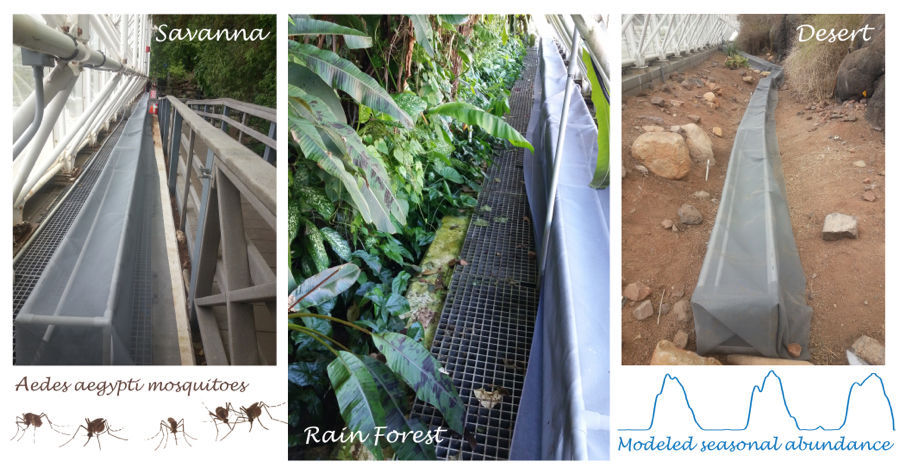
It is thus important to design well-thought-out experiments to infer this information, such as those we conduct at Biosphere 2 with support from the National Institutes of Health.
For decades, researchers have been estimating how fast various species of mosquitoes grow in the lab by measuring mosquito development in incubators maintained at different temperatures.
They also studied how long eggs remain viable before the environment becomes suitable for hatching, how well adult mosquitoes survive in cold or warm climate, and how long a virus takes to develop inside a female mosquito.
This knowledge is incorporated into the mathematical model we and others developed to predict seasonal variations in Ae. aegypti numbers, as well as the proportion of females that could be infected with a specific virus.
As our collaboration crosses disciplinary boundaries, we strive to prepare our students for a future where transdisciplinary research is the norm.
Our small research group, co-directed with our colleague Daoqin Tong, an associate professor in the UA School of Geography and Development, has undergraduate and graduate students from three different colleges working together to model and understand the dynamics and spread of mosquito-borne diseases.

Heidi E. Brown is an assistant professor of epidemiology and biostatistics in the University of Arizona College of Public Health. Her research focuses on the transmission dynamics of vector-borne diseases.

Joceline Lega is a professor of mathematics at the University of Arizona. Her research focuses on the mathematical modeling and analysis of nonlinear phenomena.


