

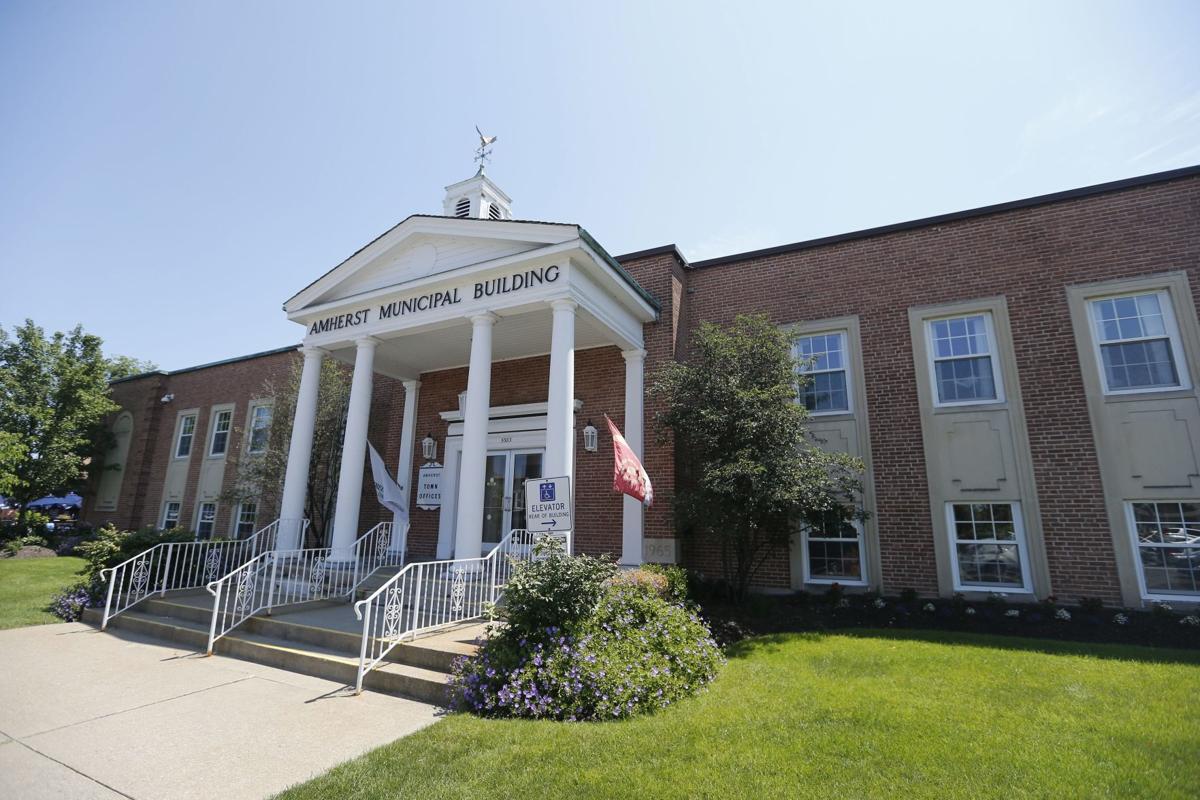
The Amherst Town Board continues to meet online without in-person attendance, a rule that limits public input on major policy questions, town Republicans say.
The town GOP accuses Amherst Supervisor Brian J. Kulpa, a Democrat who is up for reelection this fall, of hiding behind Covid-19 health concerns to avoid scrutiny on major decisions like the Amherst Central Park overhaul.
"The voices of residents have been shut out in many ways," said Larry Hunter, a member of the Amherst Republican Committee, who organized a protest rally set to take place Monday afternoon before that night's Town Board meeting.
Kulpa responded that members of the public throughout the pandemic have had the chance to speak up during Town Board meetings held via Zoom video teleconferencing.
He said the town will return to in-person Town Board meetings as soon as updates to the Council Chambers in the town's Municipal Building are completed. This could happen later in June, Kulpa said, and he blasted his critics as political opportunists.
People are also reading…
"I will remind them that there was a pandemic – there is a pandemic," Kulpa said.
Amherst isn't the only community still conducting government meetings virtually.
A survey of local cities and towns found the Buffalo Common Council still holds meetings online but is exploring a way to safely return to in-person sessions. The towns of Hamburg, Orchard Park and Tonawanda all have returned to in-person Town Board meetings, though social-distancing and mask-wearing rules have been in effect.
Hunter said it's harder for the public to offer comments during online meetings.
This is a point of concern because the town is weighing significant issues, including a project that would reshape a large swath of central Amherst, Hunter said.
Republicans and other critics have said Kulpa and town officials are giving away too much parkland and recreational space, at too low a price, to private developers to make way for a medical center and other commercial construction better suited for elsewhere in town. The town GOP and other Kulpa critics in early March held a news conference opposing the financial terms of the tentative deal.
Hunter, for example, said the town should have pushed UBMD to build a planned medical center in vacant space inside the Boulevard Mall.
Hunter said a recently formed "small group" known as United for Amherst helped organize Monday's protest. He said it includes members of various political parties and it's not solely made up of Republicans.
Kulpa said the United for Amherst group is part of the effort to try to defeat him in this year's election, when he is running against endorsed Republican Jay DiPasquale. "It's 'United Republicans for Amherst,' is what it should say," he said.
He also said Hunter is a former campaign aide to Marjory Jaeger, Kulpa's 2017 GOP opponent, and a disgruntled former employee in the Town Clerk's Office who was laid off in 2020 because of Covid-19 related budget shortfalls.
"He's got an ax to grind," Kulpa said.
Hunter denied he has a personal agenda against Kulpa and noted he worked part-time under three town clerks, including Democrat Fran Spoth.
"As a former employee and 16-year volunteer on the Traffic Safety Board, the supervisor shouldn't use me to cover up his own incompetence," he said.
And Hunter said he doesn't know why, if the renovations at the Municipal Building were the only thing preventing a return to in-person attendance, the town didn't temporarily shift Town Board meetings to the Harlem Road Community Center instead of staying on Zoom.
"This is not common sense and this is not good government," he said.
Kulpa said the public will have extensive opportunities to comment on the details of the Amherst Central Park redevelopment in the coming months and years given the project's lengthy timeline.
And he said the Town Board will hold in-person meetings once the Council Chambers renovations are completed. The town in March took out rows of seating in the front portion of the meeting space, put in new carpeting and awaits delivery of tables and chairs that can be moved to allow the room to host meetings of varying sizes, Kulpa said.
Fixed seating remains in the rear of the room where the floor is at a slight incline. The town supervisor said the cost of the renovations, including some upgraded technology, comes to about $50,000 covered by pandemic relief funding.
The furniture could arrive in the next week or two and, Kulpa said, it's possible the public could attend the June 21 board meeting– a development Kulpa said he welcomes.
"I don't have anything to hide," he said.


