
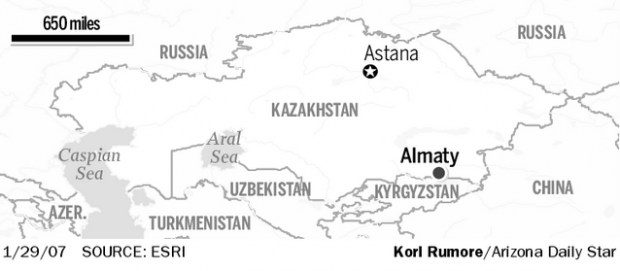
Where in the world is Ka- zakhstan?
In the American consciousness, thanks to the Golden Globe-winning movie "Borat: Cultural Learnings of America for Make Benefit Glorious Nation of Kazakhstan."
Never mind the Oscars snubbed Sacha Baron Cohen's film and his alter ego, bumbling TV broadcaster Borat. Some Tucsonans who initially abhorred the movie's primitive portrayal of the country decided to — how you say — embrace him.
For the recent Family Arts Festival, members of the Tucson-Almaty Sister Cities Committee hired a Borat impersonator to draw attention to the real Kazakhstan. "I knew he'd attract people to our exhibit," said Jerry Gary, the group's chairman emeritus.
Gary said he still dislikes the movie's backward depiction of the former Soviet republic, which he has visited numerous times. "That's insulting to me, but there are trade-offs for everything," he said. "If you take all the emotion out of it, you can see that Borat really has elevated the knowledge about Kazakhstan in the minds of people."
People are also reading…
Long before the British comedian brought fame to the Central Asian nation, the Tucson group had established strong ties with Kazakhstan through low-key people-to-people diplomacy. Almaty is Kazakhstan's most populous city and one of Tucson's six sister cities.
Veronika Syrlybayeva, a University of Arizona student from Kazakhstan, said she is not fond of Borat because he has disseminated many misconceptions about her country.
"Now everybody knows about it, but they know about it from the wrong side," said Syr-lybayeva, a freshman studying public management and policy.
"People keep asking me if it's really true that Kazakhstan is like that," she said. "I explain that it's a normal country, and I tell them to go look on the Internet."
She said she wishes more people knew about the strides Kazakhstan has made since the collapse of the Soviet Union.
"It's one of the engines driving development in Central Asia," she said. "It's developing very rapidly and growing."
Syrlybayeva is studying in Tucson on a four-year government scholarship that requires her to return to work in her country for at least five years after graduation. The Tucson-Almaty Sister Cities Committee has offered valuable friendships and social gatherings during her stay here, she said.
The authentic Kazakhstan, which became independent in 1991, is nothing like the film's, Gary said. He ought to know. He made his first visit to Almaty in 1992. "You could see the signs of declining Soviet times," he said, alluding to a general disarray of the city's infrastructure. Almaty since has evolved into a city of progress working to emulate the Western model of economic development, he said.
"The people are very warm; they're very moral," said Gary, adding that he has many friendships in Kazakhstan. The Midtown home he shares with his wife, Sally, is filled with musical instruments and other souvenirs from that country.
Gary and other committee members in March will mark 20 years of educational and cultural exchanges with Kazakh-stan. The mariachi music of Tucson and the Kazakh folk melodies of Almaty have flowed freely between the two cities.
The committee was created during the Cold War as a way to ease tensions between this country and the Soviet Union, Gary said. Since then, the group has delivered not just music, but also wheelchairs for disabled people and good will throughout.
Volunteer group members also have served as a support system for students from Kha-zakhstan like Syrlybayeva. She is one of about 30 students, known as the Bolashaks — the future — sponsored by their country's government.
"They are taking very good care of our students," Roman Vassilenko, a spokesman for Kazakhstan's Embassy in Washington, D.C., said of the Tucson committee.
Although Kazakhstan has three sister cities in the United States, he noted, the Tucson group is the oldest and the most active.
"They are bringing together people from the two countries, which are on either side of the globe, and they are succeeding in this," Vassilenko said, adding that Kazakhs consider the committee members "great friends of Almaty."
Vassilenko said he wasn't surprised to hear of the group's use of a Borat look-alike to educate people about Kazakhstan. The group is the most "dedicated and spirited committee I've ever seen," he said.
Vassilenko had to field plenty of phone calls about his country after the movie's release, he said, but early worries that the fictitious Kazakhstan would taint the world's ninth-largest country proved false. Nonetheless, he said, the embassy continues efforts to showcase the best of Kazakhstan.
"We're trying to keep up the level of interest as much as we can because it's beneficial for Kazakhstan that people come and see our country for themselves," he said.
Barbara Chinworth, the Tucson committee's chairwoman, added: "The more people who understand and know about Kazakhstan — as with any country — the better it is for exchanging ideas and more importantly, for understanding. This is probably one of the main jobs of our committee — awareness," she said.
Chinworth said she's made several trips to Kazakhstan, which she had no clue about until she met some of its natives in Tucson. She then got involved in helping to raise funds for various projects. The group annually receives about $1,400 from the city, she said.
Getting to know the people of Kazakhstan has enriched her life, Chinworth said. "I like meeting real people and knowing what their lives are like. I love their old traditional ways."
It's unfortunate that it took Borat to push people to look up Kazakhstan on a map, she said. "But I've made my peace, certainly, with the comedian."
Did You Know ...
• Kazakhstan, the world's ninth-largest country, is in Central Asia.
• About 15 million people live in the former Soviet republic.
• Tucson has a sister city in Kazakhstan named Almaty.
• To learn more about Kazakh-stan and the Tucson-Almaty Sister Cities Committee, go to: