
PHOENIX — As Jeremy Schmidt walked up the steps at the beginning of the Echo Canyon trail, his father hiked a few paces ahead.
"I'm not going to give you any guidance," John said to his son.
"I don't need it," Jeremy said.
"You're on your own," Dad said.
Those words marked the beginning of Jeremy's 1.2-mile climb to the top of Camelback Mountain last month. Though a longtime Arizona resident and outdoorsman, he had not made the trek up Camelback before.
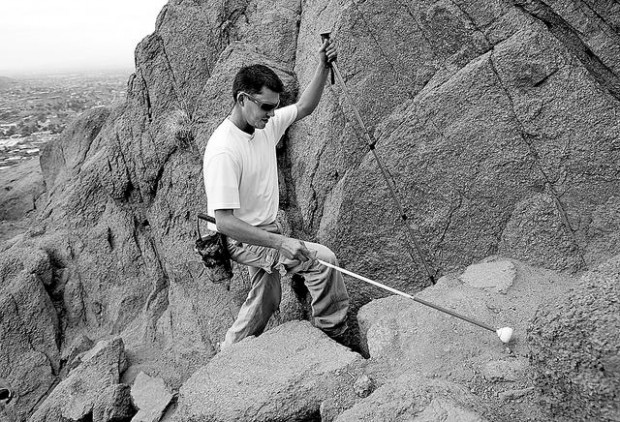
Like most hikers, he came prepared: He had a mud-caked pouch holding a water bottle slung on his hip and an orange hiking staff to maneuver around mountain boulders gripped in his left hand.
But in his right hand, Jeremy had something other hikers did not: a red-and-white cane with a rolling ball at the tip.
People are also reading…
Continuously swinging his arm left and right, he knocked the cane into rocks, plants and boulders, helping Jeremy see what his eyes could not.
Jeremy Schmidt, a resident of Pinal County, is 27. About a year ago, a rare genetic disease deteriorated his optic nerves, keeping his eyes healthy but killing the connection to his brain. In less than a month, he went from having 20/20 vision to not being able to spot an eye chart in a doctor's office.
Going blind was a particular blow for Jeremy. He has loved the adrenaline rush of such outdoor sports as rappelling, hiking and rock climbing since he was 13. He has been a member of the Superstition Search and Rescue Team for the past five years. A few years ago, he and another team member hiked 18 hours into the mountains to rescue about a dozen Boy Scouts trapped in a snowstorm.
It took Jeremy two months to get over the initial shock and depression of going blind.
"It was scary," Jeremy said. "Nobody can possibly say they lost their vision and say they were just OK with it at first."
But he decided he couldn't sit around for long. His first outing after going blind: Salome Jug, a granite slot canyon near Roosevelt Lake.
Getting there means a 5-mile hike that includes a 30-foot rappel into a pool. For the drop, Jeremy set up his gear, rigging his own knots and ropes, and had a partner check them for safety.
Since Jeremy went blind, he has continued to go horseback riding, skiing and rock climbing. "I didn't think my whole life was over," Jeremy said. "Not by far. It just meant it was going to be one heck of a challenge."
As Jeremy charged up the trail on Camelback, he stayed close behind his father to listen for the crunch of his footsteps. Jeremy needs a leader to hike but is independent otherwise, using his cane to feel where he will set his foot next.
A little after the quarter-mile mark, Jeremy heard a soft thud.
"What are you doing?" he asked John.
"Just moving a rock out of the way," his dad said, after flipping over a soccer-ball-sized rock to reveal a moist patch of dirt.
"That's cheating," Jeremy said. Unless there is an obvious danger, Jeremy doesn't want special treatment. He doesn't want to be told there's a boulder to his left or a curb ahead.
"I prefer to act like everything's fine and I'm perfectly normal," he said.
Certain things are off limits for Jeremy — driving or watching television. But besides the obvious, he's found a way to do almost everything.
On date nights, he and his girlfriend take in Phoenix Suns games with the TV on mute, both listening to radio play-by-play ("it's more descriptive").
At home, there are talking clocks, talking meat thermometers and audio cookbooks. And appliances are labeled with raised stickers so Jeremy can figure out which buttons do what.
"I'm doing everything I used to do," Jeremy said. "I'm just finding new ways to do it."
On the way to the top of Camelback, other hikers marvel at him. More than once, Jeremy hears "That's awesome!" or "Right on, man!"
After a little more than an hour, Jeremy took his last steps to the summit and received a bit of applause. "We're at the top now?" Jeremy asked.
He gulped down water as his dad described the view: the vast expanse of city, clearing clouds revealing the sun.
Then, Jeremy soaked up his own view, sitting on a rock with blue sky and the sprawling valley as his backdrop.
Jeremy doesn't see himself as special, he said.
"There's no reason anyone couldn't do this. It's cliché, but attitude is everything."