

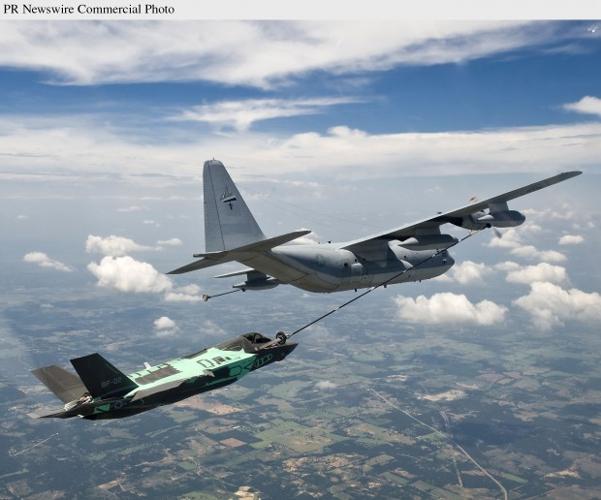
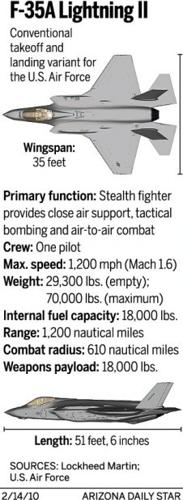
A final decision on basing a new military jet in Tucson is a year away, but a battle for hearts and minds already is in progress.
Supporters and opponents of the high-tech, high-noise F-35 Joint Strike Fighter have launched dueling Web sites to solicit backing as the Air Force readies for a first round of public-input sessions.
At stake is the future of a military unit that brings $280 million a year to Tucson, and potential impacts on thousands of civilians who could be affected by the louder jets.
The Air National Guard's 162nd Fighter Wing based at Tucson International Airport now flies the F-16 fighter, which is due to be phased out and replaced by the F-35 over the next several years.
"I don't think anyone in the military is going to tell you that the F-35 won't potentially be louder," said Col. Ted Maxwell, the unit's vice commander.
People are also reading…
Even so, said Maxwell's boss Col. Greg Stroud, "I think the pros will greatly outweigh the cons."
A new Web site promoting that view - www.tucsonf35.com - urges residents to register their support for the strike fighter. Organizers say more than 1,000 people have already done so.
"The Air Force will measure several factors before making its final decision in 2011. One of those factors will be community support," the site says.
On the flip side, a grassroots group calling itself Tucson Forward has set up its own home page - www.tucsonforward.com -where opponents can outline their objections.
Current levels of jet noise "are already unbearable to thousands of us," said Helen Bayly, 73, who lives in the Sam Hughes neighborhood and is part of the opposition effort.
David Pavlovich, 52, who lives near East 22nd Street and South Country Club Road, said he fears the F-35 "will destroy the quality of life in Tucson."
In some respects, both sides are flying blind.
At least three studies have looked at the F-35's decibel level, but their results vary and none is specific to Tucson. Communities can be affected somewhat differently by noise, depending on factors such as humidity, temperature and how much leeway exists to adjust local flight paths.
What is known so far:
• An environmental impact study at Eglin Air Force Base in Florida, the first base to get the new fighters, suggests the F-35 will be more than twice as loud upon takeoff as the F-16s the Air National Guard now flies from TIA. The city of Valparaiso, which borders Eglin, has launched a lawsuit against the Air Force over noise concerns.
• An April 2009 report from the Air Force and Lockheed Martin, the jet's manufacturer, indicates the F-35 will be at least 75 percent louder than the F-16 at full military power, 1,000 feet above ground. The report said the new jet is comparable to the F-22 Raptor or to the F-18 Super Hornet, an aircraft whose noise level has led to lawsuits against the Navy.
• An environmental impact study at Nellis Air Force Base in Nevada, also expected to get the F-35, shows that, at 1,000 feet, the new jet will be three to four times louder than TIA's F-16s at minimum power and about twice as loud at full military power.
Stroud, the local Guard unit's commander, said he's hoping the local noise impact can be reduced by adjusting flying procedures. "But I don't know that for sure yet," he said.
On March 1, a weeklong series of "scoping meetings" will be held in Tucson and in communities more than 100 miles away. Residents near Bisbee, Thatcher and San Carlos also stand to be affected since they are under military air traffic routes, Air Force officials said.
Several elected officials are on record supporting the F-35 in Tucson, including Mayor Bob Walkup, Arizona Sen. John McCain, Gov. Jan Brewer, and Rep. Gabrielle Giffords.
Giffords recently asked the Air Force to release noise data in advance of public meetings and to conduct a live flyover test over Tucson to better assess the new jet's volume level.
Whether the Air Force will honor those requests isn't clear. Service officials at the Pentagon could not be reached for comment this past week after a blizzard forced the closing of many government offices in the nation's capital.
Despite the unknown, some Tucsonans say the sound of any U.S. warplane is music to their ears.
"I love it," said Charlie Coe, 82, a World War II Navy veteran who lives in the Catalina Foothills. "To me, the people who complain about noise are crybabies."
James Dean, an audiologist at the University of Arizona's department of speech and hearing sciences, said part of the reason Tucsonans feel differently about jet noise may be that they differ greatly in their sensitivity to sound.
"Some people, when an airplane flies overhead, might look up and say 'Wow, that's really cool,' " he said. Yet others may experience the same sound "at the threshold of pain."
Given that, Dean said, "It's a pretty tricky business" to balance the military's needs with the public good.
Comments from the March public meetings will help guide preparation of a draft environmental study that will spell out the F-35's impact on the Tucson area. That document is due to be released this fall, to be followed by more public meetings.
Tucson is one of five training sites under consideration for the F-35. Final decisions are expected early next year.
IF YOU GO
The Air Force is holding five F-35 meetings in Southern Arizona. All are from 6 to 9 p.m.
• March 1 - Tucson: Sunnyside High School, 1725 E. Bilby Road
• March 2 - San Carlos: San Carlos High School, milepost 270, Highway 70 east of Globe.
• March 3 - Thatcher: Eastern Arizona College activities center, Gila Galiuro Room, 1014 N. College Ave.
• March 4 - Bisbee: Bisbee High School, 475 School Terrace Road
• March 5 - Tucson: Roskruge Elementary School, 501 E. Sixth St.
WHAT TO EXPECT
The sessions will be open-house-style. Attendees can visit information displays, talk to military personnel and fill out comment forms. For those who can't attend, the Web site www.f-35atrainingeis.com has comment forms that can be downloaded.
Contact reporter Carol Ann Alaimo at calaimo@azstarnet.com or at 573-4138.

 Plans floated to reopen San Manuel Mine as part of regional copper development


