

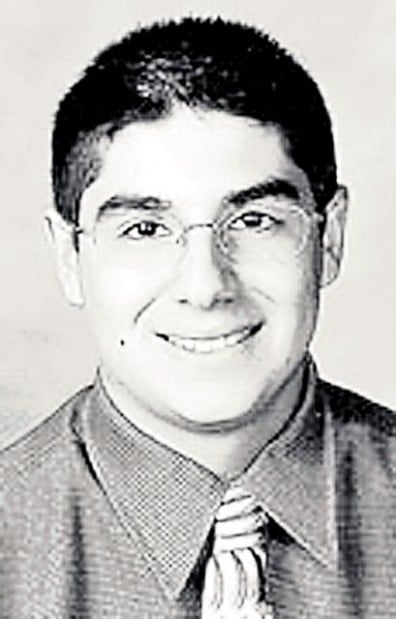
Static crackling from his police scanner was a sweet sound to Roland "Spanky" Molina.
Day or night, if he heard an Oro Valley Police Department dispatcher call a 10-50 (traffic accident), 10-70 (fire), 10-31 (crime in progress), or any other "ten code," Spanky would dial up his best friend, Alex Castellon, and the two would head to the scene to watch the police in action.
"That scanner would go off and Spanky'd be running out the door," said his mother, Ernestina Molina.
The sounds of sirens were familiar to Spanky. He'd been in and out of hospitals for a genetic heart defect since he was an infant, and required a heart transplant when he was 14.
Despite his heart condition, Molina was a healthy child and a robust young man. It was a shock to his parents when he called out in the early morning of Nov. 20 then collapsed in his bed, suffering heart failure. He was rushed to the hospital, but doctors couldn't revive him. He was 21.
People are also reading…
His parents found it miraculous that their son had survived infancy. The Molinas' first child, a daughter named Michelle, died soon after birth from the same heart condition. When Spanky — his father was a fan of "The Little Rascals" — was born 11 months later, he appeared healthy, but at 10 weeks old, he became ill and his doctor detected an irregular heartbeat. Spanky spent three weeks in intensive care.
"My prayer was I didn't want him to die in the hospital as my first child did," Roland Molina said. "I wanted to bring him home."
The family's prayers were answered and Spanky pulled through. For the next 13 years, he led the life of a normal boy — going to school, eating junk food, playing sports, taking a family vacation to Disneyland. The only deviation was a yearly checkup with a cardiologist.
"He did exceedingly well when he was an infant," said Spanky's doctor, University of Arizona pediatric cardiologist Richard Donnerstein. "I don't think many of us expected him to survive his initial illness."
The hormonal changes and growth spurt that hit during puberty took a toll on Spanky's heart. Doctors told his parents their son needed a transplant.
"We couldn't believe it," his mother said. "He'd been through soccer, baseball, everything."
"We thought, 'How can the doctors be telling us this?' We saw no evidence of it," his father said.
About six months later, though, there was no denying their son needed a transplant. After a pickup basketball game one evening, Spanky lay down, exhausted. Days later, he still hadn't regained his strength. After a long wait, he received his new heart just before his 15th birthday.
Still, Donnerstein said, his patient's outlook was always positive.
"He was always upbeat. No matter how badly things were going, he was always cheerful and willing to accept the way things were and look for the best outcome," he said.
Six days after transplant surgery, Spanky was ready to leave the hospital and resume his "normal" life, his parents said.
Susan Roth-Mulrow, a teacher at Mountain View High School, was part of that normalcy. She helped Spanky catch up on the schoolwork he'd missed.
"Spanky became my teacher. He taught me more than I could have ever taught him from a textbook," she said. "He just had a unique spirit about him. He was so kind. He had a motivating attitude.
"He faced life and his illnesses with grace, maturity. He had an ever-present gratitude for life. I think he knew that he was here for just a short time and even though he loved life, he was OK with that because he had true faith in God."
Marianne Castellon is a Mountain View educator and the mother of Spanky's best friend. Spanky and Alex had known each other since kindergarten. She saw Spanky grow up and mature. She helped tutor him and, in return, learned much.
Before his transplant, Marianne Castellon said, Spanky "was just a really healthy kid playing soccer. Once he had that transplant, he looked at life differently. He was wise beyond his years. He really had a sense of maturity about living life a day at a time and being grateful to the people around him. I had a sense of awe with how he was able to handle life's hurdles.
"People were drawn to him," she said. "He had a real calmness, gentleness and sensitivity. He was very much into giving back to people and helping people because he felt as though life had been good to him and so many people had helped him through his illness."
In preparation for a career in law enforcement, Spanky listened to his police scanner between his classes at Pima Community College and his shifts working at a local sporting-goods store. And he joined Oro Valley police officers Mario Molina and Ferdinand Tolentino on occasional ride-alongs.
"They knew quite a bit," Officer Molina said of Spanky and Alex. "They were always listening to what was going on (on the scanner). If something was going on in a different agency, they would call me and let me know. They were like little detectives. It was funny; they seemed to know more than I knew about what was going on at times."
"We could pretty much talk in code," Alex Castellon said, which vexed Spanky's sister, Sandra.
"He'd text-message me in code and I didn't know what he was saying," Sandra said.
This summer, Spanky picked up an application for the Oro Valley police force. He was 21 — finally old enough to join.
In preparing for the physical challenges of the job, an over-eager Spanky went jogging midday in the summer and passed out. That landed him in the hospital for two days. After that, Spanky's father talked to him about his physical limitations and urged Spanky to consider alternate career options. Realizing his chances of becoming a police officer were slim, Spanky decided to study for a career as a certified public accountant.
"He was really very interested in law enforcement and I thought he'd make a really good police officer if he'd pursued it," Tolentino said. "I think he wanted to help people."
On StarNet: Find a photo gallery of this Life Story at azstarnet.com/slideshows
Life Stories
This feature chronicles the lives of recently deceased Tucsonans. Some were well-known across the community. Others had an impact on a smaller sphere of friends, family and acquaintances. Many of these people led interesting — and sometimes extraordinary — lives with little or no fanfare. Now you'll hear their stories. Past "Life Stories" are online at go.azstarnet.com/ lifestories


 Tucson's iconic Arizona Inn to add rental homes to its property


