

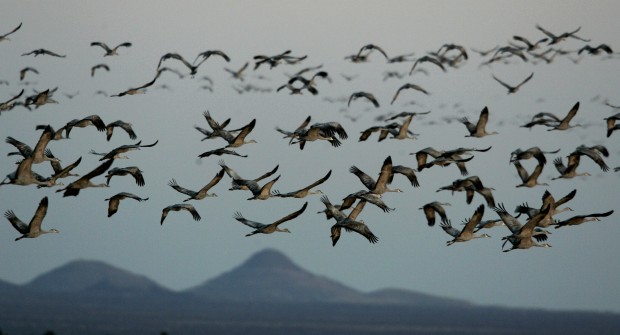
Sandhill cranes - with wingspans of up to 7 feet and a history dating to the Pleistocene - have migrated in record numbers to a valley south of Willcox.
That's thrilling news for wildlife watchers who savor what has become an annual "sandhill spectacle" in the Sulphur Springs Valley. One highlight: mass daybreak takeoffs in which thousands of cranes fill the sky in a vast avian cloud.
Biologists with the Arizona Game and Fish Department say 40,499 cranes were counted this year - eclipsing the previous valley record of 36,708 set in 2008.
Possible causes for the record numbers: excellent wet roosting conditions and plentiful feed in the area.
"It is absolutely dramatic - just amazing - to see a couple of thousand cranes take off in the morning or return to roost in the evening," said Rory Aikens, a spokesman for the Game and Fish Department.
People are also reading…
"You can usually see them throughout the day at two wildlife areas in the Sulphur Springs Valley - but first light and last light of the day are really great times to see them," Aikens said. "If you happen to get one of those fiery sunsets and you see thousands of cranes flying in against that sunset light, it will absolutely astound you."
Catch a glimpse of the big birds - about 4 feet tall when standing upright - and you're looking back in time. Game and Fish Department biologists describe sandhill cranes as "holdovers from the Pleistocene Epoch" nearly 2 million years ago, and some scientists say the species is even older than that.
Aikens said cranes migrate to the valley from some mountain states and parts of Canada in November and early December.
"They will be here through late February, and sometimes we'll have them into early March, depending on climate factors and food availability," he said.
Aikens said the annual crane count is conducted in a single day.
"A large group of biologists are in set spots, and they replicate the same counting fashion every year," he said. "They count birds in these spots and then extrapolate to arrive at a total. They're able to get a good approximation of the roosting population, with a pretty high confidence factor."
This year's record number of cranes in the Sulphur Springs Valley appears to be the result of good conditions there and not-so-good conditions at another roosting area.
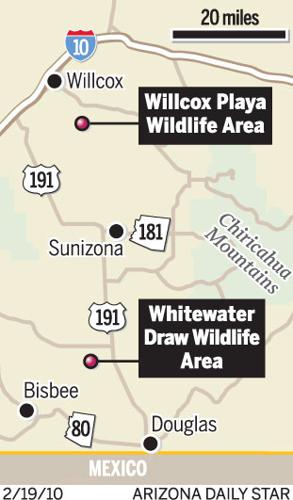
"The Whitewater Draw and Willcox Playa wildlife areas have lots of shallow water where cranes can roost overnight away from predators," Aikens said. "And the Sulphur Springs Valley has good grain crops, which the cranes feed on."
Mike Rabe, migratory-game-bird program manager with the Game and Fish Department, said a lack of corn crops at the Bosque del Apache National Wildlife Refuge in New Mexico might be another factor.
Thousands of cranes that typically spend winters at Bosque likely winged their way to Arizona this year instead, Rabe said.
See the cranes
Look for cranes at these two sites operated by the Arizona Game and Fish Department.
The Whitewater Draw Wildlife Area
Get there: From Tucson, take Interstate 10 east, past Benson, and exit onto U.S. 191 before reaching Willcox. Drive south on U.S. 191, past Elfrida, and then follow Central Highway south to Davis Road. Go west on Davis Road to Coffman Road, and follow Coffman Road south to the wildlife area.
Willcox Playa Wildlife Area
Get there: From Tucson, take I-10 east to Willcox and then drive southeast on Arizona 186 to Kansas Settlement Road. Follow Kansas Settlement Road south to the entrance to the wildlife area.
Did you know
Sandhill cranes produce a distinctive loud, rattling, resonant call.
Contact reporter Doug Kreutz at 573-4192 or dkreutz@azstarnet.com


