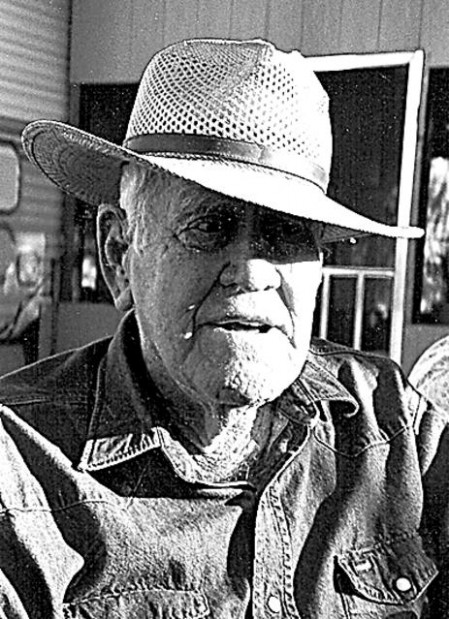
Jack Turner didn't finish high school.
He was too busy picking cotton and bucking hay for ranchers in West Texas.
Days got longer when he moved to his grandfather's 80-acre spread outside Patagonia.
Turner, who was a strapping 6-foot-2 and 230 pounds, worked full time mending fences, sowing and harvesting crops, and running cattle on two ranches, one owned by his mother's family and another owned by his wife's. Ranch work was done early in the morning and late in the evening, between Turner's full-time shifts doing road maintenance for Santa Cruz County.
"He'd get home, take a short nap, and go out and do the work until it got dark. What you didn't get done, you'd do the next day," said his son, John Turner, who now runs the Turner family ranch.
No matter how tired he was, Jack Turner still found energy for music: "Tennessee Waltz," "The Yellow Rose of Texas," "You Are My Sunshine."
People are also reading…
Turner, a self-taught musician, could play guitar, mandolin, fiddle and piano — entertaining audiences throughout Southern Arizona.
"He enjoyed playing the guitar," said George Proctor, who met Turner in the late '30s. "I thought he was pretty good."
Fans, friends and relatives crowded into a small Patagonia church on Aug. 30 to pay their respects to the hardworking rancher, father and musician.
Turner died on Aug. 24. He was 96. His health had been declining since a heart attack and triple bypass surgery 12 years ago.
"Jack knew everybody in the county," Proctor said. "He was a big man, and he was a good-natured individual. He did a lot for the community.
"He didn't have a mean bone in his frame. People respected Jack. He didn't have anything bad to say about anybody. What you heard from Jack was the good."
Since moving to Southern Arizona in the early 1930s, Turner played and sang at socials and dances in Nogales, Sonoita, Patagonia, Vail, Elgin and Lochiel.
"Any place there was a dance hall and they were throwing a party, he'd be there to play," his son said.
Turner wasn't averse to picking up an instrument at home, either.
"One of the things he'd do at night when we were kids, he'd play and sing," said daughter Jackie Hines, of Phoenix. "He'd lay down on the bed and play the mandolin."
And he always had plenty of time to share tall tales with his five children.
Turner was the third of 11 children. He was born in 1912 in Baird, Texas, though his mother maintained he was "hatched from a buzzard egg," according to family lore.
When his parents divorced and his mother moved to the Patagonia area to care for her ailing rancher father, Turner followed.
"It was a better climate down here than West Texas, and there was plenty of work here at the time, and he stayed here to take care of his mother and sisters and the ranch," John Turner said.
"He was very family-oriented and wanted to provide for them to make sure they were taken care of."
When his mother died at age 100, she left the ranch to Turner and his family. Turner married Alice Barnett, the daughter of another local rancher, in 1942.
They had four girls — Harriet, Marjorie, Ruby and Jackie — and son John, the youngest.
All the kids pitched in to help maintain the ranch.
"You get out of school, you do your homework, and you help out on the ranch as best you could," said John Turner, who also works for the county. His father "taught us all the values of life and to enjoy life and keep busy with things."
"Anytime he needed a fence put up, we'd be the ones to help him," Hines added.
The family grew peanuts, pinto beans, corn and other vegetables; maintained an apple orchard; and raised cattle.
The peanuts, said daughter Marj Black-Robbins, were grown for his mother, who donated the proceeds to their church. The other crops were for the family and anyone Turner encountered who was down on his luck.
"He was always busy helping numerous people all the time — bringing food to people who didn't have enough, always looking out for the people in the area who were less fortunate," she said.
"He took a personal pride in the ranch. He always made sure he had the field plowed and the peanuts planted and the beans planted, and the tradition of the place was kept up."
Turner didn't mind the hard work and long hours, his children said.
"I think he loved the whole aspect of ranch life," Hines said. "My dad was not a sitter — just sit and do nothing. That wasn't in his mind-set. There were things to be done, and he wanted to do them."
Jack Turner retired from his county job in 1969, after 35 years, but he didn't give up driving heavy equipment.
He acquired a road grader and front-end loader and went to work for himself.
"He drove an old pickup all the time," Proctor said. "He'd get an old pickup and fix it and have it percolating in no time."
Turner did the same with the heavy machinery, and he spent countless hours working miles of road in the then-undeveloped Rio Rico area, Proctor said.
About 18 years ago, Jack and Alice moved off the ranch and closer to town. Jack kept busy at their Patagonia home, tending a vegetable garden, but he returned to the ranch regularly to visit his son and to putter around the homestead.
"I think he just liked being up there," Hines said. "It was a place of comfort to him."
Life Stories
This feature chronicles the lives of recently deceased Tucsonans. Some were well-known across the community. Others had an impact on a smaller sphere of friends, family members and acquaintances. Many led interesting — and sometimes extraordinary — lives with little or no fanfare. Now you'll hear their stories. Past "Life Stories" are online at go. azstarnet.com/ lifestories.

 Lake Mead's drops raise prospect of unaffordable Hoover Dam electricity