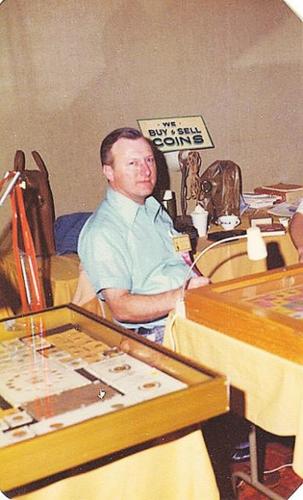
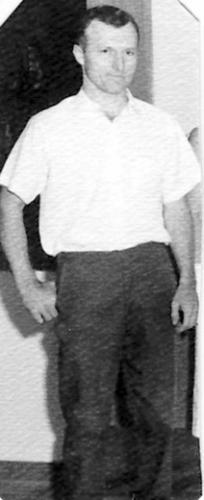
Halden Birt Jr. never outgrew his childhood hobby.
He began collecting coins when he was a boy growing up on an Illinois farm, and turned his interest into a career.
Birt was an acclaimed numismatist who was tapped by the FBI to testify in court cases involving valuable coins, and he developed a method still in use today for determining the authenticity of rare coins.
In Tucson, he operated Glass Shoppe Coins at 4325 E. Broadway for 45 years, until his death Aug. 30 from congestive heart failure. He was 78.
Birt's younger sister, Beverly Knox, remembers young Halden and their father going to the bank every Friday for a new batch of coins through which to sort. Birt started out collecting Indian head pennies and buffalo nickels. Sometimes he let his little sister help him look for those he needed for his collection.
People are also reading…
While the Birt children grew up on the farm in Illinois, the family also owned a cattle ranch in Montana. But when he was 15, Halden's severe hay fever prompted the family to move to the arid desert town of Tucson.
Birt and his brother attended the Southern Arizona School for Boys, a private prep school at the mouth of Sabino Canyon. After graduating, Birt studied ranching at Montana State University but decided life on the range wasn't for him.
Birt returned to Tucson, where his parents, Carol and Halden Sr., had opened The Glass Shoppe, an antiques store specializing in collectable glassware. Halden Jr. opened his coin shop in the same building.
Peter Spooner was 8 when he walked into Birt Jr.'s shop. He and his mother were casual coin collectors then. Birt educated the boy on coin collecting and took him to coin shows. Spooner came to consider him a father figure.
"I'd go to his shop and spend hours, and he'd always be there teaching," Spooner said. "The thing about Hal Birt that's fascinating is, he never looked down on anybody. He was fascinated by what you had to offer. He always wanted to learn and study and find out as much information as he could so he could talk about it. All different aspects of coins fascinated him. When you have someone who has that kind of passion, it rubs off.
"He was the grandfather for so many numismatists here in this town," Spooner said. "He was the numismatist's numismatist. He was an absolute student of the hobby and a teacher."
Birt wrote numerous articles and seven self-published books that are still used as reference by coin collectors. The father of two had a special interest in collecting Arizona tokens — coinlike pieces made of brass, copper, aluminum or other metal that were offered in trade by businesses, often saloons — from the 1880s to 1930s, according to a 1991 Tucson Citizen article about his token collection.
"Most times they were used for advertising," Birt said in the article. "A guy buys two drinks at saloon and they give him a token good for a free drink."
Tony Tumonis was a novice coin collector 30 years ago when he first visited Birt's shop.
"He thought that Arizona was not appreciated as much as tokens from other states," Tumonis said. "He wanted to put a book out there to introduce collectors to the field of collecting Arizona tokens because there weren't any other books in the field out there when Hal began writing his book."
Birt, a past president of the Tucson Coin Club and longtime member of the American Numismatic Association and the Sociedad Numismatica de Mexico, also was interested in Sonoran coins, tokens and scrip.
It was Birt, fellow numismatists say, who first used die stress analysis to determine the authenticity of rare coins, a test that is still used by collectors.
"He was one of the last old-fashioned coin shops in Tucson," Tumonis said. "It's kind of an end of an era. There are other coin shops that are quality establishments, but they don't have the same feel as Hal's did. It's a tremendous loss of knowledge in the numismatic community."
Spooner likened the atmosphere in Birt's shop to that of a hometown barbershop, where regulars gather to tell stories, share tall tales and talk about their enthusiasm for coins.
Birt's health had been failing in the last couple of years, yet he kept his shop going for himself as much as he did for his customers. His sister believes his passion for coins extended his life.
"He loved his coins, and that's why he got out of bed every day," she said. "He had something to live for.
"He was a wonderful experience, my brother."
Life Stories
This feature chronicles the lives of recently deceased Tucsonans. Some were well-known across the community. Others had an impact on a smaller sphere of friends, family and acquaintances. Many of these people led interesting — and sometimes extraordinary — lives with little or no fanfare. Now you'll hear their stories. Past "Life Stories" are online at go.azstarnet.com/lifestories

 Lake Mead's drops raise prospect of unaffordable Hoover Dam electricity