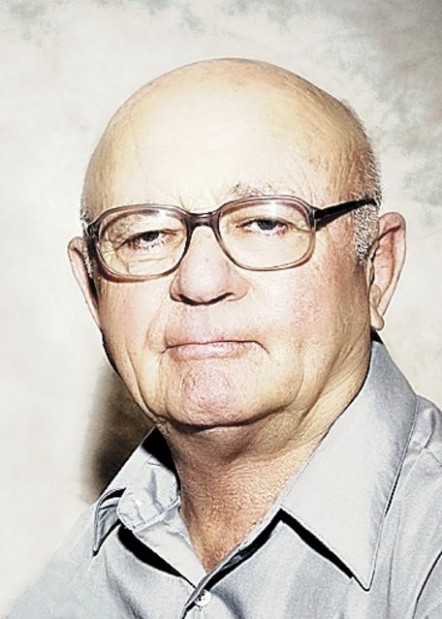
As a teen, Elemer Kovacs spent hours atop a rumbling steam-powered tractor, daydreaming about a better life as he thrashed wheat on the small plot of land his family owned in Hungary.
An aptitude for mechanics and a head for business helped Kovacs achieve his dream after he emigrated from Hungary to the U.S., but he never forgot about the steam-engine tractor.
Through the decades, he amassed 50 or so engines, some gas- or air-powered, but most powered by steam, that he refurbished and kept running.
The Sahuarita home he shared with his wife of 46 years, Charee, is a landmark along Interstate 19 that lures several hundred motorists a year who are intrigued by the giant 33-plus-ton flywheel in the yard.
Kovacs enjoyed explaining the mechanics of his machines to those who dropped in.
People are also reading…
"When you love something, that's what you do. I don't charge for it. I want people to see these engines," Kovacs said in a 2002 Arizona Daily Star article. "Young people today have never seen anything like this. The way I feel about it, these engines shouldn't be left to rust."
Kovacs' daughter is hoping to find an individual or an institution as interested in preserving the machines as her father was.
The Hungarian machinist who kept them all working died Jan. 11 after a stroke during heart surgery. He was 73.
"We hate the idea of someone coming in and tearing the place apart," said his daughter, Karen Frarer. "The engines actually drive. If we could preserve some of the bigger ones, that would be awesome."
Kovacs was in his 20s when he emigrated from his native Hungary to the U.S. after showing an aptitude for mechanics while serving in the military.
He learned English while working as mechanic and machinist for mining operations, military motorpools and airfields in Idaho and the Pacific Northwest. For a while, he owned a repair shop that specialized in Mercedes automobiles.
"All he knew how to do was fix things," his daughter said.
Her father was a savvy businessman and eventually acquired the means to buy a small airfield, Spokane Airways, in Washington state. He managed the airfield, worked on engines and flew planes.
He also developed a system for safely landing aircraft when dense fog blanketed the area.
Kovacs would dissipate the fog by putting dry ice on the runway. The dry ice would create a "hole" in the fog, clearing visibility on the runway so planes could land, Frarer said.
Wherever the family lived, Kovacs hauled his growing collection of engines. He always brought a cow along, too.
"He always had to have a cow, because when he grew up he had nothing, and if you had a cow you were a rich person," Frarer said.
In the late 1980s, Kovacs and his wife decided to expand their herd of one. They bought almost 1,500 acres in McNeal in Cochise County and raised 100 head of cattle.
A decade later, the couple retired from ranch life and moved to Sahuarita, where Kovacs tinkered with his engines and got involved in politics, serving as a member of the town council.
"You would have been treated royally if you'd stopped to ask about the wheel," friend John Sweet said. That's how he met Kovacs eight years ago.
"He has two giant lathes in his barn up there. If he needed some part for all that machinery, he would take the old part and get the measurements off it and make the new part," Sweet said. "He could build any mechanical thing. He was extremely talented."
Life Stories
This feature chronicles the lives of recently deceased Tucsonans. Some were well-known across the community. Others had an impact on a smaller sphere of friends, family and acquaintances. Many of these people led interesting — and sometimes extraordinary — lives with little or no fanfare. Now you'll hear their stories. Past "Life Stories" are online at go.azstarnet.com/ lifestories
On StarNet: Find a photo gallery of this Life Story at azstarnet.com/slideshows

 Faculty concerned about changes to U of A admissions policy