

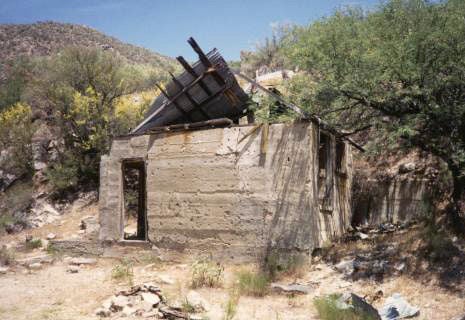
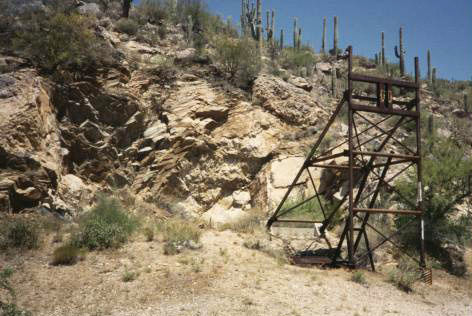
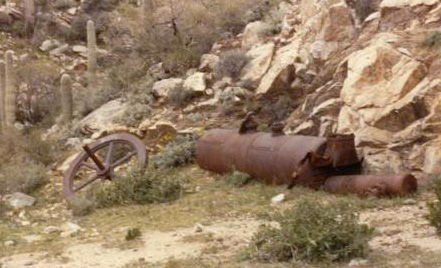
The Tip Top Mine was one of the best-producing silver operations in Yavapai County.
It is located in the Tip Top Mining District in the southern foothills of the Bradshaw Mountains, about 40 miles northwest of downtown Phoenix.
Named for its tip-top location , the deposit was discovered by John Corning and Jack Moore in 1875. They brought in $80,000 in silver production the first year of operation.
They made their first shipment of ore from the mine to San Francisco at $10,000 per ton.
The mine was then known as the Conqueror. It was later sold to Haggin, Head and Hearst of San Francisco. Early equipment included a roasting plant and pan amalgamators.
Silver was found in narrow veins and short ore shoots. In some places, a tungsten vein replaced the silver vein. It was left in place in the stopes because at the time it was thought of as zinc.
People are also reading…
The main shaft followed the vein at an angle of 68 degrees to a depth of 830 feet.
The mine operation supported several general stores, a grade school, six saloons, a Chinese laundry, blacksmith shop, a courthouse overseen by Joe Walker, a brothel and a stage line to Prescott. Faro and high-ball poker were popular in the town of Tip Top.
Grapevine Springs served as its water supply. Situated along Cottonwood Creek, the town was well-armed against Indian incursion.
Tip Top’s post office opened in 1880 and lasted 15 years. Prior to its opening, town residents relied on the neighboring town of Gillette, 9 miles away, for mail. Gillette also served as the mine’s milling site on the Agua Fria River. That lasted until the St. Louis Yavapai Mining & Milling Co. moved the 10-stamp Gillette Mill, built by California investors Lloyd Tevis and James B. Haggin, to the Tip Top Mine in 1886.
Ore from the Tip Top was transported by pack animal and later by wagon.
Between 1875 and 1883, the mine and its surrounding dumps containing oxidized ore produced $2 million in silver.
About half of the more than 1,000 residents were chloriders, small-time operators who worked multiple claims around the area. Those included the Joker and Keystone claims, and the Gold Coin and Swilling mines. The rest were employed by the Tip Top Mining Co.
The camp proved amenable to a visiting preacher from Phoenix. Lacking a church, the miners attended services under cottonwood trees.
While the preacher gave his sermon, the miners became inebriated from a supply of beer, which helped encourage their donations to the preacher after the sermon.
Frank E. Wager maintained an assay office at the Tip Top camp from 1887 to 1922, collecting ore samples from the mine. Equipment at the mine included a steam hoist, a mill containing two small gas crushers, a 7-ton capacity Denver Roller Mill, Callow Cone, Richards Cassifier, Wilfley Table and Deister Slimer.
The mill was powered by a Fairbanks Morse 16 horsepower engine along with a 10 kilowatt Westinghouse direct-current generator for lighting.
The demonetization of silver in 1893 caused the mine to close, and Tip Top became a ghost town several years later.
A later assessment concluded that several hundred ounces of silver might remain in the 40,000 tons of surrounding mine dumps.
Some tungsten in the form of ferberite and wolframite was recovered and shipped from the mine’s dumps during World War I.
Later attempts to reopen the mine proved unsuccessful, including one undertaken in the early 1980s by the Santa Fe Minerals Co. Bad ground prevented further development of the shaft.
Additional challenges included clouded property titles.
Today, the mine and ghost town encompass nearly 58 acres, and three patented mining claims are for sale for $695,000.
The area is a destination for off-road enthusiasts. The mine site is about four miles north of the New River, south of Black Canyon City.
William Ascarza is an archivist, historian and author of seven books available forpurchase online and at select bookstores. These include his latest, “In Search of Fortunes: A Look at the History of Arizona Mining,” available through M.T. Publishing Co. at
.
His other books are “Chiricahua Mountains: History and Nature,” “Southeastern Arizona Mining Towns,” “Zenith on the Horizon: An Encyclopedic Look at the Tucson Mountains from A to Z,” “Tucson Mountains,” “Arizona-Sonora Desert Museum” with Peggy Larson and “Sentinel to the North: Exploring the Tortolita Mountains.” Email Ascarza at


