

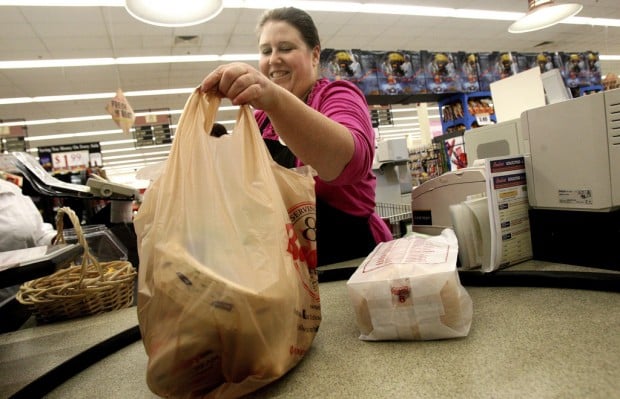
A proposal to force stores to use fewer plastic bags got sacked Wednesday.
City Councilman Paul Cunningham wanted to tighten a 2009 ordinance requiring stores to offer plastic bag recycling, saying it lacked specific goals or consequences.
What he got was unanimous approval for an education program to encourage shoppers and store clerks to reduce bag usage, and a data-collection effort to figure out how many of the bags are used in order to set a fair reduction goal.
Cunningham wanted benchmarks set for large retailers to strive for, and if the retailers didn't meet that benchmark in two years the council could discuss taking additional action.
The proposed benchmarks of reducing usage by 50 percent and increasing recycling by 30 percent came from a working group, comprising business and environmental interests, that the council formed around six months ago.
People are also reading…
Gabe Wigtil, the Sierra Club's representative on the working group, told the council the benchmarks provided a decent middle ground between retailers and the environmentalists, who have been clamoring for an outright ban.
He said reducing plastic bag use is more than just litter reduction.
"It really is showing the excess of our society that we're creating these single-use products with an average life span of 12 minutes with such a highly valuable product," Wigtil said. The bags are made with petroleum.
But retailers said they were worried they would suffer the repercussions if they couldn't meet the arbitrary reduction goals.
Tim McCabe, president of the Arizona Food Marketing Alliance and a member of the working group, said retailers were skittish because no one had ever collected data showing those numbers could be within reach.
"It's very difficult because we really don't have a good baseline number on this," McCabe said. "Our members felt this was a very aggressive number ... (and) their feet were going to be held to the fire with this number, and so they were really concerned."
Cunningham said he was still pleased with the education campaign and data collection on bag usage, even though it came up short of what he wanted. He said things will work out over time.
"I think it's a good jumping-off point. It's the start of a discussion, and as the discussion evolves we'll probably have some type of measure in the future that'll make sense," he said.
Mayor Jonathan Rothschild said most of the working group's recommendations, like public-awareness and education programs for checkouts and baggers, will go into effect, but it was just too soon to adopt any specific requirements.
Councilman Steve Kozachik was less supportive, saying he felt the discussion unfairly characterized retailers as scoundrels bent on pushing plastic bags onto an unsuspecting populace.
"If consumers weren't demanding them, then they wouldn't be providing them," he said. "We are implicitly making the retailers the villain for something that is consumer-driven. And the way a marketplace works is if the consumers are asking for it, the market provides it."
Contact reporter Darren DaRonco at 573-4243 or ddaronco@azstarnet.com


