A Canadian bull rider was taken from the Tucson Rodeo by ambulance Sunday afternoon after his head collided with the head of the bull he had been riding.
Kyle Loudon of Brooks, Alberta, broke his jaw and had facial injuries, said Joan Liess, the rodeo's spokeswoman.
He was able to walk out of the arena but had to be taken to the hospital because of his injuries.
The medical personnel at La Fiesta de los Vaqueros don't know when an incident such as Sunday's will occur, so they have to constantly be on their toes.
They consequently have one of those jobs where it's pretty much impossible to plan out a workday.
"It's long periods of boredom interspersed with all hell breaking loose," said Andy Hopkins, program manager for the Justin Boots Sportsmedicine Team currently stationed at the Tucson Rodeo. "It seems like it comes in waves."
People are also reading…
Hopkins is working with volunteer medical personnel, most of whom are local, to care for the contestants' sore, bruised, bucked, thrown and stepped-on bodies.
On-site medical personnel don't have an X-ray machine but can provide a range of care — such as taping, rehabilitation treatment, custom bracing, modality treatments, suturing, removing stitches and building a cast, Hopkins said.
The team typically gets to an event at least two hours before it starts, though sometimes three or four hours before, Hopkins said. That's so they're ready for the contestants who start filtering in the team's trailer about one to one-and-a-half hours before the rodeo starts.
While rodeo fans headed into the Tucson Rodeo Grounds, 4823 S. Sixth Ave., for the start of the 84th Annual Fiesta on Saturday, the medical personnel were bracing themselves for the unknown day and week ahead. This is how they spent Opening Day, which was much less eventful, injury-wise, than Sunday.
12:07 p.m. — It's relatively calm and quiet in the Justin Boots Sportsmedicine Team's trailer, located on the rodeo grounds. The grounds' gates opened a little more than an hour ago. However, pre-rodeo events won't begin for nearly another half-hour and the ProRodeo doesn't start until 2 p.m.
The cool air inside the trailer smells slightly medicinal, slightly spicy, and feels much cooler than the rising Tucson temperatures outside.
Saddle bronc rider Dusty Hausauer, 26, and from Dickinson, N.D., is the only cowboy receiving treatment in the trailer. He's icing his knee, which he hurt the previous night while rodeoing in San Antonio.
Knee injuries accounted for about 12 percent of contestants' injuries from 1981 to 2005, according to figures compiled by the Justin Boots Sportsmedicine Team. More than 15 percent of all contestants' injuries during that period occurred in saddle bronc riding, the Justin Boots team's figures show.
Hausauer says his knee will be all right by the time the rodeo starts, explaining that he arrived at the grounds early because he knew the Justin Boots team would be there.
"The guys wouldn't be able to compete if they didn't know there's sports medicine at these rodeos," he said.
1:33 p.m. — Orthopedic surgeon Dr. Mike Vercillo is examining 28-year-old bull rider Cody Buller, who was bucked off a bull the previous night during competition in San Angelo, Texas. As a result of the fall, Buller has been having neck and upper back pain and needs to be X-rayed. He's scheduled to compete later on that day but doesn't know if he can.
Vercillo works for the Tucson Orthopaedic Institute but is volunteering at the Tucson Rodeo for the first time as a part of the medical team.
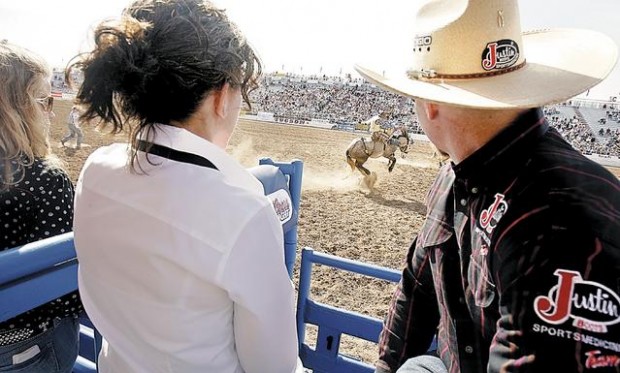
2:15 p.m. — Bareback riding, the first rodeo event of the day, has begun. The medical team is positioned where they can quickly run into the arena if there's a serious injury. Some are standing on top of the chutes and others are watching from an overhead platform.
The day's team has a range of medical backgrounds. There's Hopkins, a former bullfighter who now works as a program coordinator for the Justin Sportsmedicine Team. He is among the team's 10 program managers around the country who utilize local trainers and doctors at rodeo events.
Vercillo is the local orthopedic surgeon. Dr. Anna Waterbrook, an assistant professor of emergency medicine at the University of Arizona, is also volunteering, as is Jenny Allen, an athletic trainer who works for the UA's athletics department.
Lauralee Morris, an emergency room and intensive care unit nurse from El Paso, will be helping out at the Tucson Rodeo all week, as will Marv Pollins, a retired athletic trainer. Pollins worked for the NFL's Cincinnati Bengals for 30 years.
2:32 p.m. — The team's back in the trailer. There were no major injuries, so they didn't have to rush into the arena during bareback riding. Timed rodeo events, called slack events, are going on, so the team is inside, helping the contestants who have come by for care.
Bareback, saddle bronc and bull riding are the main three rodeo events that the sports medicine team stands by the arena for, Morris explains.
Known as rough stock events, more than 88 percent of contestants' injuries from 1981 to 2005 occurred in those three events combined, Justin Boots Sportsmedicine Team's statistics show. Slack events such as steer wrestling, and calf and team roping are less dangerous.
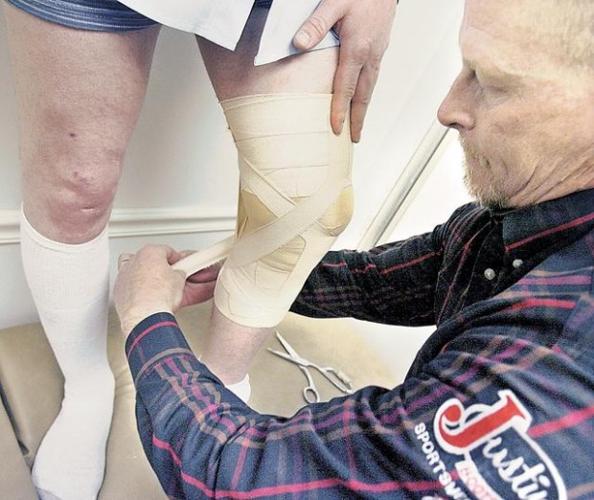
2:43 p.m. — Allen tapes up local bull rider Will Oliphant's knee in the trailer, while the rest of the medical team is on standby at the arena during saddle bronc riding. Oliphant reinjured his knee about two weeks ago and is scheduled to compete later on in the day.
3:11 p.m. — The medical team's back in the trailer during more slack events. Saddle bronc riding ended without any major injuries in the arena. There are several repeat visitors from earlier in the day, back for more ice and other care.
Buller is still in the trailer, too hurt to ride, so the bull rider won't be competing in the upcoming event.
3:41 p.m. — The team's by the arena during bull riding, the most dangerous rodeo event by far. Nearly half of all contestants' injuries from '81 to '05 happened during bull riding, the Justin Boots team's statistics show. A South Tucson rescue crew is also there watching the event on standby. Luckily, neither they nor the rodeo's medical personnel are needed.
4 p.m. — The first day of the 84th Annual Tucson Rodeo is coming to a close and all is pretty quiet so far. That's a positive sign, Pollins observes.
"That's a good day, when they don't need us."
Schedule of events
Unless otherwise noted, the rodeo begins at 12:30 p.m. each day with Dodge Mutton Bustin' and the Justin Junior Rodeo. The ProRodeo begins at 2 p.m. Gates open at 11 a.m.
Today and Tuesday
8 a.m. — Slack competition for barrel racing, steer wrestling and tie-down and team roping,
Admission: $5 at the gate. Children under 13 are free.
Wednesday
8 a.m. — Barrel racing.
10 a.m. — Gold Card team roping.
Noon — Mike Cervi Jr. Memorial Team Roping. Proceeds benefit the Justin Cowboy Crisis Fund.
Admission: $10 at the gate. Children under 13 are free.
Thursday
9 a.m. — Tucson Rodeo Parade begins at South Park Avenue and East Ajo Way, goes south on Park to East Irvington Road and west on Irvington to the rodeo grounds. For more information, go online to www. tucsonrodeoparade.com or call the parade office at 294-1280.
12:30 p.m. — Tucson Rodeo: Third performance.
Friday
12:30 p.m. — Tucson Rodeo: Fourth performance.
Saturday
12:30 p.m. — Tucson Rodeo: Fifth performance.
Sunday
12:30 p.m. — Tucson Rodeo finals.
Admission: $14 to $20 up to 24 hours in advance; $15 to $21 at the gate.
To buy tickets
Online: www.tucsonrodeo.com
Phone: 741-2233 or 1-800-964-5662.
In person: Tucson Rodeo Grounds, 4823 S. Sixth Ave.
Unless indicated, admission is $12 to $18 up to 24 hours in advance, or $13 to $19 at the gate.
Parking is $5 per car.