Two Arizona architectural projects have won international awards, with one going to a Tucson-area housing enclave yet to be built and another awarded to a memorial that was altered after two years of public controversy.
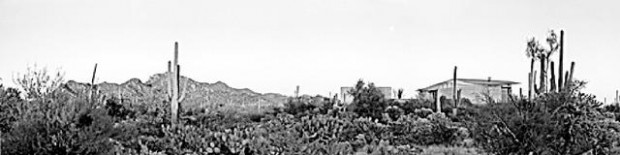
The Tucson architectural firm of Rick Joy won its American Architecture Award from the Chicago Athenaeum: Museum of Architecture and Design, for Avra Verde, a design concept for seven homes to be built around a renovated hacienda in Avra Valley near Saguaro National Park.
Two Phoenix firms won one of the 66 awards announced this week for their design of Moving Memories: the Arizona 9/11 Memorial. That memorial, which showcased a variety of reactions to the terror attacks of Sept. 11, 2001, came under political attack after its completion two years ago.
The contest jury, a panel of Greek architects who convened in Athens, was aware of the controversy, said Athenaeum director Christian Markiewicz-Laine. "It was one of the most talked-about entries," he said. "The jury supported the architects' including all of the thoughts of all of the people," he said.
People are also reading…
It was the second international award for the Memorial design, said Matthew Salenger of coLAB Studio, the Tempe firm that shared the prize with Jones Studio of Phoenix. It also won a prize in last year's London Creative Competition, he said.
Salenger called the furor over some of the memorial's content "overblown by the media."
He said people who visited the memorial without knowing about the controversy did not find the wording on it objectionable.
The memorial was built with $600,000 in private money but sits on state land across from the Capitol in Wesley Bolin Plaza in Phoenix.
The same citizens commission formed to choose the thoughts and timeline for the memorial ultimately decided to excise two of the comments. The memorial recently reopened after a $50,000 revision.
The Avra Verde project is a group of homes, which Joy calls "pavilions," arranged around an existing hacienda on a 50-acre plot west of Tucson that borders Saguaro National Park and the Arizona-Sonora Desert Museum.
Project architect Phillipp Neher said it was too early in the process to quote a price, but that the pavilions would be "high-end" residences. Each will occupy only 3 percent of its five-acre site, he said. Each would also share ownership of the hacienda, which will be remodeled into a community space, with guest rooms for visitors and a live-in caretaker, Neher said.
Neher said the firm has asked Pima County to treat Avra Verde as a "pilot project" in ecologically sensitive design and exempt it from subdivision requirements that would dictate, among other things, paved roads and detention basins.
Each pavilion will have its own water-harvesting system and photovoltaic panels capable of generating 5 kilowatts of power, Neher said.
Carla Blackwell, deputy director of Pima County Development Services, said the county is working with Avra Verde to ease some restrictions. "We're looking at, instead of asphalt, what else can we use? Can we have a smaller development footprint? Handle rainwater in different ways?"
Blackwell said the exercise might result in a new way of looking at small subdivisions in rural areas and possibly an ordinance that would drop some standards in return for a more sensitive approach to development.
In areas such as Avra Valley, where unregulated lot splitting has been the norm, it could lead to better development, she said. "It's an opportunity to look at it in terms of sustainability and green-building standards."
to learn more
Architect Phillipp Neher of Rick Joy Architects will speak today at MOCA on the Plaza on the subject: "Urban Desires: Why Live Here?"
The talk is part of MOCA's (Museum of Contemporary Art) Invisible City series.
When: 3 p.m. today.
Where: MOCA on the Plaza, 149 N. Stone Ave.
Fee: $5.
Information: 624-5019 or www.moca-tucson.org

 Faculty concerned about changes to U of A admissions policy