

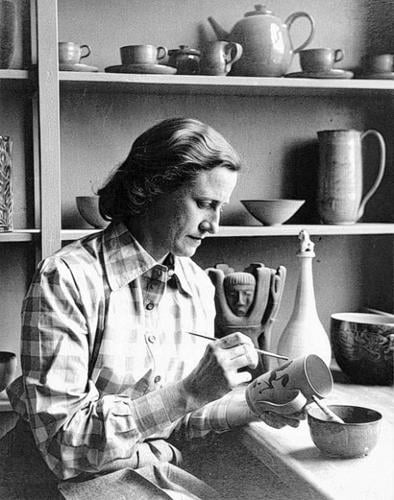
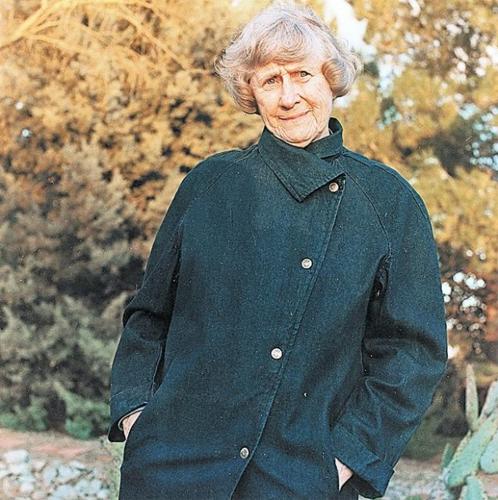
With strong hands and long, elegant fingers, ceramics artist Mary Scheier formed lumps of clay into delicate yet utilitarian pottery.
Her pitchers, vases and bowls are sought by ceramics collectors and museum curators.
She and her husband, Edwin Scheier, were at the forefront of the studio pottery movement from the 1930s to the 1960s with their award-winning designs that now can be seen in more than 50 museums around the world, including New York's Museum of Modern Art.
"They were real giants at the time," said Susan Strickler, director of the Currier Museum of Art in Manchester, N.H., which has a collection of their pottery.
The Scheiers' nearly 70-year collaboration ended May 14 when Mary Scheier died at age 99 in Green Valley. Her husband, Edwin Scheier, 96, survives her.
People are also reading…
Mary Goldsmith met her future husband in 1937. A Virginia native, she had studied art in New York and Paris. In 1935 she was appointed director of the Big Stone Gap and Abingdon Art Centers — the first federally funded art galleries in Virginia — where she organized art classes for local schools. It was part of the Works Progress Administration to provide employment for artists during the Great Depression.
It was in the coal mining town of Big Stone Gap that Goldsmith met Scheier. He was a field supervisor for the Federal Art Project — a division of the W.P.A.
Their connection was inexplicable, said Scheier, and within two months they decided to get married.
Shortly after they wed, the couple resigned their positions and hit the road, giving puppet shows to workers in the Civilian Conservation Corps — another Depression-era jobs program. They made their own puppets, mostly from papier-mâché, and traded tickets to their shows for food.
"We enjoyed doing what we were doing, but we couldn't quite earn a living," Edwin Scheier said.
After a year with their travelling puppet show, Edwin took a job as director of a federal art center in Tennessee. That's when the couple began experimenting with ceramics, fashioning their first potter's wheel from parts off an old Ford Model T and a kiln from an oil drum.
In less than a year the couple opened their first ceramics studio — Hillcrock Pottery — in an old log cabin. They dug their own clay and made and sold their functional pottery.
"They were at the forefront of establishing the studio pottery movement," Strickler said.
Within a year they started winning national awards at ceramics exhibitions and were invited to teach at the University of New Hampshire. During their 20 years at the university, the Scheiers continued to make their own distinctive pottery.
"Mary's work is distinguished by the elegance and thinness of the vessels she was able to throw," Strickler said. "The shapes are really quite exquisite in their form. They are really simple, but really exquisite. I've seen footage of her throwing pots and it seemed so effortless."
Author Michael Komanecky, of Pennsylvania, saw the 1940s-era footage, too, when he was writing the 1993 book: "American Potters: Mary and Edwin Scheier."
"She was throwing a pitcher . . . on the wheel and it was a thing of beauty to watch her raise that pitcher from a ball of clay with incredible confidence and self-assurance," he said. "Mary quickly became — through hard work and a lot of practice — one of the most accomplished potters on the wheel that our country has ever seen."
"She was an exceptionally talented thrower," Edwin Scheier said. "We worked together on some things, but most things we did on our own. We had quite different styles. She . . . was well known for quite delicate throwing. I did larger pieces."
Thirty years of kneading clay and throwing pots took its toll on Mary Scheier, however. In her early days, she would make as many as 200 pieces a day, according to a 2001 Phoenix New Times article. By the time the couple retired to Oaxaca, Mexico, in 1968 — a town they had visited on several occasions — she had severe arthritis.
It was difficult for Mary to give up ceramics, her husband said. "She certainly missed the pottery."
After a decade of living in Oaxaca, the couple returned to the United States in 1978 and moved to Green Valley.
In the late 1990s, macular degeneration began affecting Mary Scheier's eyesight.
At a 2001 screening of "Four Hands One Heart" — a documentary about the couple — she needed binoculars to see the screen from the front row of the theater in their retirement community, the New Times article said.
Even though Mary Scheier had been unable to throw pots for almost 35 years, and her husband had stopped making ceramics in the early 1990s, they were given a living treasure award in 2003 by the governor of New Hampshire.
Just days before Mary's death, they received the Lifetime Achievement Award from the League of New Hampshire Craftsmen.
"The Scheiers were two of the most important American potters of their generation," Komanecky said. Mary's death "was a great loss for American ceramics."

 Faculty concerned about changes to U of A admissions policy


