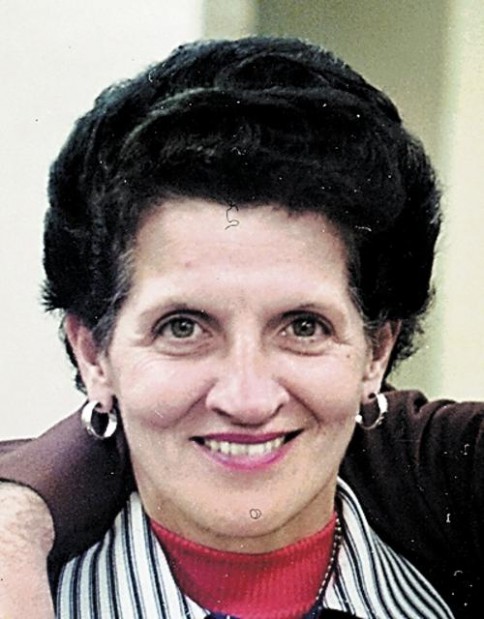
Lina Caccavale was a fixture in her Southeast Side retirement community.
Neighbors knew her as "the lady who was always walking."
At least once every day, she traipsed down each street in The Cove community and the adjacent Voyager RV Resort, greeting everyone she met.
Inclement weather didn't slow Caccavale. If it was windy or rainy, she'd snap on the radio and walk laps for an hour inside her two-car garage, said her son, Sal Caccavale.
If she had a cold and stayed home for a few days to recuperate, neighbors worried.
"Everybody was concerned if they didn't see her walking," said neighbor Ginny Heyes.
Every once in a while, a neighbor still asks friend Jean Huston what happened to the walking lady.
People are also reading…
Caccavale's exercise regimen was curtailed several years ago when dementia and Alzheimer's disease took hold. She died April 9 at age 81.
Born Lina Mastrogiacomo, she was the first daughter of Italian immigrants Vito and Giustina, who raised their children in one of Chicago's Italian neighborhoods.
Their home was close enough to Lake Michigan that Lina, her sister Eleanor and their friends often walked there.
"It was the Depression. We didn't have money, so we'd walk down to the lake. We entertained ourselves in those days," her sister said. "As kids, we had a lot of energy. We played baseball, volleyball. That energy remains with you, too, if you continue with it."
The sisters were born just 11 1/2 months apart. Eleanor was the younger.
"It was kind of funny," she said. "For two weeks (each year), we were the same age."
The sisters' connection deepened when they married brothers from the neighborhood.
Lina wed Sam Caccavale, the first son of Italian immigrants, in 1946. In 1961, the Caccavales — who by then had two sons, Sal and Robert — moved to Tucson, where Sam was transferred by his employer.
It was here that the couple became active in the local Italian-American club and, at Lina's insistence, took up square dancing and round dancing.
"They'd dance at least twice a week," Sal Caccavale said. "My dad was never much of a dancer, but she got my dad into round dancing . . . and it kind of went from there. They learned to square dance as well. My mom had the petticoats, and my dad had the (Western) shirts."
Lina had been raised in a traditional Italian home, and family was of utmost importance.
"She was somewhat Old World in a lot of things because of her upbringing," her son said. "When she started kindergarten, she couldn't even speak English. They only spoke Italian at home."
As an adult, "being of Italian descent, she kept a very tidy house, led a very scheduled life," he said. "Her strongest trait was being a good mom and grandma."
His mother didn't even possess a driver's license until her late 40s and took lessons from the Sears driving school. But she preferred walking.
When Sam Caccavale died in 1980, Lina cut back on her involvement in community activities, but she still found time to take walks with friends, sometimes around the track at the nearby high school.
In the mid-1990s, she moved to The Cove community and began walking in earnest, up to six miles a day.
With the sun shining on her wavy, silver-white hair and flip-flops on her feet, Caccavale was hard to miss.
"She never wore a walking shoe," her son said. "We tried to get her some a couple of times, but they never struck her fancy."
Jean Huston and her husband, Jerry, met Caccavale when they moved to The Cove 11 years ago.
"Everybody knew Lina by sight. They may not have known her name, but they knew her as the lady who always walked," Huston said. "She didn't like to walk with anybody. She didn't want to break her stride. If she was close to home, she'd stop and talk, but if she was walking, she'd wave and she wouldn't stop."
Huston said her neighbor started each day at 4 a.m. by doing chores. Then she walked.
And at 4 o'clock each afternoon, she'd sit down for coffee, cookies and socializing, often with her sister, who moved to The Cove for five years before returning to Chicago.
"I asked her one day, 'Lina, where do you get all this energy?' She said: 'I get it from peanut butter and cookies. I love them. I eat them every day, sometimes twice a day,' " Huston said.
"She liked her peanut butter in the jar. She'd just open up the jar and scoop out some peanut butter with a spoon.
"She had three or four jars of peanut butter on hand at a time. I tried it for a week, but it didn't do for me what it did for Lina," Huston said.
Caccavale was as well-known in her neighborhood for her collection of salt and pepper shakers as she was for her walking.
Over the course of 50 or so years, she amassed 900 sets of shakers. It started in the 1950s when her husband returned home from a business trip bearing two sets as gifts.
Since then, family members and friends had given her shakers for holidays and picked them up for Caccavale when on vacation.
She had them displayed throughout her home, on shelves, counters, bookcases and in china cabinets.
Covered wagons and cactus plants, bowling pins and baked potatoes, tiny cottages and tiki gods, ladybugs and lovebirds, kitty cats and cartoon characters, windmills and whale tails, cheese graters and chipmunks, snowmen and seashells, teapots and telephones, cable cars and coffee cups.
Not to mention: pineapples and pilgrims, elephants and Easter eggs, sandwiches and space shuttles, octopuses and onions, pancakes and pine cones, frying pans and funky feet, washing machines and watering cans, streetlamps and starfish, alligators and apple crates, buffaloes and blue suede shoes, spaghetti bowls and Space Needles, potbellied stoves and palm trees, dolphins and Dutch kids, burgers and bears, Santas and sombreros, railroad crossings and roosters, skyscrapers and sea lions, boots and bananas, clothing irons and coffee grinders, sad-sack clowns and slot machines, livestock and leprechauns.
"Anybody who wanted to see her salt and pepper shakers, she was thrilled," Huston said.
Caccavale told her she never tired of dusting her shakers because as she polished each set, she thought of the person who gave it to her and remembered the good times they shared.
"She could tell you who gave her every single one of them," Huston said. "Those were her treasures."
LIFE STORIES
This feature chronicles the lives of recently deceased Tucsonans. Some were well-known across the community. Others had an impact on a smaller sphere of friends, family and acquaintances. Many of these people led interesting — and sometimes extraordinary — lives with little or no fanfare. Now you'll hear their stories. Past "Life Stories" are online at go.azstarnet. com/lifestories.

 Plans floated to reopen San Manuel Mine as part of regional copper development