
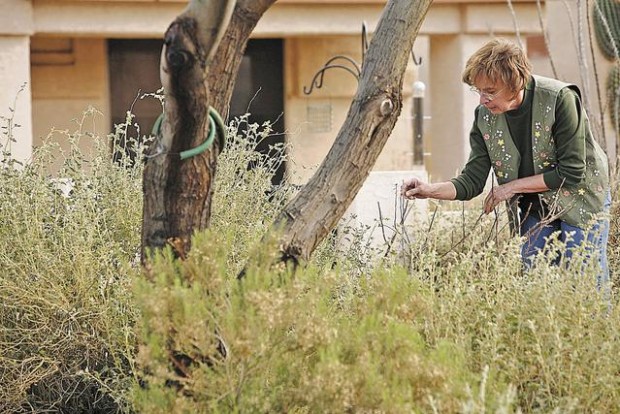
Marilyn Hanson planted pinkish violet, native Arizona wildflowers next to her Continental Ranch driveway in hopes of drawing butterflies.
She got them — 20 species, in fact. But now her yard may draw fines of $25 to $100 and up, as well.
Her neighborhood's homeowners association in Marana says those flowers look like weeds when they aren't blooming. The association rules require homeowners to keep yards clear of weeds.
Hanson says she won't pay the fines because the association hasn't scientifically defined what it means by weeds.
"It's outrageous," she said with a sigh, as she bent over the now-dormant wildflowers, called Arizona foldwing. They bloom a lush purple in the spring from water out of her drip-irrigation system. "These are native plants. This is a natural-habitat garden."
People are also reading…
Her front and back yards were written up last year in Phoenix Home and Garden Magazine, which said Hanson "embraces the Sonoran Desert with a landscape rich in indigenous plants."
But Al Stark, a committee chair of her homeowners association, said wildflowers "look like weeds when they are growing, are beautiful when they bloom, but when they die they look like weeds and garbage again."
Most of the yards in Continental Ranch, just west of the Santa Cruz River and north of Cortaro Road, have desert landscaping, he said.
"I know wildflowers are part of that and there are times when they look like weeds. You can't tell the difference. ... I drove by her place and I wouldn't want her as a neighbor. She may think it's nice but it looked trashy to me," he added.
Stark chairs the association's Covenants Committee, which recommended last week that Hanson be found in violation of the association's restrictions against weeds.
Hanson's case has drawn support from the Tucson Botanical Gardens and the Arizona Native Plant Society.
And in Continental Ranch, the tussle over Hanson's wildflowers is but one of many disputes that has rained harsh criticism onto the homeowners' group from other residents as an organization that has overstepped its bounds.
At a board meeting this week, homeowner Jerry Hairston likened the group to the Gestapo, as he tried to avoid a citation for trees that the association said were planted too close to a boundary fence.
Russell Clanagan, who served as association board president for a year, said he worked closely with management and staff. "I saw firsthand the way they bullied and intimidated people," he said. Clanagan remains on the board after leaving the presidency recently.
Other board members say they are simply trying to carry out rules that the group adopted long ago.
"The board is looking out for the best interests of the community at large," said Nicole Glasner, the board's second vice president. "Those are the rules. If people want to change them, they can join the committee. They have a voice, if they can get enough people to vote."
Everybody who lives there must sign a paper saying they have read the association's various covenants and restrictions and agree with them, association board member Gunter Haussler said.
"Personally, I looked for an association with rules, and I live by the rules and if I cannot live by the rules, I guess I move," Haussler said.
Some other recent association cases:
● At Tuesday's board meeting, the group upheld a fine against resident Adi Halili for having a lime bush in his front yard. Association rules prohibit citrus plants outside backyards. Halili removed the bush in January — after the association warned he would be fined at least $250 after refusing to obey previous notices telling him to take it out.
● A case is pending involving a couple seeking a variance from association rules forbidding on-street parking. They want to be allowed to park their van in a spot where it is easy for the driver to get his wheelchair rolling on a flat surface. Otherwise, the couple must park on a sloping driveway.
● At the same meeting, the board granted resident Hairston's request for a waiver of association rules forbidding planting of trees too close to a boundary fence because his palm trees had been next to a fence long before he had bought the house. It also granted two other residents waivers of association rules forbidding the placement of concrete strips between a sidewalk and a curb.
● In a 2005 case similar to Hanson's, resident Dan Anderson removed a yardful of blue, yellow and white wildflowers after the association told him they were in violation.
Anderson said this week that he felt frustrated and powerless about having to remove the flowers.
"The problem with the HOAs is that they don't answer to anyone," said Anderson. "They make their decisions — there is nothing you can do about it."
The association was being dictatorial because it never told Hanson which plants of hers are in violation, said Nancy Zierenberg, an administrative assistant for the Arizona Native Plant Society.
Hanson said she is frustrated because the association's list of permitted plants includes four non-native ones, including the highly invasive tamarisk tree and the rhus lancea or African sumac.
The association, for its part, laid out its views on weeds in its July 2005 newsletter, saying wildflowers are not an approved plant in Continental Ranch.
"These particular flowers are beautiful when they are in bloom but with many drawbacks," the association wrote.
Besides their weedlike appearance after the flowers die, the association wrote: "Their seeds spread, and the next thing you know, everyone on the block has wildflowers whether they want them or not. ... Be proactive and spray them now before the rains hit."