

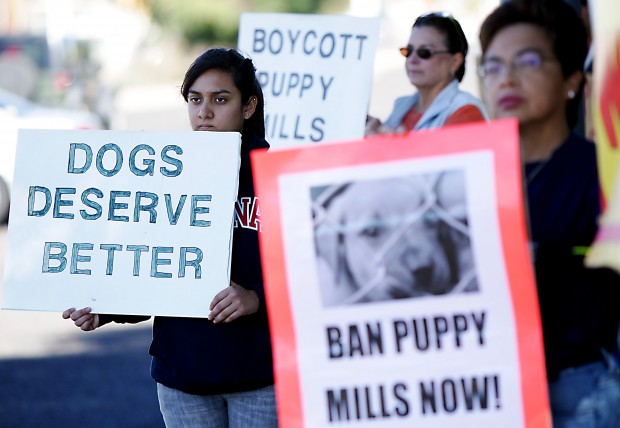
For animal advocate Jamie Massey, there's a simple reason why he wages war against "puppy mills" - the mass-breeding operations often criticized as being inhumane.
"Just about everybody loves dogs," Massey said. "They have a special status among animals; they're part of the family. And most people who buy a pet from a pet store have no idea where the animals come from."
For Massey, who was involved in last year's campaign targeting the now-closed Petland Inc. stores, the opening salvo in the next battle came Nov. 20 with a demonstration at Animal Kingdom, a northwest-side pet store.
He said he wants the business to stop buying pets from a company that has been accused of selling animals from puppy mills.
Amanda Sobieski, the manager of Animal Kingdom, said the store goes to great lengths to ensure the health and quality of the dogs it sells.
People are also reading…
"Our company is here to sell a healthy companion," Sobieski said, "not just a dog."
Massey described puppy mills as large, corporate-run operations where animals are bred in huge numbers for eventual sale.
"They don't have to get any exercise; they don't have to get any veterinary care," Massey said. "All of the citations for puppy mills are for small cages, no food or no water. And that's not the full extent of the problem."
To Massey, one of the biggest issues with puppy mills is the lack of oversight for the breeding industry.
"The USDA has very lax standards," Massey said. "People hear about puppy-mill puppies being inbred, having separation anxiety because they're never separated (properly) from Mom, but it's more the breeding stock that is the tragedy. The puppies get out of there pretty soon, but Mom's in there for years."
Specifically, Massey focuses on those stores that receive puppies from the Hunte Corp. in Missouri. Hunte, one of the largest providers of puppies to pet stores nationwide, has long been accused of buying from puppy mills - allegations that the company has repeatedly denied.
On its website, Hunte says it adheres to all standards required by the U.S. Department of Agriculture, the American Kennel Club and Missouri state law.
Massey was at the center of several protests last year targeting Petland stores in Tucson. The Humane Society of the United States asserted that the stores received mistreated or mishandled puppies from puppy mills. The two branches of Petland closed shortly thereafter.
"You can't know just walking into a store whether or not you're buying a puppy-mill puppy," Massey said.
Both Hunte and Petland are currently the subjects of a class-action lawsuit filed by customers who claim they were misled about the health of puppies they bought. Most of those claims have been dismissed due to insufficient evidence of wrongdoing.
Although Petland no longer operates in Tucson, Massey said there are other pet stores here that buy animals from Hunte.
He said he has met with the managers of both the Desert Pet and Animal Kingdom stores, and both acknowledged having bought animals from Hunte.
Massey said he doesn't contend that all puppies sold in pet stores come from puppy mills, but "generally, good breeders don't sell to pet stores."
Sobieski said all Animal Kingdom dogs go through a thorough vetting process, and three veterinarians examine each dog.
"We examine everything from joints and hair loss to making sure dew claws are removed, (and) that there are no hernias," Sobieski said. "It's a pretty comprehensive process, and we get three different opinions on each animal."
Sobieski said Animal Kingdom also would never accept dogs from breeders in Arizona, due to the lack of state laws prohibiting the type of animal treatment Massey described.
"Basically, Arizona can have puppy mills; there's no restrictions on breeding here," Sobieski said. "So to be 100 percent safe, we always buy animals from states that have those kinds of restrictions."
The owner of Desert Pet, Bill Conroy, said his store would buy in-state animals, though its sources of pets depend on public demand and breed popularity.
"It depends a lot on adoption demands, what people are looking for," Conroy said. "We're here to try and fill the needs of the people of Tucson."
Where they buy their dogs may differ, but Desert Pet has equally stringent processes to ensure the health of its dogs.
"We perform a general health check daily and record those in a log," Conroy said. "If a dog appears to be unhealthy, we get them (dogs) checked to make sure (whether) they are sick or just stressed. In a couple of cases, we've paid thousands of dollars to get a dog healthy. Sometimes we lose money on them when we sell them for hundreds. It's more about caring for the dog than anything."
Massey said Desert Pet, which confirmed to him that it buys animals from Hunte, is not the focus of protests because it currently has no dogs for sale.
Luke Money is a University of Arizona journalism student apprenticing at the Star. He can be reached at 573-4142 or at starapprentice@azstarnet.com

 Plans floated to reopen San Manuel Mine as part of regional copper development


