
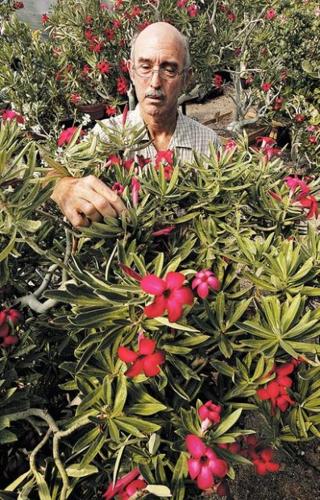
In Tucson, a handful of people know the work of Mark Dimmitt, a horticulturist who breeds adeniums, a little-known succulent plant. But in Taiwan and other Asian countries, Dimmitt has almost rock-star status for his hybridization successes.
In Thailand, he gets special treatment from his fellow horticulturists. In Taiwan, some breeders gave Dimmitt a special name for breeding a popular adenium as one of the first with patterned flowers.
"I am the grandfather of Harry Potter," Dimmitt said of the adenium hybrid that came from a plant he sent to Taiwan in 1999.
Such is the global stature of Dimmitt, 62, director of natural history at the Arizona-Sonora Desert Museum.
I went to see him and his plants at his five-acre West Side home of nearly 30 years. Spread around his property are some 10,000 inventoried plants inside and outside his two greenhouses. But it's his 1,000 or so adeniums that he cultivates and pampers.
People are also reading…
"This is the only plant I can think of," said Dimmitt, who has created and named about 200 "cultivars," plants that are derived from stem cuttings rather than seeds.
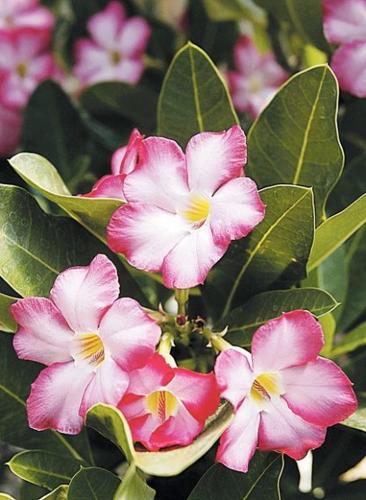
The adenium is sometimes known as the desert rose for its brilliant red, pink, white and purple flowers. But Dimmitt said the name is a misnomer. The plant is neither a rose nor a desert plant, he said.
It is a tropical plant native to many areas in Africa, from the south to the north. Some wild species are found in Yemen and other parts of the Arabian Peninsula.
It is bred commercially and widely grown in gardens in Asia, primarily in Thailand, Taiwan and Indonesia. In this country, the plant's popularity is beginning to grow, he said.
Much of the plant's popularity is connected to Dimmitt.
He saw his first adenium in the late 1960s in a locked greenhouse at UCLA, where he was a graduate student. The plant was in full bloom with pink flowers, its natural color. He asked about the plant. No one knew what is was or who owned it, he said.
After some sleuthing, Dimmitt found it was an adenium, a rare plant at the time.
"They didn't know how to grow them. They thought they were delicate," he said.
Dimmitt learned how to grow the hardy plant. He also realized his passion.
Years earlier, Dimmitt discovered his love for plants while growing up in Southern California and running loose in his grandparents' gardens.
"I had 'Lucy in the Sky With Diamonds' experiences decades before the Beatles," he said.
He was hooked on plants.
Dimmitt also was hooked on Tucson, which he remembered driving through as a kid with his parents. The desert landscape stuck with him, and he promised himself he would live here someday.
In 1979, after earning a doctorate degree in zoology, Dimmitt came to Tucson as the Desert Museum's curator of botany. Along with him came 20 adeniums.
Their flowers were typical pink, but Dimmitt, who loves brilliant colors, wanted a red adenium. He began hybridizing and waiting.
In 1982, Dimmitt saw his first red flower. More vibrant reds were to come from his breeding practices.
Today's deep reds make his first red look "like a real dog." His favorite is the deep-red Crimson Star.
Dimmitt said that when he began creating new varieties, adenium breeding was at its nascent stage. Breeding was virtually unknown in the 1970s and began in earnest in the mid-'80s in Thailand and Taiwan.
"Horticulture in Thailand is like football in this country," he said.
Today large-scale Asian commercial operations dwarf U.S. breeders. Dimmitt's efforts hardly pay for his costs, which include large quantities of water. The adenium requires frequent watering in the Tucson summer but can go unwatered for much of the winter. However, the plant needs to be potted and taken indoors during the winter, he said.
His long-term goal is to create a good, red adenium with a large and perfect base. "The thicker, the better, and fast-growing," said Dimmitt, who has written articles and is near publication on a new book on his fave plant.
He desires a circular flower with intense color, which will bloom year-round. The flower will be red, of course.
Dimmitt is optimistic the adenium's popularity will grow as an ornamental plant in this country. While few nurseries carry the plant, he said its development is in its infancy.
The rose, for example, has been cultivated for hundreds of years. The commercial adenium is less than 30 years old.
"This is a new plant to be domesticated," he said.
Grandfather knows best.
DID YOU KNOW
There are three adenium breeders in Tucson, the most in any city in the country. There are two in Florida.
Adeniums are tropical plants native to Africa and the Arabian Peninsula. But the rock trumpet adenium can be found in the grasslands of Sonoita, Elgin and other parts of Southeastern Arizona. It blossoms several times during the summer rainy season.
Source: Mark Dimmitt
Online
Find out more about adenium breeding at Mark Dimmit's Web site, adenium.tucsoncactus.org.