Mexico has quietly become the main entry point for Cubans aiming to touch American soil, where they’re allowed to stay and apply for permanent residence a year later.
The trend has accelerated over the past five years — long before President Obama began talks of normalizing relations with Cuba.
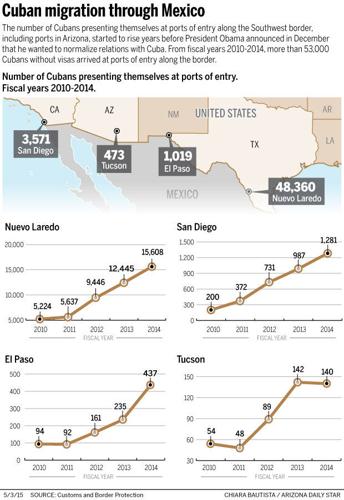
The number of Cubans without a visa who present themselves at ports of entry along the Southwest border has increased from less than 6,000 in 2010 to 17,500 last fiscal year, Customs and Border Protection data show. As of December, the first quarter of the fiscal year, nearly 6,500 have come through Mexico.
Many more are entering through Mexico than Miami, the more traditional route, in part because of tighter enforcement on the coast. Cubans seeking to flee their government come here to take advantage of the United States’ “wet-foot, dry-foot” policy, which allows them to stay once they reach the U.S. The practice is so common that Cuban migrants even gave it a nickname: “dusty foots.”
People are also reading…
For Cubans who can afford it, hiring a smuggler to travel to Mexico is more effective and easier than taking a boat ride to Miami, said Marc Rosenblum, deputy director of the U.S. immigration policy program for the Migration Policy Institute.
After an initial round of Cubans successfully made the journey through Mexico, he said, word spread of a potential new pathway and a smuggling system rose up to help migrants come to the United States. The same has happened with other migration patterns, like last summer’s surge in women and children arriving from Central America.
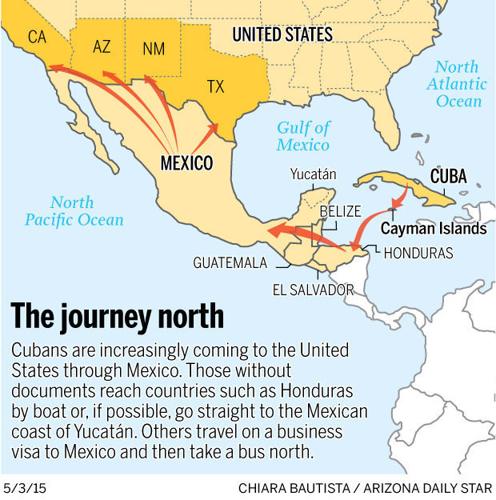
The more than 2,000-mile journey from Cuba to the Cayman Islands, Honduras, Guatemala, Mexico and the U.S. border can take up to four months, with stops along the way to work and raise money for the next leg of the trip.
As with other migrants, Cubans risk being kidnapped or deported along the way, and are often extorted by criminal gangs or the police.
SEEKING FREEDOM
Cubans with money can fly to countries such as Brazil or even Mexico on a business visa and from there take a bus to the U.S. border, where they present themselves at a port of entry and ask for asylum.
That’s what Patricia Espinosa did 10 years ago when she left her native Cuba to take part in a conference at a university in northern Mexico.
In Cuba, she worked as an agricultural engineer and researcher.
“I was actively looking for an event,” she said. “Because of my job, I had the possibility of legally leaving Cuba with my passport and that’s how I did it.”
Espinosa, now 40 and a University of Arizona graduate student and employee, was in a long-distance relationship for six years with her current spouse before that trip to Mexico.
“If I had been openly lesbian in Cuba, my professional career would have ended,” she said. “I wouldn’t have gone beyond being a researcher.”
But she couldn’t bring herself to climb aboard a homemade raft, as many do.
“You hear so many stories of people who have drowned at sea,” she said. “I didn’t want to be one of them.”
So she took a bus from Monterrey to Juarez, across from El Paso, and on Dec. 12, 2004, she presented herself at the port of entry.
Back then, few Cubans were showing up at ports of entry seeking asylum. The Havana Times, an independent online news outlet, reported that 6,000 Cubans sought asylum at ports of entry along the Southwest border that year.
Espinosa was detained for five days while her claim was processed. She later joined her partner here in Tucson.
Since then, the practice of using Mexico as a way to the United States has become more popular.
The word in Cuba is that it is becoming increasingly difficult to escape Bahamian and U.S. authorities. Migrants know that if they get caught, they will be sent back. Everything they’ve risked will be for nothing.
Over the last decade, more than 17,000 Cubans have been interdicted at sea by the U.S. Coast Guard. Apart from a period between 2009 and 2011, most years saw between 1,000 and 3,000 people detained trying to leave the island.
Once you make it to Mexico, Espinosa said, you essentially have a secure passage to the United States.
“I’M PROTECTED”
In the last five years, ports of entry west of Laredo, Texas, have seen the highest share of Cubans seeking asylum. But in places like San Diego, the rise has been more stark — a 500 percent increase from 200 in 2010 to nearly 1,300 last fiscal year.
Arizona’s ports of entry have also seen an increase, from 54 in fiscal year 2010 to 140 last fiscal year. As of January, another 88 had presented themselves at Arizona ports of entry.
Yasel Mendoza, 41, arrived at the Nogales port of entry in 2007.
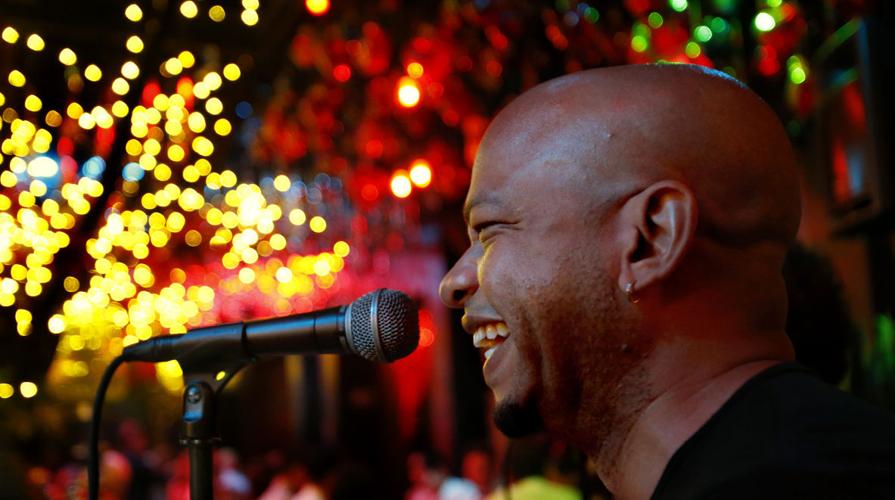
The Cuban singer didn’t leave his native country with the intention of coming to the United States, he said. He came to Sonora to perform and give workshops with his ensemble.
But once in Mexico, he said, his group disintegrated. Two of the members decided to stay in Mexico, another came to the U.S. and one went back to Cuba. He decided to follow the one who came here.
Had he gone back to Cuba, “I would have been a member of a group that betrayed the ideals of a system.”
He also fell in love with a woman from Hermosillo, whom he later married. They now have two small children.
Last month Mendoza became a U.S. citizen. It was a way to thank the country that opened its doors to him, he said, and a gift to himself.
“I am not alone anymore,” he said. “I now know I’m protected, that I belong to something and that something will protect me.”
WHY CUBANS LEAVE
Current migration trends in Cuba are similar to those from other sending countries.
A small share of Cubans come as refugees, meaning they were interviewed in their home country and able to prove they were members of a persecuted group, including religious minorities, human rights activists and former political prisoners. In 2013, the latest year records are available, 4,200 Cubans arrived this way.
But, increasingly, Cubans are coming without visas to reunite with family members here and for economic reasons.
Life is hard in Cuba, Mendoza and Espinosa say.
Espinosa comes from an educated family. Her mother was a university professor for 40 years. Her brother is head of a company; his wife a college professor. Still, they couldn’t make ends meet without the money she sends back home.
“My brother and his wife make about $65 a month,” she said, “when they need three times as much to cover their basic needs.”
In December the Obama administration said that after 50 years the United States wanted to normalize its relationship with Cuba — including removing it from the list of state sponsors of terrorism, reopening embassies and easing barriers to commerce and travel.
Since then, the question of what to do with the 1966 Cuban Adjustment Act continues to pop up. There’s an increasing perception that Cubans take advantage of the act — which provides for a special procedure under which Cuban natives or citizens and their spouses and children may achieve permanent residence — even though they don’t fit the criteria of being traditional refugees and don’t fear persecution, said Rosenblum, of the D.C.-based Migration Policy Institute.
Upon receiving their permanent residence cards, he said, one of the first things some do is visit Cuba.
Also, “it’s difficult for the countries to have normal diplomatic relations and for the United States to maintain a policy where anyone who flees is considered a refugee,” he said.
As there is freer travel between both countries, he said, it may be easier for Cubans to take advantage of the policy, which will in turn put more pressure on the act. But it’s not likely that will change any time soon — and that has a lot to do with politics.
“Constituents, including some Cuban-Americans and others critical of the Cuban government, continue to see this policy is valuable as a humanitarian tool,” Rosenblum said.
Florida, home to many Cuban-Americans, is a swing state and both parties will be competing for their vote.
Mendoza said he was the happiest man on Earth last Dec. 17, when Obama said he wanted to normalize relations with the Castro government.
“It means we are no longer enemies,” he said, and that will increase commerce, tourism and employment. “That will be reflected on the table of the average Cuban.”
But Mendoza thinks the “wet-foot, dry-foot” policy should remain in place. Cuba will never be a fully open or democratic nation where people can truly express themselves, he said.
For Espinosa, who also supports a more open relationship with her native country, there’s always the possibility that the Adjustment Act, as it’s known, should change to offer new alternatives.
“There are so many Cubans already here in the United States that there can be other ways Cubans can come here,” she said. “Perhaps it can now be easier for Cubans to come here on a visa.”
Whatever happens, she said, “I just hope all of these changes are for the good of the island and that it helps the economy so people can survive.”