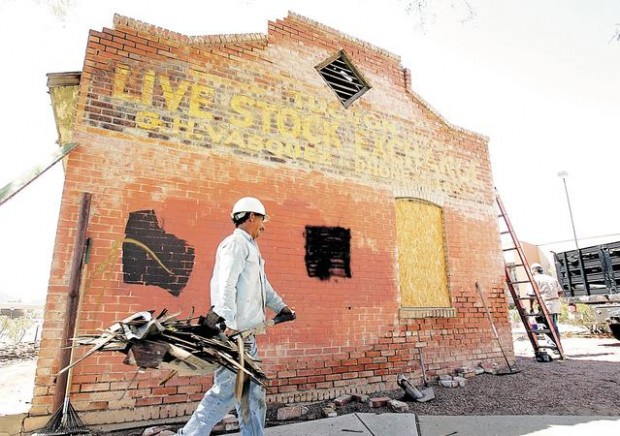
It's just an old brick building, with boarded-up windows and fading letters painted on the wall.
But, oh, what it represents.
"It was the center of all Southern Arizona livestock, where everybody congregated," says Dick Pacheco.
Back in the late '60s, Pacheco ran the old Tucson Livestock Exchange out of that building on West 29th Street, just east of the railroad tracks.
For decades, it served as the hub where ranchers bought and sold their cattle and horses, as well as burros and the occasional goat.
The bawling cows and milling crowds are long gone, replaced by a community behavioral health center, La Frontera, which bought the property at 504 W. 29th St. in 1979.
Though not designated as historic, the little brick building — the last vestige of the exchange — still stands.
People are also reading…
At first there was talk of turning it into a children's library. Later came the idea of remodeling it for the fundraising that La Frontera does for its annual international mariachi conference.
"But we found out there were no waste- or waterlines there, and it would cost too much to tap into the closest sewer line," says Elvira Bustamante, La Frontera's facilities director.
Meanwhile, only the pigeons seemed to have found a use for the building, flitting in through a partially destroyed roof. It became, says Bustamante, "a humongous pigeon coop."
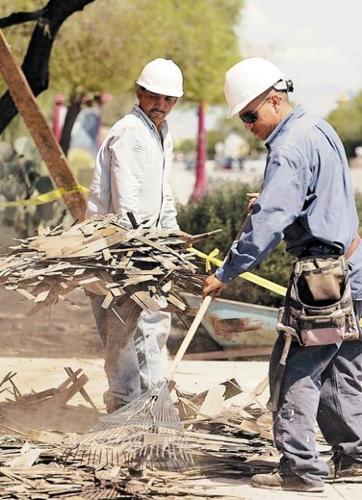
No more. Late last month, a temporary roof was installed. "In the future, when there are funds to remodel, we can put in wood shingles like it had before," says Bustamante.
Money for the temporary roof — $4,000 — came from a grant from the National Trust for Historic Preservation. It was written by Mick Jensen, a student in the graduate planning program at the University of Arizona. He also serves as planning intern for the city of South Tucson, where the building is located.
"This community grew up around cattle," says Jensen. It also grew up around the railroad, whose rails once carried cattle right from the old stock exchange to other markets.
Pat King, whose father, Joe King, ran the King Anvil Ranch and was at one time an owner of the old livestock exchange, remembers the family stopping by the exchange at night during the 1940s.
"I can remember them loading cattle through the chute into the railroad car to go to Kansas City. It was nighttime, dusty, and the cattle were bawling."
The tracks where those cattle were loaded have long fallen into disuse as part of the old El Paso and Southwestern Railroad.
But their historical significance lingers on in the form of the El Paso and Southwestern Greenway, a six-mile-long path for bicyclists and pedestrians that will roughly parallel the tracks from downtown Tucson to the Kino Sports Complex on East Ajo Way.
Now in the master-planning phase, the greenway should one day snake right by the old livestock exchange and its former office building.
Jensen is hoping that the building eventually could serve as a rest stop for bicyclists, as well as a museum harking back to its livestock-trading days. "The next step is an architectural assessment and cost estimate," he says.
Only a portion of the greenway has been funded so far, with nothing funded to enhance the old livestock exchange building, says Tom Thivener, project manager for the greenway.
But he agrees that the greenway project and the building both share a storied history.
Gus Vasquez, son of pioneer Tucson carriage maker Adolfo Vasquez, is the man most credited with starting up the exchange when he bought the property in 1938.
His widow, Anita Vasquez, told me back in 1992 that Gus, along with Jerry Martin, who also held the property for a short time, built corrals out of railroad ties and filled them with cattle.
Already, the little brick building, along with several adobe structures, stood on the land.
In the early '50s, Gus Vasquez built his auction house, and veteran rodeo announcer and auctioneer Gene Payne ran his operation there for a time.
In 1957, Payne moved on, and Gus Vasquez died. The next year, his widow sold the property to Alfonso "Chapo" Aguirre.
"Chapo only did Mexican cattle. I bought some Mexican cattle from him. He would be at his desk, smoking a cigar," says Gus Amado, a member of the pioneer Amado ranching family.
By the mid-1960s, the property was in the hands of the King and Pacheco families, namely Joe King and Richard M. Pacheco, both now deceased.
In the late '60s, Dick Pacheco, Richard's son, ran the cattle auctions. On his first day of business, a runaway steer jumped the fence, forcing him to rope it in front of the Fox Theatre.
Auctions were held every Saturday morning. "On a real good day, we'd do 250 to 300 head. On a bad day, maybe 60 or 70 head," says Pacheco.
The place was being rented out to others by the early '70s. Eventually, the corrals became tumbledown.
At the end of the decade, Joe King, his wife, Celia King, and Ida Pacheco, widow of Richard M. Pacheco, sold the property to La Frontera.
Only the little brick building remains. "It does not have any official historic status," says Bustamante. "But it does in the community."
DID YOU KNOW
The passenger depot for the El Paso and Southwestern Railroad lasted only from 1912 to 1924. Vacant for more than six decades, the site at 419 W. Congress St. later housed a couple of Mexican restaurants and served as space for storage and offices.