Homeowners soon will have a cheaper, quicker way to take on their homeowners associations.
A new state law that takes effect Sept. 21 lets homeowners have their disputes heard before an administrative law judge rather than resorting to more expensive and time-consuming litigation in Superior Court.
But it can't address the two aspects of human nature responsible for most such disputes — apathy and a failure to communicate — said local attorney Carolyn Goldschmidt, who hosts a local talk-radio show on homeowners associations.
And it can't nullify a covenant, code or restriction, or CC&R — no matter how strange or silly — if it's part of the contract you signed when you bought your home, said Scottsdale-based homeowner advocate George Staropoli. The only way to do that is by building enough consensus among fellow homeowners to amend your association's rules.
People are also reading…
Often, homeowners can take one simple step to prevent a minor dispute from ramping up into a court battle, said Goldschmidt, who has two decades of experience in HOA litigation.
"People need to come outside of their doors and get things changed," she said. "Most of the disputes are started by people who don't know or don't like their neighbors, and use their association or an attorney to solve a problem instead of just trying to talk to their neighbors about it."
Many homeowners fail to realize that the law requires HOA boards and management companies to adhere to the rules, said Carol Ann Keck, president of the Butterfield Ranch Homeowners Association.
"We inherit the CC&Rs and we have a legal responsibility to enforce them, even if we disagree with them," Keck said. "And it takes 75 percent of the homeowners to make a change to them. Try getting 75 percent of the vote in any kind of election, much less getting 75 percent of the people involved to vote period, and you see what we're up against."
Goldschmidt said she's noticed an increase over the last 20 years in the number of lawsuits over HOA rules and an increase in the complexity of homeowners-association laws and in changes to them. That has prompted many associations to contract with management companies such as Cadden Community Management and Stratford Management, Pima County's two largest HOA managers.
"HOAs are mini-municipalities, and I used to believe that self-managed associations were perfectly OK, but I'm finding that isn't true anymore," Goldschmidt said.
About a third of Arizona homeowners are governed by homeowners associations. Pima County alone has more than 800 associations representing about 100,000 homeowners, said Linda Lang, executive director of the Arizona Association of Community Managers.
What new law provides
Under the new law, feuding homeowners and associations first will file petitions with the state Department of Building and Fire Safety.
If a homeowner files, an association will have 20 days to prove the petition should be dismissed. The department then will decide whether to hold a hearing. Homeowners who prevail can be refunded the $500 filing fee — and a penalty of up to $500 can be imposed if a homeowners association violated state laws.
"For the first time, the homeowners have got something on their side to hold these private governments at least a little bit responsible," homeowner advocate Staropoli said. "For a long time, there was really no recourse for the homeowner unless they were willing to spend $10,000 to fight over what might have been a completely fraudulent $100 fine."
The $500 filing fee will make the process self-supporting, and thus not drain taxpayer money, and it will deter frivolous lawsuits, Staropoli said.
"I know they had to set the bar somewhere, but I just wish it could have been a little lower," said Sierra Vista condo owner Kathleen Chamberlain.
Chamberlain has all too much experience with HOA disputes. She would have fallen into the category of homeowners who paid tens of thousands of dollars to fight their homeowners associations had it not been for Sierra Vista attorney Robert Stachel, who was so angered by the actions of the Las Casitas Condo Association that he tried her case for only the $135 filing fee, she said.
Chamberlain's HOA refused to compensate her for structural damage to her condo caused by roots of a tree that was cut down but kept growing because it was not properly removed, she said. The association's general membership voted to compensate her, but the board overruled its members.
"I'm of mixed mind because $500 is a lot for someone to come up with, but I can see how they'd be flooded with cases if they didn't have a filing fee," she said. "The thing is, I think they're going to be flooded with cases anyway, the way HOAs seem to have gotten."
Homeowner's complaints
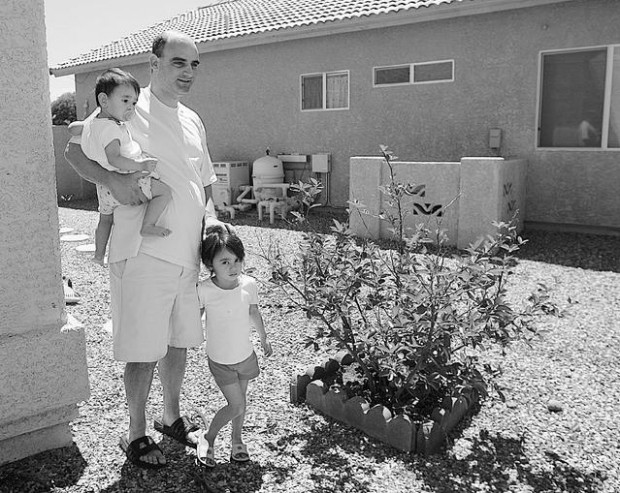
Ask Adi Halili what he has against the Continental Ranch Homeowners Association in Marana — the largest in the Tucson area at 4,000-plus members — and he'll show you an inch-high stack of correspondence.
He and Continental Ranch have gone toe-to-toe over the visibility of the top of his garbage can, the color of the cables to his satellite dish, and the small citrus plant in his front yard. He hasn't decided whether to take the ongoing dispute to an administrative law judge.
"Everybody in their right mind knows that you've got to trim your weeds and don't have junked cars in your yard, but you don't need to have people constantly harassing people about every little thing," he said.
The last straw for Halili is the miniature Japanese lime plant his mother-in-law planted 3 1/2 years ago to celebrate the birth of his daughter. The planting took place before the association adopted a rule that prohibits citrus trees — and besides that, the plant is not a tree but a small bush, he said.
"All the rest of that stuff I'll accommodate, but I'm not going to cut something down that has been there more than three years and is bearing fruit," he said. "It's the epitome of stupidity is what it is."
Halili has billed his association for wasting his time and has informed the board he used his copy of its covenants, codes and restrictions "as a fleet of airplanes to the delight of my daughter and her friends." Upon receiving a reply saying citrus would not do well here, he felt compelled to offer a differing opinion in the form of "a little road called Orange Grove."
Representatives of the Continental Ranch Homeowners Association declined to comment.
Code of ethics raises the bar
Though not related to the passage of House Bill 2824, an industry code of ethics developed by the Arizona Association of Community Managers could reduce the number of disputes by raising the bar on how homeowners associations are managed, said Vince Braun, a board member of the group.
The 15-page code adopted last April lays out a process for educating and certifying state community managers and establishes standards of practice in all areas of association management, from adhering to state open-meetings laws and disclosing information to protocols on inspections, property maintenance, record-keeping and membership policies.
If management companies adhere to the code and if homeowners and HOA boards make an effort to communicate, disputes can usually be resolved without litigation, Braun said.
"What gets lost a lot of times in all the attention that gets paid to homeowner disputes is the fact that the vast majority of homeowners very clearly want to have guidelines to protect the value of their property and want to see those rules and guidelines enforced," he said.
If homeowners took advantage of the power they wield by attending meetings and voting, they'd realize that associations can be made flexible and can respond to changing attitudes, said Tonya Martin, community manager for the Gladden Farms Community Association.
It's in the best interest of all concerned — management companies, HOA boards and homeowners — for homeowners to take an active role in their HOA, Martin said.
"We do everything we can to get people to come to meetings," she said. "We held an ice cream social and a raffle before our last meeting, and of the 40 families we invited, we probably had about 15 attend, but then all but three left when the actual meeting started."
'Silly' rules drive owners batty.
Page A11
● Arizona Office of Administrative Hearings, www.azoah.com, 1-602- 542-9826 — The state office that will begin hearing cases brought by homeowners against their associations when the new HOA law takes effect Sept. 21. For information about the law and the administrative hearings process, visit www.azoah.com/HB2824.htm
● Arizona Association of Community Managers (AACM), www.aacmonline.org, 1-602-685-1111— a statewide organization that represents the interests of community-association management companies. The organization's code of ethics can be found at www. aacmonline.org/ethics_code.pdf
● American Homeowners Resource Center (AHRC), www.ahrc.com 1-949-366-2125 — a public-interest interactive Web site for homeowners.
● Coalition of HomeOwners for Rights and Education (CHORE), www.chore.us — A national organization founded in Arizona that educates the public about buying in and living in a homeowners association.
● Citizens for Constitutional Local Government (CCLG), pvtgov.org 1-602-228-2891 — A nonprofit organization that provides full and material disclosure of all factors that may affect your decision to buy into an HOA-controlled property.
● "Legal Hotline-Community Association Law Edition" — Local attorney Carolyn Goldschmidt hosts this hourlong call-in radio program the third Saturday of the month at 8 a.m. on KNST (790-AM).