

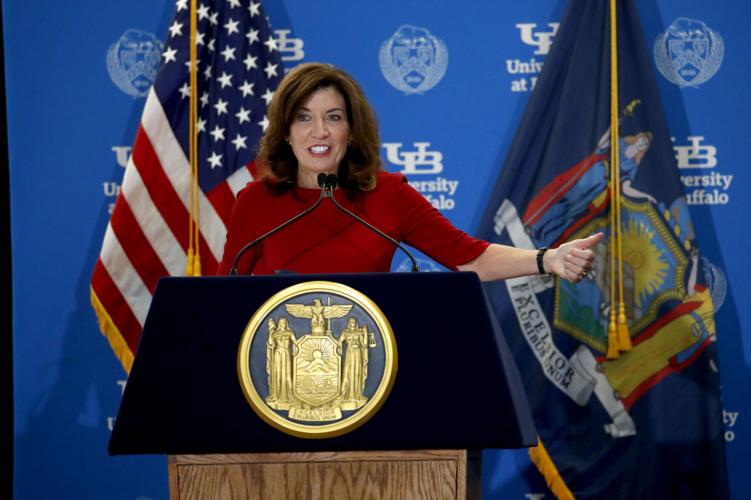
When Lt. Gov. Kathy Hochul was part of daily and weekly conversations about how to distribute the new and hard-to-get Covid-19 vaccines in Western New York, part of her job was to listen to frustrated local leaders who felt as though their ideas for responding to the health crisis were getting kicked to the curb.
So when she showed up Tuesday in Buffalo for her first news conference since taking the oath of office, she opened up by thanking the many local leaders she has worked with and made it clear that she would share the road going forward.
"One of the takeaways I had from being in the trenches with you is that I understand there is a role for state government, and there's a role for local governments," she said at the University at Buffalo's Jacobs School of Medicine and Biomedical Sciences.
People are also reading…
Hochul, who has served at all levels of government, referred to a "new philosophy" for fighting back against the highly contagious Delta variant and getting more people vaccinated, based on cooperation with local leaders, instead of commands.
"I will not be micromanaging," she said. "But I'll be giving guidance based on your input. I'll be giving you the cover you need. I'll be an ally, but I will not be imposing state people and locations on you without consultation. You tell us where there's gaps. Tell us where there's something that needs to be enhanced by the state and we'll be there, without stepping on the local public health agencies."
She also made several other announcements involving funding and school staff testing:
• The state will provide $65 million to help local governments set up mass vaccination clinics to provide Covid-19 booster shots to those eligible for them. This is in addition to American Rescue Plan money that local governments also received from the federal government to assist with Covid-19 response efforts.
Local governments, not the state, can dictate how and where vaccination sites are set up, Hochul said.
• She plans to require that any unvaccinated school staff undergo mandatory Covid-19 testing each week. Hochul said that while she does not have the same sweeping emergency powers Cuomo once had, she believes the testing requirement for unvaccinated teachers and staff can overcome any hurdles or collective bargaining issues.
Since many school districts cross county lines, she said, a statewide mandate makes the most sense.
• Finally, Hochul said she wants to build on state requirements that staff at health care facilities be vaccinated and is looking at potentially expanding this requirement to include staff at all state-regulated facilities.
But it's her pronouncement that the Governor's Office will be listening more carefully to local officials that garnered her applause from the many locally elected leaders and government health professionals in attendance.
"I have talked many, many times with the governor – back when she was lieutenant governor – about the lack of local control," Erie County Executive Mark Poloncarz said in response to Hochul's intention to give local communities more say in Covid-19 testing in vaccination efforts.
He referred to how the state shelved the county's initial plan to distribute locally available vaccines, which Poloncarz previously announced at a news conference. He also recalled how, for a long time, the state wouldn't even give Erie County the green light to run its own television and radio vaccination campaigns.
"The state was basically like, 'Nope, we're going to make all the decisions,' " he said.
At times, the state would announce pop-up mass vaccination clinics without consulting with the county about whether they had the manpower to help staff it. The state also wanted total control over what locations the county could use to set up its own vaccination sites.
Poloncarz said the exercise was ridiculous and resulted in him simply ignoring the state's approval requirements after a while. Other county leaders experienced frustrations.
"You cannot micromanage a pandemic response, and unfortunately, what happened in the past was there was an attempt to micromanage the pandemic response for the entire state," Poloncarz said. "You have to be able to trust the local leaders to do what's in the best interest of their communities. If they don't, you have the power to come in and say, 'This is how things should be done.' "
As a board member with the National Association of Counties, Poloncarz said he heard how some other counties outside of New York were doing some things better, but counties in New York were hamstrung by state dictates.
Hochul understands that, he said.
The new governor acknowledged that the state was "heavy handed" under former Gov. Andrew Cuomo in its dictates on how local governments could reach out and vaccinate their own residents. While the state still has the authority to make policy, she said, local governments deserve a say in how those state policies are executed.
"I saw, firsthand, the frustration that they had when they said, 'We have health care professionals who are trained for this,' " she said. "This is one example of how my administration is going to govern. I'm going to empower the people who are supposed to be doing this. It's not about the ego of the state, or the state government, or the state governor."
The state exists to help local governments do what's best for their own communities, she said.
"I'll be there to assist," she said. "I'll give guidance. I'll give direction. In some cases, I'll give mandates. I'm also going to show them the flexibility that they did not have. I was in those control rooms. I heard from Allegany and Cattaraugus and Niagara Falls. So I'm steeled with the knowledge that there's another way to do this, and there's an enthusiasm for this approach I've heard from every part of the state."
She also said she knows few expected that the coronavirus would still be such a problem, but the Delta variant has made ongoing mitigation and vaccination efforts necessary.
Western New York's 7-day positive test rate stood at 4.1% as of Monday. Hochul noted that hospitalization levels are manageable, but Monday's one-day positive test rate for this region was 5.6%, a sign that infection levels remain high.
"I don't like those numbers, my friends," Hochul said.
Poloncarz also pointed out that for all Erie County Covid-19 deaths in July and August reported so far, those who were unvaccinated were dying at a younger age. Among those who were vaccinated, the average age of death was 80. But among those who were unvaccinated, the average death was 70.
With the 2020 Census raising the total population of Erie County, the percentage of adults who have received at least one dose of the vaccine has now fallen from more than 70% to 69%, which is lower than the state average.
Later Tuesday, Hochul announced during a virtual news conference that she will convene an "extraordinary session" of the state Legislature beginning Wednesday to address a trio of issues, including one related to the pandemic: the extension of an eviction moratorium until Jan. 15. The U.S. Supreme Court earlier this month intervened to strike down a federal eviction moratorium put in place by the Biden administration. Absent state legislation, leaders have feared a housing crisis for renters who are behind on payments.
Hochul also said she will seek to amend the state's open meetings law to make it easier for residents to participate remotely in municipal government board meetings.
The governor also said she wanted to get the ball rolling on a long-stalled plan to create the regulatory agency necessary to oversee the legal sale of recreational marijuana. The Legislature agreed to decriminalize marijuana last year, and the legislation called for creation of a state agency to author the rules by which New Yorkers can buy and sell pot. Former Gov. Andrew Cuomo, who had long opposed the legalization of marijuana, had failed to appoint a "czar" to oversee the regulatory agency, the first step in the process. Under the legal pot law, the Legislature must approve the governor's nomination to serve as the agency's executive director. The governor and both the Assembly and state Senate are empowered to make appointments to its board of directors – actions that would also require legislative action.
Absent the extraordinary session, lawmakers aren't scheduled to return to Albany until January.
Hochul, who was in Buffalo on Tuesday morning, had returned to Albany for the virtual news conference.
She said she had conferred with leaders of both legislative chambers, who agreed a rare fall special session was needed to address the trio of topics.
Staff reporter Harold McNeil contributed to this report.


