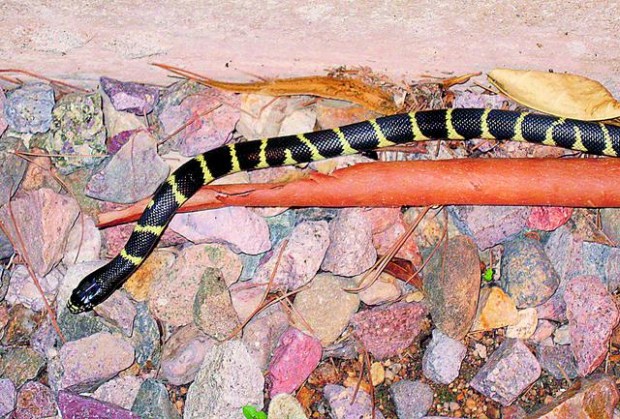
Got native critters?
Want some?
As native trees mature, they provide shelter for lower layers of desert vegetation and the local bugs, reptiles, birds and mammals who love them.
Rule No. 1: Make them feel at home with native Sonoran Desert vegetation, the experts at the Arizona-Sonora Desert Museum, Tucson Botanical Gardens and Tucson Audubon Society say.
We've got a good start in the older parts of Tucson. There, where the native tree species planted 15 to 25 years ago during the early days of the low-water-use landscape movement are maturing, they provide habitat for native creatures.
Rule No. 2: No outdoor cats. Animal welfare groups and wildlife organizations and agencies vary in their estimates, but most figure domestic and feral cats kill well over 100 million wild birds in the U.S. annually.
People are also reading…
But creating a miniature Desert Museum in your yard is not just a matter of planting native species, it's also a matter of not planting non-native — or invader, as they're called at the Desert Museum — species.
Buffelgrass, a fast-growing, hot-burning weed from Africa, is the best known of these species. Many invader species were intentionally introduced, and several, including fountain grass, are still sold at Tucson-area nurseries and stores.
When planted in yards, their seeds can be washed downstream during heavy rains, blown or carried into the desert by animals, and then displace native species.
The Desert Museum has an Invaders Program (http:// desertmuseum.org/invaders) aimed at getting the public's help in removing, and not planting, invader species that displace native species and/or harm the terrain in other ways.
"Xeriscape" doesn't mean "zeroscape," the experts at the Tucson Botanical Gardens and Tucson Audubon Society say.
The Audubon Society has warned that xeriscaping — in its strictest sense, the use of plants that require no irrigation — excludes the crucial varied levels of vegetation required for different species of birds and mammals.
Low-water-use landscaping, even using runoff from roof and gutter systems, can support extensive desert vegetation — just as it does in the desert.
Without cover of some sort, small birds and lizards aren't safe from predators. Each level supports its own animals.
With the proper trees, shrubs and ground-cover plants, a yard becomes a multistory natural space for desert creatures.
"With more native vegetation — both Arizona native and Southwest native — on our lots with a good mix of under-story and over-story heights of vegetation, we definitely see more native birds moving into the city and doing quite well," said Scott Wilbor of the Tucson Audubon Society.
He said the yards still won't attract and support as many species as true undisturbed desert vegetation, but he said certain species will be attracted when a good mix of plant heights is available.
"Curved-bill thrashers, they're the ones that like the under-story," Wilbor said.
Gila woodpeckers also aren't shy and take quickly to native vegetation, Wilbor said.
"But one you don't see unless you have the larger vegetation is the Gambel's quail," Wilbor said. In addition, the urban counts show quail seldom get into the city core because they don't cross major roads.
Still, there are large birds — including red-tailed, Harris' and Cooper's hawks — that can be found even in the city's core, as long as there are suitable habitat and prey.
It seems to be a boom year for lizards as well, with a bumper crop of whiptail and scaly lizards in even Tucson's most urban areas — as long as that desert vegetation is there.
But when you invite the desert natives into your yard, be prepared for some raw nature.
Cooper's and other hawks sometimes leave grisly surprises for the workers who walk the Tucson Botanical Gardens' paths before opening time every morning, said Yarina Hynd, the gardens' continuing education coordinator.
She said the Cooper's hawks that hunt from the gardens' tallest trees have a taste for the gentle — and slow — doves that live at ground level.
A how-to on attracting critters
Urban wildlife populations seem to be on the rise in Tucson, in part because of a relatively wet year, but also because of maturing native trees that were planted 10 to 20 years ago as Tucsonans made the switch to native trees and desert landscaping. Desert Museum wildlife people tell us what to do to our yards to attract native creatures.
For more information
• Try the Arizona Sonora Desert Museum's Web site for tips on attracting desert creatures: www.desertmuseum.org/ center/edu/faq_desert.php#11
Included in the Desert Museum's tips are ways to keep certain problem creatures — rattlesnakes and Gila monsters — out of your yard: No. 1, build a low wall around part of your yard. Make sure gates don't have a large gap at the bottom.
• Visit the Arizona-Sonora Desert Museum's site to learn about avoiding invader (plant) species: http://desertmuseum.org/ invaders
• Visit the Tucson Botanical Gardens in person at 2150 N. Alvernon Way to see how low-water-use desert plants attract interesting insects, birds and mammals. The Midtown site has a butterfly garden that shows how plants can be used to attract native butterflies.
The Tucson Botanical Garden offers a Butterfly Walk the second and third Thursday of the month at 9 a.m. The 45-minute tour, included in the price of admission, shows the connection between plants and butterflies.
The gardens' Web site: www.tucsonbotanical.org


 Tucson official: Air Force won't pay for D-M groundwater cleanup now