

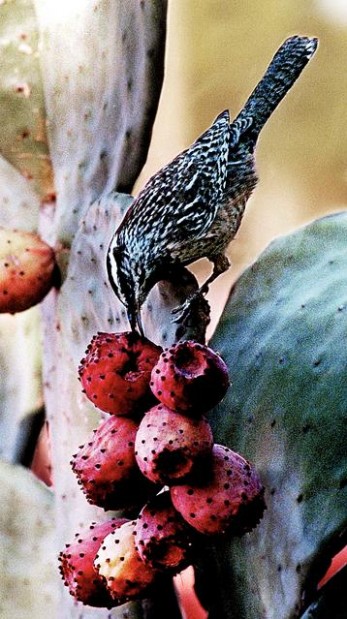
The other morning, I had just scattered seed for the quail and other ground-feeding birds and filled their watering dish. Amongst the usual finches, quail, thrashers and chickadees, I noticed a bird doing something quite unusual.
At first I thought it was a thrasher because of its down-curved beak. It wasn't. The vivid upper white eye stripe identified my source of interest as a cactus wren, Arizona's state bird.
This bird was jumping at a large spider web that had been constructed between two cacti. The web was full of insects. The wren removed one with each jump. She had quite a breakfast for herself.
Actually, I have no idea whether it was a male or female, as there is little external difference between the sexes. But somehow for me the word "wren" connotes a female.
Once, years ago, a reader asked me why I always referred to snakes and toads as males. He was a bit upset. I actually like snakes and toads.
People are also reading…
Anyway, back to Campylorhyncus brunneicappilum. The first word, I believe, refers to the bird's down-curved beak, while the second has something to do with the brown spotty and striped plumage. These Latin names are important, by the way, as they allow scientists the world over to study all living things in one language. The practice is called binomial nomenclature, and is a whole other column.
The first time I saw a cactus wren, I hadn't a clue as to its identification. Wrens, where I lived for many years, were kind of chubby little things, with their tails held cocked and switching back and forth. Not so the cactus wren, which is the largest wren in the United States.
Though I've tried to pin it down, sources are all over the map on size. They say anywhere from six to nine inches. The wrens in my area appear to be pretty much in the seven- to eight-inch range. Many people confuse them with thrashers because of that down-curved beak. The dead giveaway is the white eye stripe. The tail is held straight out for the most part. There is a tendency for feisty behavior, which they share with the thrasher. I would not call cactus wrens shy.
In addition to the spider web raid, I have observed these birds walk up boldly to another and pull an insect from its beak. Stealing is, evidently, not a no-no to our state bird! Our wrens have a quite varied diet, including the aforesaid insects. They will also eat seeds and some fruit. Most of my references say they get all of their water from their food, but every once in a while I have seen cactus wrens taking a hearty drink from my waterer.
The "song" of the cactus wren is really pathetic. Even the ever-present thrasher sings "Wee-wheat." Some books and other sources say the song sounds much like a car trying to start on a cold morning. To me it sounds like a bronchial cough. I think every one needs to see a doctor.
Cactus wrens form permanent pair bonds. The female will select a nest site, usually in a cholla, but saguaros are also used. Both parents build the nest, which is actually quite conspicuous among those nasty spines. The nest is lined with the feathers of other birds, as well as fluffy tidbits found about. The male then constructs another nest for the next clutch.
He will often build several more, which have been described as decoys. The young hatch at about 16 days, and fledge in 23. Despite the care given by both parents, baby wrens frequently will be eaten by small snakes.
There you have it — an overview of a bird of which we may be proud. Resourceful, loyal to each other and brave (brazen?). Truly a bird of our deserts. May they multiply and stop coughing.
Desert corner
By Lee Reynolds


