

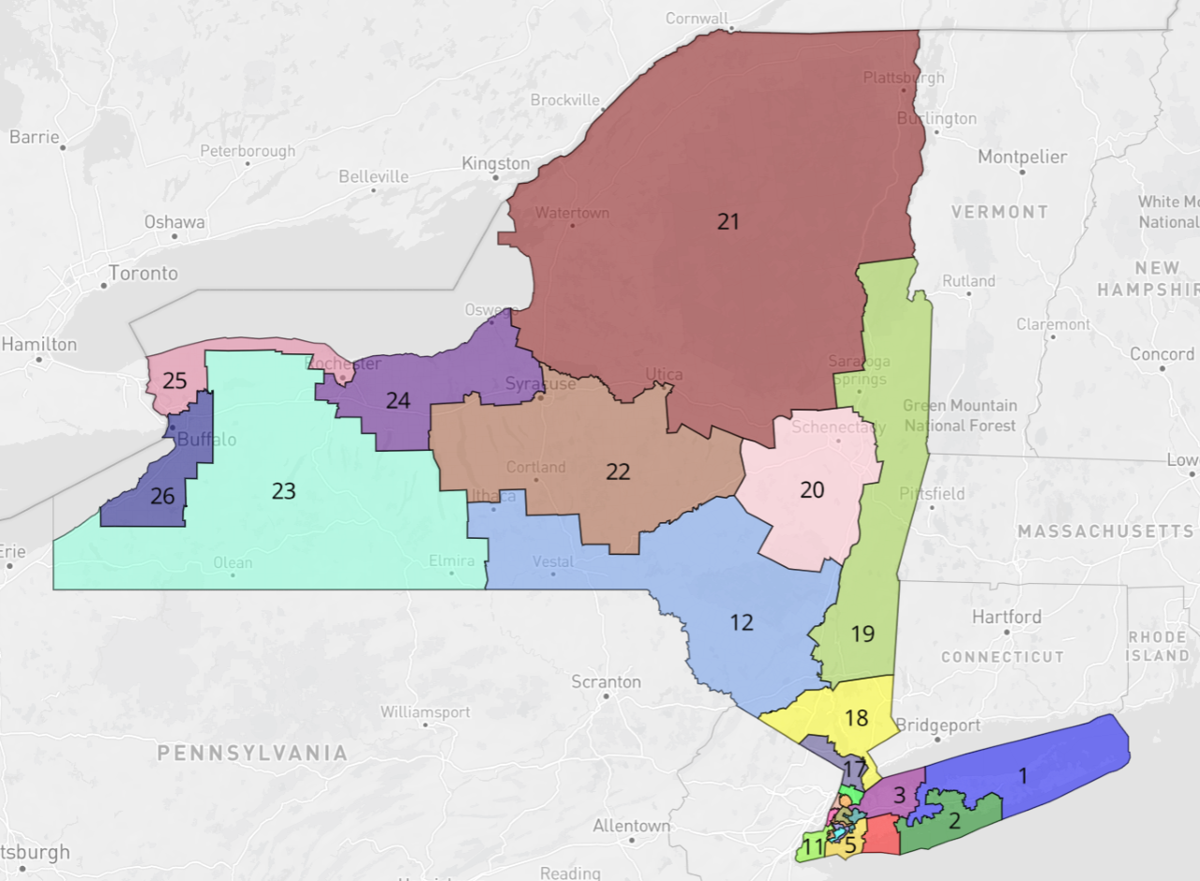
WASHINGTON – "The Earmuff District" – that strange gerrymander of a congressional district that connected voters in Buffalo with their counterparts in Rochester via a thin strip of land along Lake Ontario – died a decade ago.
But it's conceivable that it could be about to make a comeback, all because Democrats bent on maximizing their power in Washington may want it.
From a Western New York perspective, the return of the Earmuff District highlights a prospective House redistricting map drawn up by David Wasserman, House editor at the Cook Political Report. Under Wasserman's scenario, the district of Rep. Joe Morelle – an Irondequoit Democrat – would be stretched westward along the lake to swallow up Niagara County's Democratic-leaning territory. Doing that to Morelle would allow Albany Democrats to stretch the district of Rep. John Katko, a Syracuse-area Republican, westward into Monroe County – and presumably closer to defeat at the hands of a Democrat.
People are also reading…
Wasserman's map is nothing more than well-informed speculation at this point, but it reflects a reality that Democrats and Republicans alike privately acknowledge. With Democrats tasked with shrinking the state's number of House seats from 27 to 26 under new census numbers released Monday, Democrats in Albany are likely to use their monopoly on power to try to bolster the size of their delegation.
"I believe, the New York Legislature is going to come under heavy pressure from powerful Democrats in the delegation who want to maximize their seats," Wasserman said. While Republicans hold eight of New York's congressional seats, "it's possible for Democrats to draw a 23-to-3 map of New York."
That's just what Wasserman has done. In addition to stretching Morelle's territory westward to Niagara County, Wasserman's map shifts the district of Rep. Brian Higgins, a Buffalo Democrat, slightly southward into the Dunkirk area. And it largely combines the district of Rep. Chris Jacobs, an Orchard Park Republican, with that of Rep. Tom Reed, a Corning Republican who is retiring next year.
Only two other Republican districts, a huge one in the North Country and a smaller one on Long Island, would remain in New York under Wasserman's map.
Of course, Wasserman's redistricting scenario is just one of many floating among the minds and computer hard drives of politicos in Albany and Washington.
"There are a million different ways to slice the salami," noted former Rep. John LaFalce, a Town of Tonawanda Democrat and veteran of four redistricting efforts during his political career.
The knife slicing the salami will at first be in the hands of an independent commission created by voters in a 2014 referendum and then filled by legislative appointment. The commission will get the detailed census data it needs in September and then will set about drawing up a congressional map of New York with 26 seats of about 761,000 residents each.
So far, the commission effort isn't inspiring much confidence.
"The rules are all new to everyone and the process is all new to everyone and the players have never done it before and the layers of decision-making are more complicated than ever before," said Roman Hedges, retired deputy secretary of the Assembly Ways and Means Committee and a veteran of four rounds of redistricting. "So it's going to be hard."
What's more, the law allows the state Legislature to reject the redistricting plan the commission draws up – and a referendum set to be on the ballot in November would make it even easier for the Legislature to do so. That being the case, political insiders from both parties privately said they expect the heavily Democratic Legislature to draw the new district lines.
Given that the state's commission will have to draw up the map first, though, state legislatures in Republican states are likely to finish their reapportionment processes before the New York State Legislature even addresses the issue. Those legislatures are likely to draw lines that benefit the GOP, legislators in heavily Democratic states will be under pressure to do just the opposite in hopes of preserving their party's narrow majority in the House.
"Democrats likely will be able to gerrymander Illinois and quite possibly New York," wrote Kyle Kondik, managing editor of Sabato's Crystal Ball, a political blog published at the University of Virginia's Center for Politics.
The process of doing that won't be easy. Redistricting never is.
"I look at redistricting as the toughest form of politics," said former Rep. Thomas M. Reynolds, a Clarence Republican and veteran of several decennial redistricting efforts.
Incumbent lawmakers will fight hard to get a district that benefits them – even if doing so pits them against their own party allies, political insiders said. Meanwhile, state legislators will face off against reformers who will insist on districts lines that fit the state's geography and demography rather than the Democratic Party's needs.
And Republicans won't stand for a congressional map that contorts district lines to benefit Democrats, said Nicholas A. Langworthy, the state Republican chairman.
"Our best avenue would be get this into court as soon as we can," Langworthy said.
A court-appointed special master ended up drawing the congressional district lines in 2012, and the same thing could happen this time if Republicans take a Democratic-drawn map to court.
No matter who draws up the district lines, political pros from both parties said one thing seems likely. New York's 23rd District – the Southern Tier/Finger Lakes territory that Reed represented for a decade – is by far the most likely to be carved up, given that there won't be an incumbent to fight for it.
Less certain is the fate of the Earmuff District. Morelle, for one, didn't sound thrilled about the idea of having Monroe County chopped up as reapportionment moves forward.
"What's most important is that our community continues to have a voice who is from our community advocating for us in Washington," he said. "I've always fought to ensure Monroe County has the representation we deserve, and I'll continue to do so as we move forward."


