

Half the town slept in tents, burros served as transportation and for a time the sheriff had to tie drunks to the trees, for want of a jail.
Welcome to Ruby, or rather the Ruby that was.
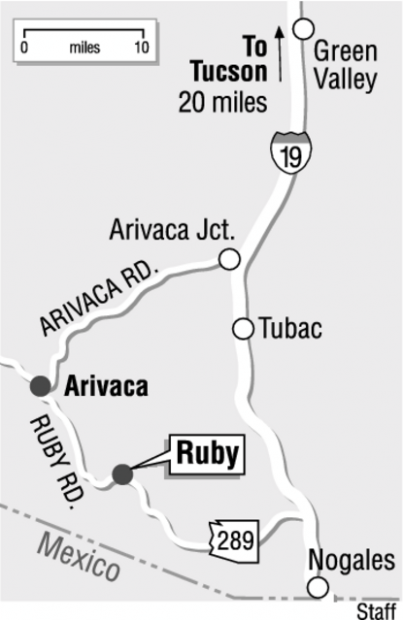
For more than a decade now, Tallia Cahoon has led tours of Ruby, a mining town gone-to-ghost a dozen miles southeast of Arivaca.
"I feel so fortunate to have lived there," says Cahoon, 76, who lived in Ruby until the age of 9.
"The ore started giving out. That's when we left," says Cahoon, whose father was a mining engineer.
But she never forgot the town of her youth, or lost the urge to revisit it.
In 1993, she attended Ruby's first reunion. About 150 were expected. More than 400 showed up.
I guess you had to have lived there. When I visited Ruby back in 1993 with Aurelia Gonzales, a former resident, I saw only tumbledown shacks and loneliness.
People are also reading…
Gonzales saw home.
Same for Cahoon. "This was a place where we spent a lot of time," she says.
Known during the 1870s as Montana Camp, the town became Ruby in 1910 — named for Postmaster J.S. Andrews' wife, the former Lillie B. Ruby.
During its heyday, 1926-1940, the Eagle-Picher Co. hauled more than $7 million worth of lead, zinc, silver and copper from deep underground.
Cahoon's father, Walter Pfrimmer, arrived in Ruby in 1926. Two years later he married Cahoon's mother — the two had met at a dance in Tucson years earlier — and brought her to Ruby.
In 1929, Cahoon arrived, followed closely by a brother and a sister.
They all lived in an adobe "shotgun" house — living room, kitchen, bedroom, all in a row.
Light initially came from kerosene lamps, water from a pipeline Cahoon's father designed and mapped, running from a well at the Santa Cruz River, across the Atascosa Mountains and into Ruby.
School in the beginning was a two-room affair, grades 1-8, taught by two teachers. "We sat on long benches at long tables," says Cahoon.
When the Depression started to ease about 1934, the town began to boom.
That's when the tents started going in. "They were 25 feet wide, 30 feet long, with wooden floors and wood going up the sides about 3 feet," says Cahoon.
Everyone lived by the mine whistle. "It blew every day at noon and again at 4, when the kids got out of school," says Cahoon.
The town had its own clinic, barbershop, Sunday school, ice cream parlor, pool hall and mercantile — store in front, meat section in back.
"There was this huge, glass-enclosed refrigerator with big chunks of meat hanging on hooks," says Cahoon.
Not until 1935 would the town have a jail — after Deputy Sheriff Fred Pyeatt told the Santa Cruz County Board of Supervisors that he was reduced to tying the town's drunks to trees.
Once a month a visiting priest from Nogales celebrated Mass in Ruby.
The dead who could not afford services in Nogales were buried in the town cemetery.
"Tony and Herminia Cordova helped build the coffin," says Cahoon. "Mrs. Cordova would go out and collect grass. She would put a thick layer of grass in the bottom of the coffin, then cover it with fabric."
In 1938, the ore started giving out and Cahoon's family moved to California and then Tucson.
Years later, she started a family history. "When I got to Ruby, I needed to know more," says Cahoon, who has researched state and mining archives and plumbed the memories of former Ruby residents.
"We really loved that town," says Cahoon.
"I feel so fortunate to have lived there."
Tallia Cahoon, former Ruby resident

 Tucson's El Güero Canelo for sale


