
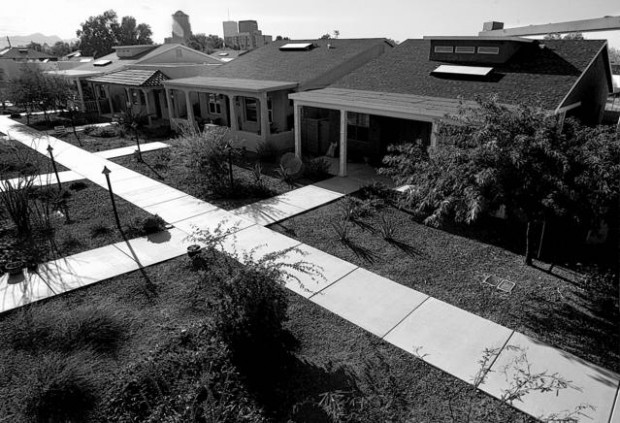
Armory Park del Sol's position as one of the top 10 communities on Cottage Living magazine's list is just another step in the neighborhood's growing national recognition.
The first homes were built in 2000 near the railroad tracks just south of the Broadway-Aviation Parkway intersection. Since then, builder John Wesley Miller's vision of 99 homes powered solely by photovoltaic solar panels has been featured in the Wall Street Journal and national trade magazines, has won local and national awards, and has been the model for future developments around the U.S.
In addition to producing solar electricity, Cottage Living praises Armory Park del Sol's architecture and xeriscaping as well as its innovative design. The neighborhood's alleys serve as the streets, turning the area in front of the houses into a "walker-friendly" environment with sidewalks and shade trees.
People are also reading…
In the magazine, the neighborhood is listed as the ninth-best community. Forest Hills Gardens in Queens, N.Y., heads the list..
Tucson's first zero-energy home was built in 2002, and shortly after its dedication, Jose and Marciala Reyes moved in. Their home creates as much energy as it uses, Jose Reyes said, and the extra energy it absorbs from the sun in the summer is stored away for use in the winter. A second-generation model was recently unveiled by Miller.
The Reyes couple moved to Tucson to retire after running an industrial machinery shop, Reyco Precision, in Chicago for many years. They never imagined they could find a home that fit their lifestyle and was so close to Downtown's attractions, they said.
"It was important to us that we be close to the theater, the museums, and especially the (St. Augustine) cathedral, which is very important to us," said Jose Reyes, 61.
What do you think the article in Cottage Living left out?
"It was a very concise article, very compact, but I think pretty much everything was covered. What I would have put more emphasis on is the neighborhood feel. Everyone here will tell you the camaraderie, the friendship, the connection that has happened here is unique. We've owned several homes, and in the past we kind of knew our neighbors, but you don't find that kind of community here."
Does it feel weird not having the street in front of the house?
"We're used to it. But in the beginning it was odd. For 40 years, I lived where the street was in the front. When you're inviting people who have never been here, you have to be specific about the directions: 'You will see the address in the back on the garage, but that's not where you come in, the front of the house is. ...' You have to go through a little bit of extra explanation, but once they come, they know.
"When you step out of the house, you meet your neighbors face to face, not across the street. Here, you're forced to talk to them, and that's a good thing."
What would you say is the most important thing people who are interested in moving to this neighborhood should know?
"The solar thing will come last, because people are still not conditioned to look for that amenity. The Downtown location, the image that neighborhood has gives you a good feeling — I think people will go for that first. Once you're inside the different homes, the layout of the homes will blow you away, and then people will open their eyes to the solar issue."
Do you do anything differently in this home?
Reyes: "We behave like you would behave when you're at home. You watch TV, you turn on the lights and turn them off, you set the thermostat at a level that's comfortable for you. But the difference is your bills might be $60. Ours is about $5.30.
Downtown

 U of A president declines to sign shared governance contract with faculty