A Rochester social services agency that serves people with developmental disabilities, addictions and mental illness is planning a residential project between Delaware and Colvin avenues, featuring more than 150 apartments spread across three buildings.
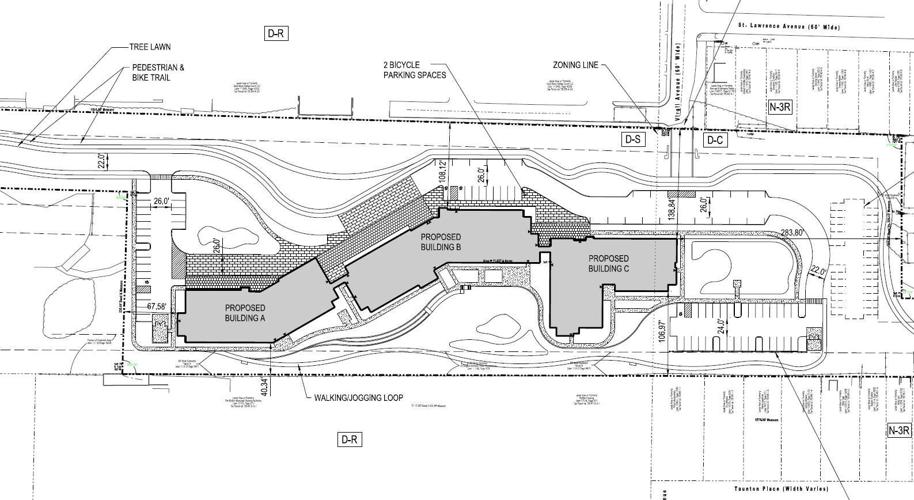
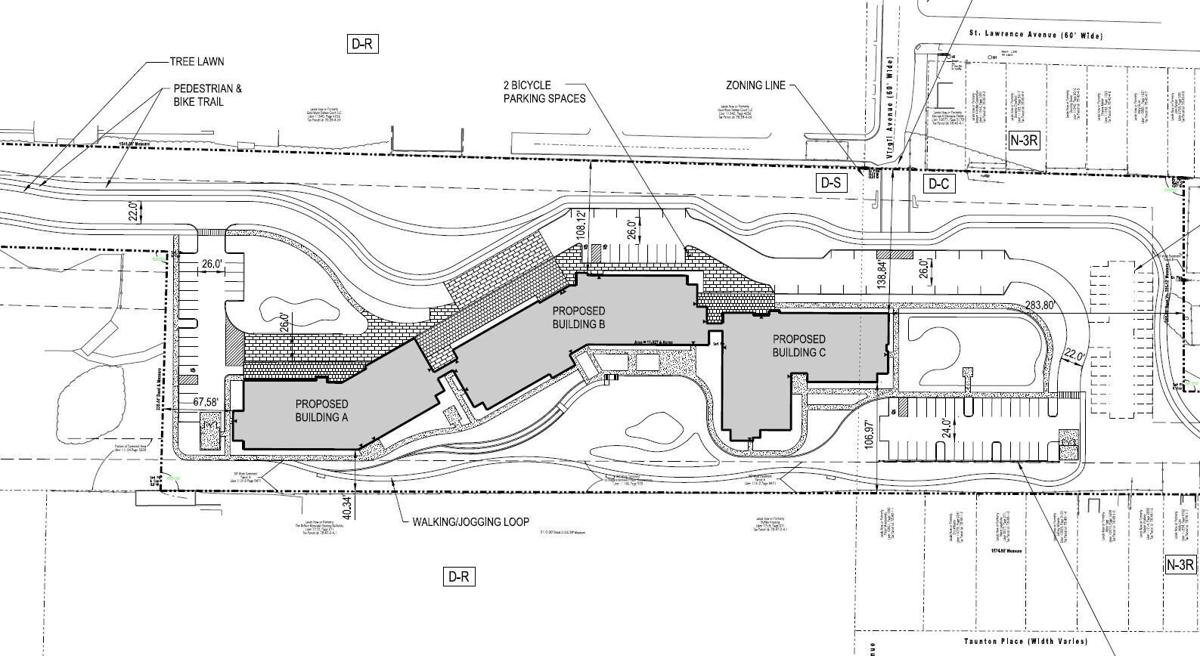
DePaul Developmental Services wants to construct a 174,000-square-foot complex on a long and slender stretch of land that extends between the two roads, starting across from the Delaware Consumer Square. It would feature three interconnected four-story buildings in a curved row, linked by one-story walkways.
The proposed Delaware Avenue Apartments would feature a mix of studio, one-bedroom and two-bedroom apartments. Designed by architectural firm SWBR of Rochester and C&S Engineers, the $30 million project would include 83 parking spaces and 20 bicycle spaces.
The site is located at 2633 Delaware, but the site also incorporates 2629 Delaware, 520 Colvin and 291 Virgil Ave. The property is owned by Plaza Group of Amherst, but under contract to be sold to DePaul.
People are also reading…
"We really think it could be an exciting reuse of that parcel," said Gillian Conte, vice president for DePaul Properties, the nonprofit's real estate arm. "We felt that it had a lot of potential. It just seems to be a really good location from a tenant perspective."
Because of the nature of the 11.03-acre property's shape and uneven topography – it's narrow at both ends and bulges in the middle, and it slopes – the complex would be constructed in the center of the site, more than 600 feet back from the street. That requires a variance from the Zoning Board of Appeals, but is necessary because of the "physical nature of the site and property boundaries," architect Brett Gawronski of SWBR wrote in a letter to the ZBA, which will consider the request on Feb. 17.

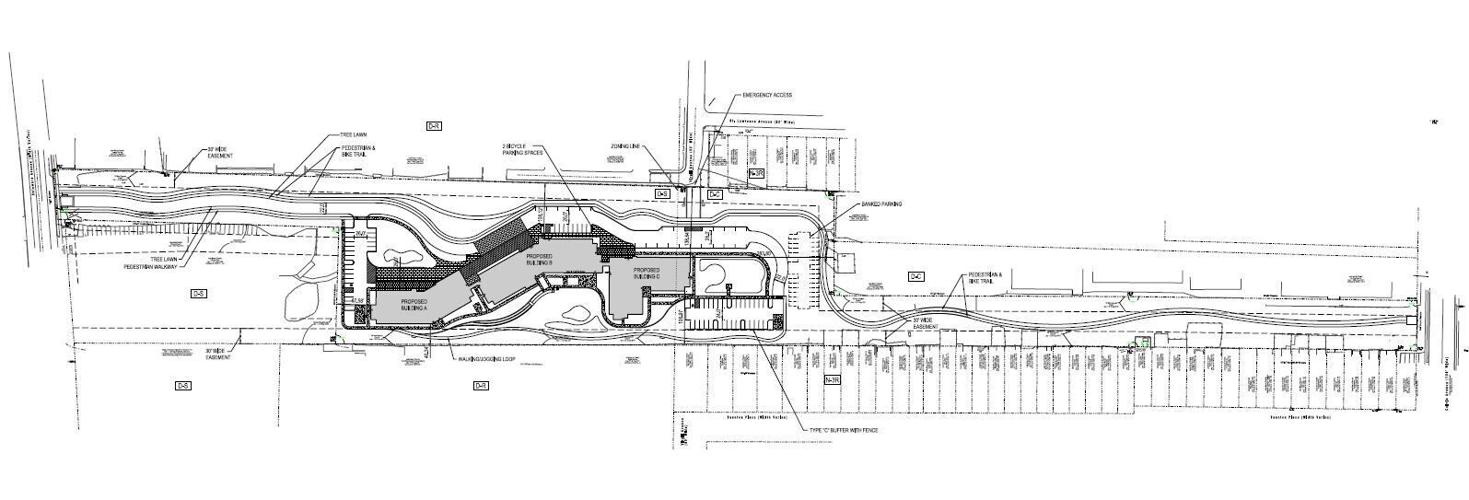
The full site plan for DePaul Developmental Services' Delaware Avenue Apartments, showing the extent of the property stretching from Delaware to Colvin avenues.
The rest of the elongated site would feature landscaped recreational and green space, including a bicycle and pedestrian path that winds from Delaware to Colvin and around the buildings, with additional jogging and walking paths extending outward. However, the complex will be closer to Delaware, and the vehicle entrance would be from that highly commercial area, not from Colvin.
Units would average about 750 square feet, and will rent from $800 to $950 per month, including utilities. The apartments are priced to be affordable for those earning 60% of the area median income – $32,640 for one person or $46,560 for a family of four.
The mix of apartments will include some supportive or service units reserved for people in recovery from mental health challenges, and Conte said DePaul will have staff on site to monitor and help those residents, connecting them with help as needed while striving to keep them independent. She said there will not be any difference or separation between the units, so tenants will not know who is receiving support unless they disclose on their own.
The campus is also being designed to support aging-in-place, Conte added. "It's getting harder and harder to do that in a lot of city environments, and we're hearing loud and clear that people want it," she said.
This would be the second major development in the neighborhood around Colvin and Taunton, as the site is directly across from the Colvin Estates subdivision. That's the new neighborhood in Buffalo where first Burke Homes and now Marrano/Marc-Equity Corp. has been building single-family homes on a similarly slender site stretching from Colvin to Starin Avenue, along the newly built Rachel Vincent Way.
That multiyear development has at times encountered delays and problems from disgruntled neighbors unhappy over the construction or drainage problems. But Conte said DePaul has been talking with the community for months, including Common Council member Joel Feroleto.
Officials have reassured neighbors that the agency has a "strong vetting process" for all of its tenants, and the county also gets involved with mental-health clients.
"We have a long history of doing this, and doing this well," Conte said.
The nonprofit is hoping to finance the project with 4% low-income housing tax credits from New York State Homes and Community Renewal. DePaul is also starting the municipal approval process now, and Conte said officials hope to start construction by spring 2022.
DePaul is seeking seven variances from the Green Code from the ZBA, for ground-floor transparency and height, and for the front and side-yard setbacks. Additionally, one of the variances would allow the building to have apartments on the ground floor, rather than commercial or retail space as normally required.
In his letter to the ZBA, Gawronski argues that it wouldn't be practical or viable to have offices or storefronts in the building because it's so far back that they wouldn't be visible from the street.