

Agua Prieta, Mexico -
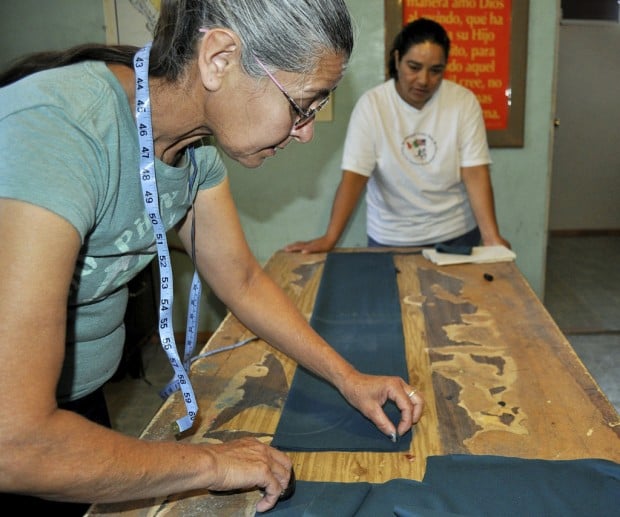
Down here in Colonia Ladrillera, where brick ovens burn and dirt roads are lined with trash, a group of women have been stitching together a bit of dignity.
Compared with the towering double wall that cuts through Douglas and Agua Prieta - it's just a small thing.
But here you can find a handful of women who sew sturdy bags, which are bought by churches and humanitarian groups and then given to deported migrants. The women make a little money. The migrants have something to carry their belongings home in.
I heard about "dignity bags" from a friend, and of course, I had to check it out. I had to see how four women in a sewing cooperative could capture what we often forget when we talk about immigration and the border: humanity.
"The women making the bags have, perhaps for the first time in their lives, begun to feel some self-esteem and more decision-making power within their families," Marybeth Webster, of the nonprofit DouglaPrieta Works, told me.
People are also reading…
An art therapist, Webster, 82, was heading down to Agua Prieta to work on a mural. She crosses the border every week, often bringing fabric rolls.
She helped found DouglaPrieta Works and its cross-border partner DouglaPrieta Trabajan to help residents build job skills and economic independence. DouglaPrieta teaches gardening and woodworking and has a computer lab. It also has the sewing group.
We drove past taco trucks, bars and groups of guys standing on street corners. Eventually, the asphalt gave way to dirt. We were in Colonia Ladrillera, the brickmakers neighborhood.
Here I met Rosalinda Sagaste Chavez and Hijinia Arce Acosta, two members of the sewing co-op. DouglaPrieta's new executive director, Fernando Ramirez, a lanky 24-year-old, joined us. He once worked in a Phoenix factory illegally and speaks English well enough, at least, to serve as a rough translator.
His father, Jose Ramirez, helped Webster start DouglaPrieta. Now Fernando is taking over.
The sewing has been good work, the women said. They were producing about 100 to 150 bags a week, and were taking home $2.50 a bag. Sagaste Chavez had used the new money to improve her house. Arce Acosta had paid for eye surgery for her mother.
Still, there have been struggles. The sewing co-op was once eight women strong, but four have dropped out.
The fabric they use - a garish green, but it works - was a lucky score on Craigslist that was given to the sewing group. But they are almost out, and need a cheap and reliable source of fabric.
"They have enough work right now with the bags because it's only four of them," Ramirez said. "But if they have to buy materials, it would not be enough."
Ramirez said the group needs to look into making uniforms for schools or maquiladoras.
For years, the sewing co-op has produced potholders, tote bags and other specialty items. Dignity bags are a new thing. The first orders came toward the end of 2011.
Religious and humanitarian groups buy the bags for $20 each, but every time a bag is purchased, two are given to the humanitarian group No More Deaths, which gives them to deported immigrants. Members of the sewing group receive $2.50 for every bag made - sold or donated. The balance covers the fabric and goes back into the organization.
The idea traces back to volunteers with No More Deaths and Dwight Metzger, a printer in Tucson who has bought crafts from DouglaPrieta.
"It really made the connection of not just jobs in Sonora and dignified work there, but for people to be treated in a dignified way when people are dumped over the border," Metzger told me.
It was Metzger who embraced his Internet shopping addiction and scored 3,000 yards of fabric for $400.
"They need everything," said Jim Walsh, a volunteer with No More Deaths, who helped raise funds to get the dignity bags project started. "A drink of water. Everything else. A pair of socks. A belt. Shoelaces."
Heather Williams, Arizona's first assistant public defender, told me belongings for arrested illegal immigrants are usually held by law enforcement for 60 to 90 days. Sometimes the immigrants get their stuff back. Sometimes they don't.
In the landscape of the border - cartels, violence, politics, the need for quality jobs - a bag is a small thing.
Sewing machines aren't nearly as noisy as political rhetoric. Bags for immigrants don't overwhelm you like a double border wall.
But if the double wall is a monument to division - although the wall that splits Douglas and Agua Prieta does end - then dignity bags are monuments to a humanity that is borderless.
Contact Brodesky at 573-4242 or jbrodesky@azstarnet.com


