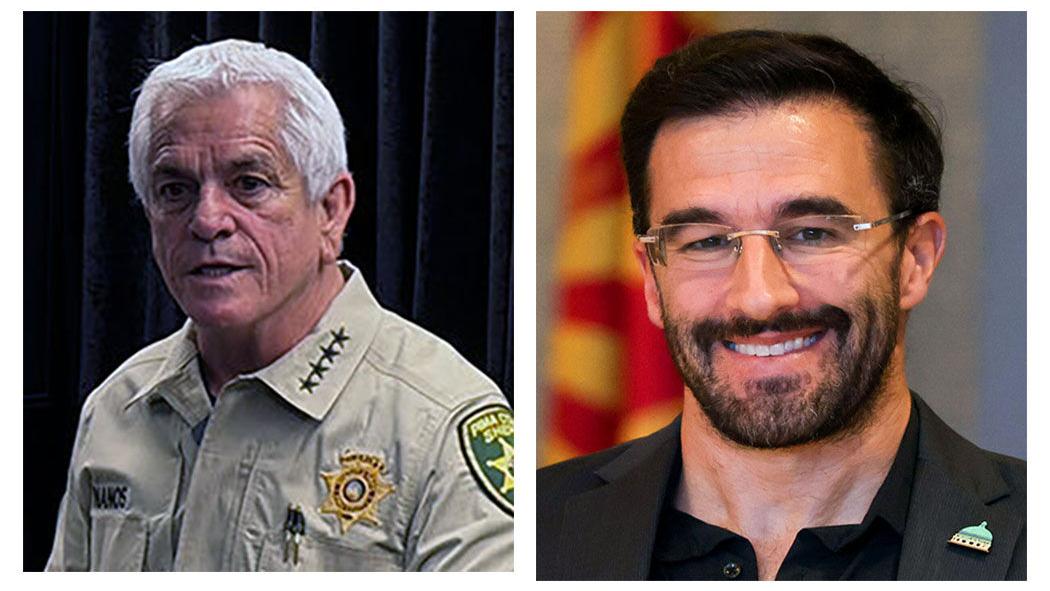
Pima County Sheriff Chris Nanos has assured the public his deputies don't collaborate with federal immigration authorities. But a recent court filing in an ongoing lawsuit highlights several incidents in which local deputies called Border Patrol after interacting with Spanish speakers who were not suspected of committing a crime.
The American Civil Liberties Union of Arizona filed the court brief Wednesday, alleging the sheriff's deputies' actions potentially violate the 4th Amendment's protections against unreasonable search and seizure, ACLU of Arizona immigrants' rights attorney John Mitchell said.
"The progress of this lawsuit confirms what concerned community members have long suspected: Sheriff Nanos’s public statements contradict the full picture of his deputies’ actions," Mitchell said in a March 25 press release. "We will continue to push for the transparency that real accountability demands — especially as concerns for the safety of our immigrant neighbors is driving a wedge between the public and law enforcement."
People are also reading…
In a Thursday email, Nanos said his office does not comment on matters of pending litigation.
In one such incident described in the ACLU's court brief, a private security guard called the sheriff's department and Border Patrol to report five people on construction company property who said they were searching for work.
"Upon hearing that Border Patrol will take over an hour to arrive, PCSD deputies offer the men a ride to a Taco Bell," the court brief said. "The PCSD deputies then inform Border Patrol to meet them at the Taco Bell and take the men into federal custody."
Another time, a deputy alerts Border Patrol to the presence of Spanish-speaking men on the side of the road with whom the deputy was talking, "despite admitting the men are under no criminal suspicion," the brief said.
The brief also cites an incident in which a 911 caller reported seeing 25 to 45 Hispanic people, "with foreign accents," behind a Dollar General store, prompting a deputy to call Border Patrol.

Pima County Sheriff Chris Nanos.
The incidents cited happened between 2021 and 2023, and it's not clear if similar incidents have taken place in more recent years, Mitchell told the Star Thursday.
"The tallying of incidents including prima facie constitutional violations ends abruptly in 2024," the ACLU's court brief said. "This is because Defendant ceased tracking communications between his deputies and Border Patrol, contrary to his publicly posted policy."
The ACLU of Arizona sued Nanos in Pima County Superior Court in July 2025, alleging his department violated the state's public records laws by failing to provide records requested by the ACLU of Arizona and Arizona Luminaria.
Nanos, who started his second full term as sheriff in January 2025, has previously told the Star that his deputies don't enforce immigration law or work with immigration officials, though deputies will assist when law enforcement, including U.S. Immigration and Customs Enforcement or Border Patrol, requests back-up.
The sheriff's department also complies with judicial warrants obtained by ICE, or any other law enforcement agency seeking a Pima County jail inmate, Nanos has said.
Nanos affirmed those views in a March 20 radio interview with Bill Buckmaster and the Arizona Daily Star's Tim Steller. Nanos told the interviewers that when he took office in 2021, he ensured sheriff's deputies don't inquire about inmates' citizenship, nor allow ICE agents to be housed at the Pima County jail.
"We took care of those problems right away," he said. "And why did I do that, because I'm anti-Trump or I'm anti-(ICE)? No, it was because that's not our role. We are not involved in immigration process. ... If ICE wants somebody that's in our custody, we gladly give them over to them, just like we would TPD (Tucson Police Department), Texas Rangers, anybody across this country, if they have a judge-signed warrant."
Nanos has been under fire for misrepresentations on his résumé revealed by The Arizona Republic. Nanos has said the misstatements were made in error.
Opponents have launched a recall effort against Nanos, and the Pima County Board of Supervisors has asked an outside attorney to review Nanos' misrepresented work history, which could potentially result in his removal from office, the Star reported.
An evidentiary hearing in the ACLU of Arizona lawsuit is scheduled for April 3, Mitchell said.
"We hope it both vindicates our legal position and brings greater transparency for these issues surrounding the sheriff's department," he said.
Contact reporter Emily Bregel at ebregel@tucson.com. On X, formerly Twitter: @EmilyBregel

Emily Bregel
Border reporter