Read the latest coverage of Tucson Electric Power's proposed power line plans.
Tucson Electric to host update on controversial power line
Local residents can hear an update and comment on a high-voltage power line Tucson Electric Power proposes to build through much of central Tucson, at a virtual open house meeting April 14.
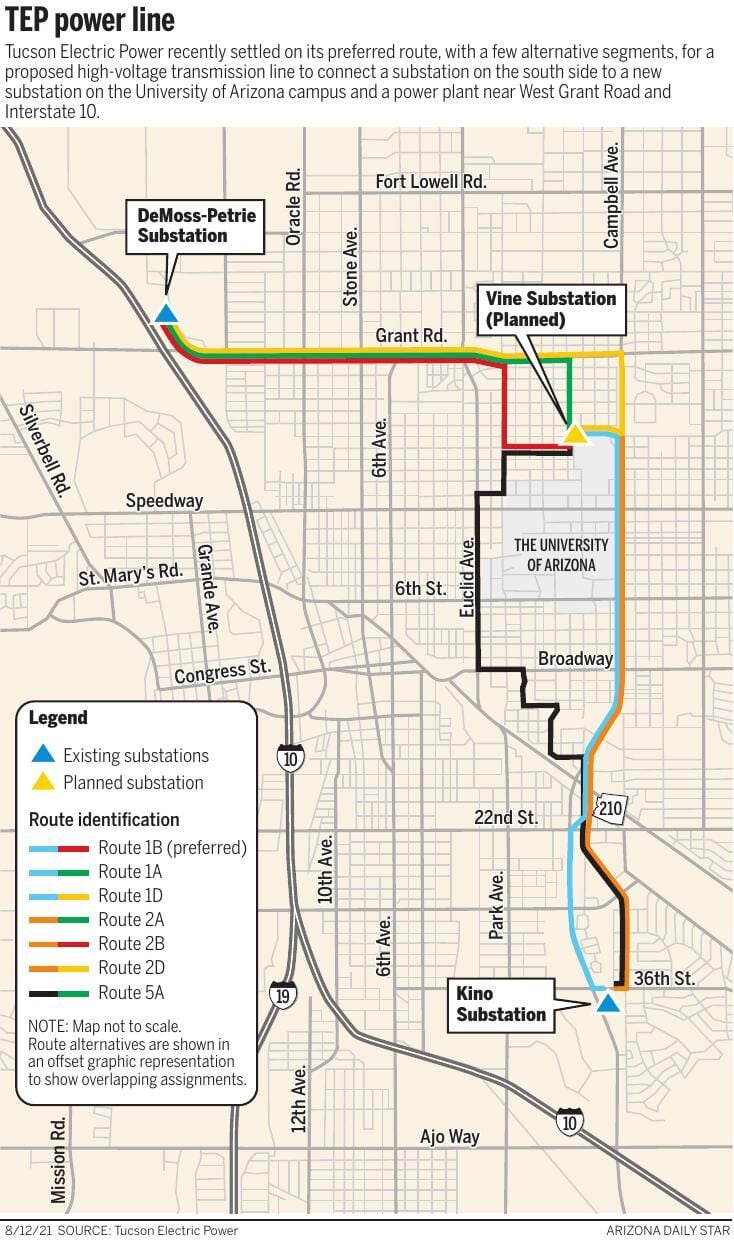
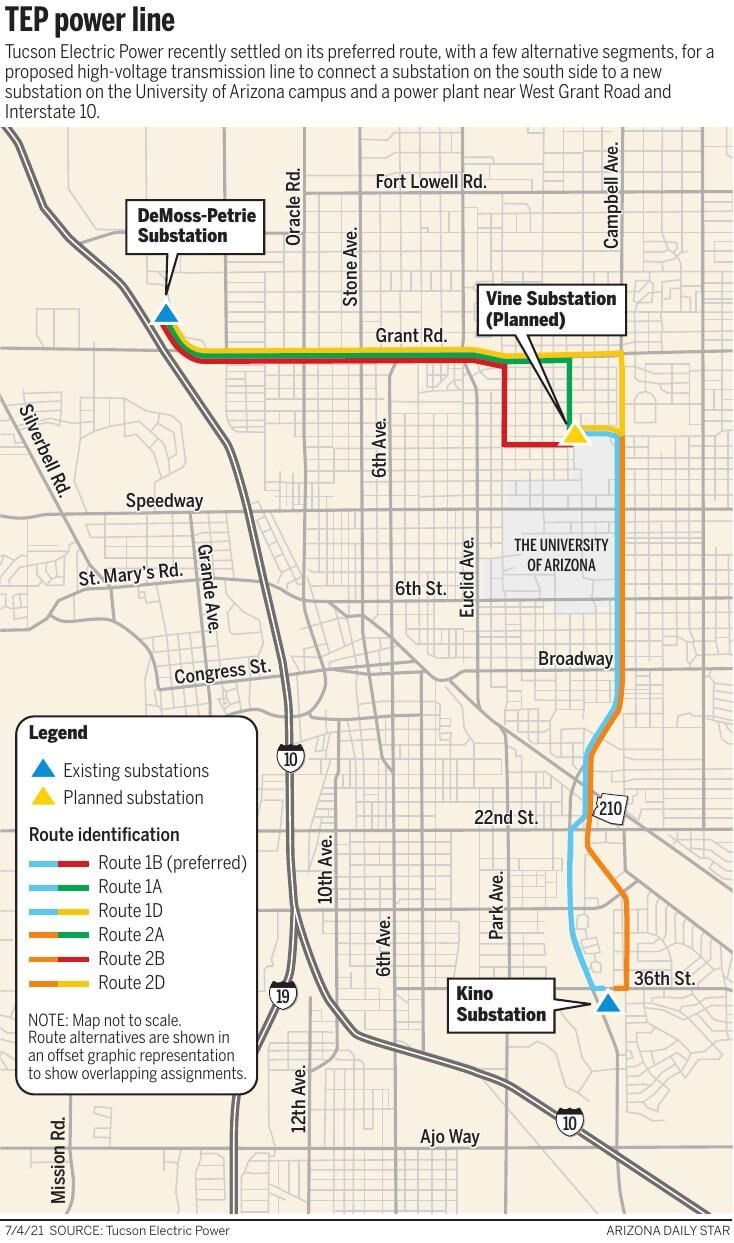
TEP has proposed running the planned Kino to DeMoss-Petrie 138-Kilovolt Transmission Line Project on overhead lines from a substation near East 36th Street and South Kino Parkway north past the University of Arizona campus and up North Campbell Avenue to a power station near Interstate 10 and West Grant Road.
But the route would traverse or pass by several historic Tucson neighborhoods, and the city of Tucson says it would violate city ordinances banning overhead power lines along designated scenic and gateway corridors, including North Campbell Avenue.
The city and neighborhood leaders want TEP to install the line underground, but TEP says that is too costly and opposes charging its customers for the project.
TEP and city officials have been discussing construction options including the potential of installing part of the line underground while allowing some overhead lines in less sensitive areas under special exceptions to the ordinances.
In a notice sent to ratepayers, TEP says its discussions with the city have focused on options for covering the additional cost of undergrounding the line “that is fair to all city residents, businesses and residents adjacent to the project, and other TEP customers,” but those talks continue and have not yet reached a resolution.
TEP said it is also discussing possible amendments to the City’s Unified Development Code to allow special exceptions for overhead-line construction within gateway and scenic corridor zones “when discrete and narrowly defined conditions are met,” including in industrial zoning areas.
The virtual meeting on the project is scheduled from 6 to 7 p.m. Thursday, April 14, over Zoom.
To listen via telephone, call 1-669-900-6833 or 1-253-215-8782 and use Webinar ID number 951 6050 0924 and passcode 55864353.
Such traditions as the Procession of the Cross up "A" Mountain and Easter services are important to many Tucsonans. The youngest of us, however, are more interested in hunting Easter eggs.
Tucson Electric files for state approval of controversial power-line plan
Tucson Electric Power Co. has formally filed for state approval of a controversial new high-voltage transmission line that will run through much of central Tucson, amid ongoing objections from several historic neighborhoods along the route.
In a filing with the Arizona Corporation Commission late Tuesday, TEP stuck to its preferred route for the Kino to DeMoss-Petrie Transmission Line, a proposed 138-kilovolt transmission line spanning about seven miles from a substation at East 36th Street and South Kino Parkway to a substation and power plant just east of Interstate 10, north of West Grant Road.
The application for a Certificate of Environmental Compatibility — filed after nearly two years of study and public-comment session — now will be considered by the Arizona Power Plant and Transmission Line Siting Committee.
After holding public hearings, the committee will decide whether to issue a certificate for final approval by the full Corporation Commission, likely within a few months.
TEP hopes to put the new transmission line into service by 2023.
Meanwhile, TEP plans to host a final public open house on the power-line proposal virtually on Thursday, Aug. 19. For details and more information on the project, go to tep.com/kino-to-demoss-petrie.
TEP’s preferred route would run along the east side of the University of Arizona campus and north up North Campbell Avenue to reach a planned substation just north of Banner-University Medical Center Tucson, before zigzagging east and north to West Grant Road.
The project will feature power poles roughly every 650 feet, generally ranging from rom 75 feet to 93 feet tall, with a few poles as tall as 120 feet, TEP says.
TEP says the power line and substation project is needed to boost power capacity and improve reliability, and to tie into the UA and Banner-UMC to meet growing demand and serve 100% renewable energy to the campus.
But the plan has drawn stiff opposition from residents of Sam Hughes and other historic neighborhoods.
TEP’s preferred route along North Campbell would run along the edges of the Sam Hughes and Blenman Elm neighborhoods, and the route leading west from the planned Vine Substation on the UA campus would cut through the Jefferson Park neighborhood.
The plan has also drawn fire from Tucson City Council members including Steve Kozachik who cited city requirements for underground utility lines in city-designated “Gateway Corridors” including North Campbell Avenue.
In its application to state regulators, TEP added back one proposed alternative route, dubbed 5A, that would route the line to the west of the UA campus to avoid the Campbell Avenue corridor.
TEP said it was including that route segment, which had been dropped from consideration as the utility refined the line segments in mid-2020, as an alternative to the Campbell alignment.
But the company noted that the 5A route — which would run up Euclid Avenue between Broadway and Speedway — would take the line through a historic preservation zone in the West University neighborhood and cost up to 60% more than other routes.
Meanwhile, Sam Hughes, Jefferson Park and about 10 other neighborhood associations have formed a group called the Underground Coalition, urging TEP to bury all or parts of the roughly seven-mile-long transmission line underground.
TEP has said it did not propose burying the lines and recovering the cost through rates because it is unnecessary and too costly for ratepayers, citing a study showing that “undergrounding” similar transmission lines costs more than 13 times the cost of overhead lines, which it estimated at about $1 million per mile.
The utility says it would support creation of a special taxing district to pay for undergrounding the line.
But supporters of burying the line say TEP has overstated the costs and point out that the entire city will benefit from the preservation of a vital city gateway.
In May, a city zoning examiner denied TEP’s request for a special exception land-use permit to build the new Vine Substation, citing a lack of information on the proposed line’s compliance with area development plans.
Tucson Electric overhead power line plan runs afoul of neighbors, city
Tucson Electric Power’s plan to run a high-voltage transmission line through central Tucson is facing backlash from historic neighborhoods and some city leaders who say the project will blight a wide swath of town.
After a series of stakeholder and public meetings since 2019, TEP is preparing to file its final plan for the 138-kilovolt Kino to Demoss-Petrie Transmission Line — which will feature 75- to 110-foot power poles — with state regulators at the end of July.
TEP says the line is needed to boost power capacity in the area and to better serve the University of Arizona and Banner-University Medical CenterTucson.
But as TEP plans to file for approval of its final route with state regulators later this month, neighborhood opponents who want the line buried underground have hired an attorney — and the city is preparing to defend an ordinance that would prohibit the utility from installing the line overhead.
About a dozen affected Tucson neighborhoods have formed a group called the Underground Coalition, to advocate for installing all or part of the roughly seven-mile line underground, arguing the line would ruin the aesthetics of many historic neighborhoods and cause property values to plunge.
Participating neighborhoods include Jefferson Park, Sam Hughes, Iron Horse, Pie Allen, West University and Catalina Vista.
“As a neighborhood, we’re very concerned about the placement of the lines,” said Colleen Nichols, president of the Jefferson Park Neighborhood Association and a resident since 1977. “These are massive lines, and they have no business in or near a residential area.”
The neighborhoods have found an ally in Tucson City Councilman Steve Kozachik, who says TEP has not adequately addressed concerns over the proposed line.
He says the line, which would run along much of South Kino Parkway and North Campbell Avenue would violate a city ordinance banning overhead power lines in so-called “Gateway Corridors” to the city.
“That’s a serious conversation that we still have to have, and so far TEP has ignored it,” said Kozachik, whose Ward 6 encompasses Sam Hughes and several other neighborhoods on or near the proposed power-line route.
Cost gives pause
TEP says it is studying the legal issue with the city but maintains that “undergrounding” the line is an unnecessary expense that would cost more than 13.5 times the $1 million-per-mile cost of an overhead line. That would come to about $90 million for seven miles underground compared with about $7 million overhead; the substation is expected to cost about $30 million.
The utility says it would be unfair to force all of its ratepayers to pay the extra cost of burying the line, suggesting that the city form a special underground utility taxing district to have affected property owners pay for the undergrounding.
TEP has been responsive to the neighborhoods throughout the public siting process and hasn’t ignored the undergrounding issue, spokesman Joe Barrios said.
“As we've said publicly before, we're more than happy to work with neighbors and other stakeholders to consider formation of an underground district,” he said.
Formation of an underground district, Barrios said, would “ensure that all TEP customers are not asked to subsidize a discretionary and expensive expenditure that primarily benefits residents or property owners in one small area of our service territory.”
Barrios noted that TEP heard from some neighborhood and public officials who say customers not directly impacted by the line should not pay for undergrounding it.
TEP officials say the only underground lines on its system are lower-voltage distribution lines, and those were all paid for by developers or other parties.
As part of its proposed Kino to DeMoss-Petrie transmission line project, Tucson Electric Power has published comparative images of the views at various observation points along the line, with the current streetscapes and renderings of expected views with the new power lines. This view is from North Campbell Avenue and East Fourth Street, looking northwest toward the University of Arizona campus.
Tucson Electric Power
Kozachik and others argue that undergrounding the transmission line would preserve the aesthetics of a key city gateway, for the benefit of all area residents, and set a precedent for other areas of the city as TEP expands its high-voltage system.
Citywide concern?
Retired UA political-science professor John Schwarz lives several miles northwest of the proposed line, but he’s jumped into the effort against TEP’s overhead power-line plan nonetheless.
“They affect the entire city, these lines and they affect principles that are important to the city,” said Schwarz, a 51-year Tucson resident who taught public policy at the UA. “You shouldn’t have to live in one of the neighborhoods (along the line route) to be concerned.”
Schwarz said that, like many of the neighborhood leaders opposed to overhead line, he wholeheartedly supports the line as part of TEP’s efforts to improve service reliability.
But he says it’s also a matter of equity, since the property owners in the path of the new line will bear a significant cost of an overhead line as a result of property devaluation.
Observation Point 20: Taken from just north of North Park Avenue and East Adams Street, looking northeast.
Tucson Electric Power
A white paper Schwarz authored with two other Underground Coalition members cites a federal study that found homes within 1,000 feet of an overhead high-voltage line could suffer property devaluation of 10%. Other studies have estimated devaluation of 2% to 9%.
Litigation over property devaluation stemming from an overhead line could run into the tens of millions of dollars — money TEP could put to use undergrounding the line, Schwarz and Kozachik said.
TEP’s Barrios said the company has not estimated possible property devaluation related to the project, but he said studies reviewed by TEP indicate that, “though short‐term impacts to property values can occur, long-term property values are not greatly affected by transmission lines.”
But Schwarz said making only the affected property owners pay for the undergrounding through a special utility district just adds insult to injury.
“That’s asking people TEP is damaging to pay for TEP not damaging them,” he said.
The Underground Coalition has also questioned TEP’s cost estimates for undergrounding the line, citing examples that cost as little as half TEP’s per-mile estimate, as well as questioning TEP’s assertion that maintenance costs of underground lines would be much higher than overhead lines.
Barrios says TEP stands by its estimates, which were developed by a third-party professional engineer.
“The cost analysis is based on the costs of actual projects that TEP’s consultant was involved with, and actual material costs,” Barrios said, adding that wire used underground can't carry as much current and underground lines require special insulating infrastructure.
Whatever the cost premium, it would represent a tiny fraction of TEP’s revenues — and barely 1/100th of TEP’s most recent rate increase, Schwarz noted.
Bumpy road
TEP said it plans to file its formal line-siting request with the Arizona Corporation Commission by July 30. The matter then will go before the Arizona Power Plant and Transmission Line Siting Committee, which after public hearings will make a recommendation to the Corporation Commission, which has final say.
But the plan has hit some speed bumps at the city of Tucson, and Kozachik has vowed to invoke the Gateway Corridor ordinance to stop the project.
In May, a city zoning examiner denied TEP’s request for a special exception land-use permit to build the new Vine substation, which would be built on the north end of the UA Banner campus and next to the Jefferson Park Neighborhood and link the two major sections of the Kino line.
The examiner said he could not determine the line proposal’s compliance with other area development plans because the line route in and out of the substation hadn’t been determined.
Barrios said TEP will refile the for the permit after it has filed its final route with the ACC.
As part of its proposed Kino to DeMoss-Petrie transmission line project, Tucson Electric Power has published comparative images of the views at various observation points along the line, with the current streetscapes and renderings of expected views with the new power lines. This view is from North Campbell Avenue and East First Street, just south of Speedway, looking northwest.
Tucson Electric Power
But Kozachik said TEP will still have to deal with the Gateway Corridor ordinance prohibition on overhead power lines.
“The ordinance that we have mandates underground utilities on Gateway Corridors and that's what Kino is and it goes all the way to River Road,” he said. “So they need to square that circle and decide whether they want to pursue that alignment with that understanding.”
Acknowledging that could lead to a court battle, Kozachik said the City Attorney’s Office has assured him the ordinance is defensible though it’s never been tested in court.
TEP’s Barrios said the company is reviewing the city’s Uniform Development Code, which deals with the Gateway Routes, and expect to provide a response to that issue in the application to the Corporation Commission.
Meanwhile, the Underground Coalition has raised more than $30,000 to hire a lawyer to represent the neighborhoods' interests in the regulatory proceedings, Schwarz said.
As part of its proposed Kino to DeMoss-Petrie transmission line project, Tucson Electric Power has published comparative images of the views at observation points along the line, with the current streetscape and renderings of expected views with the new power lines. These images are from West Grant and North Oracle roads, looking west.
Tucson Electric Power
Proposed high-voltage power line may cut through historic Tucson neighborhoods
As Tucson Electric Power moves closer to identifying a route for a proposed high-voltage transmission line to run through central Tucson, residents of historic neighborhoods are alarmed at the prospect of 110-foot poles popping up around them.
But the proposed 138-kilovolt line — designed to better serve customers, including the University of Arizona — must run from a TEP power plant on the south side through part of the UA somehow, and that means the line could cut through the neighborhoods that essentially ring the campus.
Under some proposed routes for TEP’s Kino to DeMoss-Petrie Transmission Line, residents of the Sam Hughes Neighborhood would see the power lines and poles from 75 to 110 feet tall along its western border on North Campbell Avenue.
“The massive scar of the proposed power poles and lines cutting through the center of the city should not be inflicted on any historic neighborhoods, even along a perimeter boundary of those neighborhoods,” said Kathi McLaughlin, a longtime local architect who sits on the Sam Hughes Neighborhood Association’s committee on TEP.
“This permanent scar will affect not just the neighborhoods, but all Tucsonans,” McLaughlin said, arguing that Campbell Avenue and Grant Road are traversed by many Tucsonans “whose street views will be forever changed by these massive poles.”
Residents of Jefferson Park, West University, Iron Horse and other neighborhoods listed as historic districts on the National Register of Historic Places have also opposed running the new transmission line, known as the Kino to DeMoss-Petrie Transmission Line, through their neighborhoods.
They argue the line and its lofty power poles would destroy the character of their neighborhoods, and some have urged TEP to consider installing the line underground to avoid aerial lines altogether.
TEP says the project, which includes a new substation on the UA campus at the northwest corner of the Banner-University Medical Center campus, is needed to boost power capacity, improve reliability and tie into the UA and Banner-UMC campuses to meet growing demand.
TEP says “undergrounding” the high-voltage lines would be too costly and make repairs lengthier and more expensive — something some neighborhood activists dispute.
Not everyone is opposed to the new power line running through or near their neighborhood.
Residents of Pueblo Gardens, a neighborhood just northwest of the new substation at Kino Parkway and East 36th Street, are looking forward to improved electrical service as the system has strained under new load from nearby retail and office development, said Cindy Ayala, president of the neighborhood association.
Ayala, a Pueblo Gardens resident for 40 years, said the neighborhood is now on three separate circuits, and residents are used to outages and brownouts that have caused damage to TVs and other electrical equipment.
“You never know what’s coming, and whether it’s going to affect one, two or three grids,” she said. “With this coming to fruition, this is going to be fixed and we won’t have to worry about dealing with so many brownouts.”
Narrowing down potential routes
TEP is still in the process of narrowing down proposed routes for its Kino to DeMoss-Petrie 138 Kilovolt Transmission Line project, which is designed to carry power from a substation nearing completion at East 36th Street and South Kino Parkway to the DeMoss Petrie Generating Station, a gas-fired power plant just east of Interstate 10 off West Grant Road.
The utility most recently has proposed eight line segments for the power line, consisting of of four southern routes running from the Irvington power plant to the planned new UA substation just north of Banner-University Medical Center-Tucson, and four to the north running from the UA substation west to the DeMoss-Petrie plant near Grant Road and Interstate 10.
After taking further public comment on those routes through Sept. 20, TEP plans on holding more public meetings, likely online, in October, TEP spokesman Joe Barrios said.
TEP plans to identify a preferred, complete route and at least two alternatives in an application the utility plans to file with the Arizona Corporation Commission in December, Barrios said.
The matter will then be considered in public hearings by the Arizona Power Plant and Transmission Line Siting Committee. That panel will then recommend the issuance or denial of a certificate of environmental compatibility for the project to the Corporation Commission, which will make the final decision.
Barrios said TEP has been working with more than 30 neighborhood groups, local government entities and other utilities on the power-line proposal.
Last week, TEP dropped two similar, proposed southern routes that would run from the Irvington power plant and along Euclid between Broadway and Speedway, leaving a substantially similar route that avoids a short section on Speedway.
The utility also dropped one proposed northern segment that ran from the new UA substation directly south through campus to Speedway, then up North Oracle Road to Grant and DeMoss-Petrie, replacing it with a similar route that veers west before dropping down to Speedway.
TEP’s Barrios said the new route was added as another option in response to concerns about the power line running through neighborhoods east, west and north of the planned UA substation.
Barrios said the company has tried its best to keep more than 40,000 residents and property owners in the power-line study area informed about the proposed routes with two newsletter and postcard mailings and newspaper ads.
TEP held public-comment open-house meetings on the transmission line project last October and stakeholder working group meetings in December and February. And another planned meeting in March was postponed because of the pandemic and held as a virtual meeting in August.
Speaking out
Barrios said TEP has received more than 800 comments on the Kino to DeMoss-Petrie line project, and all of them will be included in its application to the state line-siting committee and Corporation Commission.
Last week, the heads of four historic neighborhoods to the west and south of the UA — West University, Feldman’s, Pie Allen and Iron Horse — wrote a letter to the Tucson City Council, advocating for routes along the west side of North Campbell Avenue.
The groups said the Campbell route was “the least disruptive,” citing the wide road and easements and absence of private homes on that route.
In contrast, they said, routes proposed along Euclid Avenue are longer, run through historic and neighborhood preservation zones and would negatively impact the UA and Tucson High Magnet School.
The groups said burying the power lines is the best alternative and asked the council to press TEP and the Corporation Commission to explain why that solution is not viable.
Sam Hughes’ McLaughlin said TEP’s proposed routes have had the effect of pitting one neighborhood against another.
McLaughlin said Sam Hughes in its comments to TEP has opposed plans to run the new power line through any historic neighborhood, but TEP has essentially asked residents to “vote” on which routes they prefer.
“We didn’t want to throw anyone under the bus, but now none of our comments were tallied and considered as votes,” she said.
Pueblo Gardens’ Ayala said she’s heard the complaints from the other neighborhoods, but service improvements are desperately needed in her neighborhood.
“They are going to gripe, but this is something that is needed down here,” she said.
Barrios said it was never TEP’s intent to play one neighborhood against the other, and the routes proposed are simply the only potential routes that are feasible to connect the Irvington and DeMoss-Petrie power plants via the new UA substation.
“We’re not interested in pitting neighborhoods against each other; we have reached out to all the neighborhoods in the study area,” Barrios said. “We fully admit that we face some challenges in finding a route for this project because of neighbor concerns and other factors.”
But Barrios said the historic neighborhoods will benefit especially from the new transmission line because many of them have reached the capacity of their aging distribution lines and switch gear.
“We’re looking at building facilities in this study area because that’s where the customers are, that’s where the needs are,” he said. “We need to replace them or we’re going to have reliability problems.”
“Undergrounding” rejected by TEP
TEP has rejected the idea of installing all or some of the Kino to DeMoss-Petrie line underground, because of the cost of construction and cost and difficulty in making repairs to underground lines.
The utility commissioned a study showing that “undergrounding” the lines would cost $11 million per mile, compared with about $1 million per mile for overhead wires.
Maintenance costs and outage times would also increase because underground lines must be accessed through vaults or dug up for repairs, TEP says.
The utility says it only installs smaller, neighborhood distribution lines underground, and then only when the developer or property owner pays for it.
But a resident of the Iron Horse neighborhood with a background in financial analysis says TEP has vastly overstated the cost of underground lines.
Dan Dempsey, who spent several years as a research analyst for the investment arm of a major bank, said he found two power-line undergrounding projects in Scottsdale, one about a mile long and the other 2 miles, with the mile-long project completed by Arizona Public Service Co. in 2018 at a cost of $3 million, less than an initial estimate of $4 million.
Those lines were half the capacity of TEP’s proposed line at 69 kilovolts, but even at double the cost they are still half of TEP’s estimate, he said.
He also cited a 2011 study for the Wisconsin Public Service Commission that pegged the cost of a mile of underground for 138kV lines at $2 million, which even at triple the cost now would be a little more than half of TEP’s estimate.
While TEP and city officials have suggested that undergrounding would have to be funded through a special tax district, as was one of the Scottsdale projects, Dempsey said TEP could easily afford the cost itself, calculating the annual cost of a $10 million undergrounding project at less than 0.01% of TEP’s annual revenue of about $1.4 billion.
“Undergrounding Campbell is the only option that makes any sense and I think everybody can get unified behind it,” said Dempsey, who now heads a software startup.
TEP had not seen Dempsey’s calculations, which he said he plans to file as comments to TEP and later with regulators.
But TEP’s Barrios said the utility stands behind the findings of its study on the cost of undergrounding, which was written by a third-party consultant and is posted on TEP’s project website.
Regulators approve new high voltage power lines stretching up Tucson's east side
Tucson residents will see new high-voltage power lines go up on the east side starting next year as Tucson Electric Power Co. builds a new transmission line to boost system reliability, especially for Davis-Monthan Air Force Base.
The Arizona Corporation Commission last week gave unanimous approval to the Irvington to East Loop transmission line project, a 12.8-mile, high-voltage power line stretching from the H. Wilson Sundt Generating Station on East Irvington Road to TEP’s East Loop substation near East Broadway and Kolb Road.
The new line, which TEP is planning to place into service in 2022, also would connect to two new substations, one at South Kolb and East Escalante roads and the other near Kolb and East Littletown roads.
TEP says the new transmission line and substations are needed to serve growing energy needs, help D-M meet its energy resiliency requirements and improve electric reliability for customers across Tucson.
Construction on the 138-kilovolt power lines, with poles ranging in height from 75 to 110 feet, is expected to begin in the third quarter of 2021 and substation construction will start in the fourth quarter of next year, TEP spokesman Joe Barrios said.
The power line route, approved with public input, runs from the Sundt plant southeast along the railroad line, heads east along East Littletown Road and turns north along South Kolb Road.
After jogging east along East Escalante Road, it runs north along South Pantano Road to East Fifth Street, where it turns west to the East Loop substation on Kolb.
TEP held public-comment meetings on the project last year and mailed a newsletter with information on the project to about 22,000 residents in the project study area.
Kino-DeMoss Petrie line
Meanwhile, in response to the COVID-19 pandemic TEP has postponed planned public comment hearings set for mid-March on a major new transmission line proposed to run through the University of Arizona area.
The proposed Kino to DeMoss Petrie line, planned for service by 2023, would potentially cut through historic university-area neighborhoods, which has raised concerns among some neighbors and city officials.
TEP has not yet published its preferred routes for the line but has posted some potential line segments at the project page online at tep.com/kino-to-demoss-petrie.
TEP is encouraging neighbors and other stakeholders to view the online project update and share their comments about multiple potential line route links by May 22, via email or an online comment form on the project web page.
Written comments also may be mailed to P.O. Box 711, ATTN: Kino-DMP, Mail Stop RC131, Tucson, AZ 85701-0711.