

Skip to main contentSkip to main content
Register for more free articles.
Log in Sign up
Back to homepage
Subscriber Login
Keep reading with a digital access subscription.
Subscribe now
You have permission to edit this collection.
Edit
Arizona Daily Star
93°
  • Sign in
  • Subscribe Now
  • Manage account
  • Logout
    • Manage account
    • e-Newspaper
    • Logout
  • News
    • Sign up for newsletters
    • Local
    • Arizona
    • Business
    • Crime
    • Nation & World
    • Markets & Stocks
    • SaddleBrooke
    • Politics
    • Archives
    • News Tip
  • Arizona Daily Star
    • E-edition
    • E-edition-Tutorial
    • Archives
    • Special Sections
    • Merchandise
    • Circulars
    • Public Notices
    • Readers' Choice Awards
    • Buyer's Edge
  • Obituaries
    • Share Your Story
    • Recent Obituaries
    • Find an Obituary
  • Opinion
    • Submit a Letter
    • Submit guest opinion
    • Letters to the Editor
    • Opinion & Editorials
    • National Columnists
  • Sports
    • Arizona Wildcats
    • Greg Hansen
    • High Schools
    • Roadrunners
  • Lifestyles
    • Events Calendar
    • Arts & Theatre
    • Food & Cooking
    • Movies & TV
    • Movie Listings
    • Music
    • Comics
    • Games
    • Columns
    • Play
    • Home & Gardening
    • Health
    • Get Healthy
    • Parenting
    • Fashion
    • People
    • Pets
    • Travel
    • Faith
    • Retro Tucson
    • History
    • Travel
    • Outdoors & Rec
    • Community Pages
  • Brand Ave. Studios
  • Join the community
    • News tip
    • Share video
  • Buy & Sell
    • Place an Ad
    • Shop Local
    • Jobs
    • Homes
    • Freedom RV AZ
    • Marketplace
    • I Love A Deal
  • Shopping
  • Customer Service
    • Manage My Account
    • Newsletter Sign-Up
    • Subscribe
    • Contact us
  • Mobile Apps
  • Weather: Live Radar
  • Facebook
  • Twitter
  • Bluesky
  • YouTube
  • Pinterest
  • Instagram
© 2026 Lee Enterprises
Terms of Service | Privacy Policy
Arizona Daily Star
News+
Read Today's E-edition
Arizona Daily Star
News+
  • Log In
  • $1 for 3 months
    Subscribe Now
    • Manage account
    • e-Newspaper
    • Logout
  • E-edition
  • News
  • Obituaries
  • Opinion
  • Wildcats
  • Lifestyles
  • Newsletters
  • Comics & Puzzles
  • Buyer's Edge
  • Jobs
  • Freedom RV AZ
  • 93° Sunny
Share This
  • Facebook
  • Twitter
  • Bluesky
  • WhatsApp
  • SMS
  • Email

Voter guide: 2021 primary elections

  • Jun 19, 2021
  • Jun 19, 2021 Updated 11 hrs ago

Early voting began June 12 to kick off the 2021 election season. Primary day is June 22. Get caught up with recent stories relating to this year's elections.

Byron Brown, seeking a fifth mayoral term in Buffalo, is not taking the campaign bait

For Mayor Byron W. Brown, the campaign trail in these last days before Tuesday's Democratic primary varies little from his regular travels through Buffalo.

Byron Brown

Mayor Byron Brown speaks as he presides over a senior health fair at the William Street YMCA on Thursday, June 17, 2021.

Harry Scull Jr./Buffalo News

On Thursday, for example, the four-term incumbent seeking an unprecedented fifth term stood before a phalanx of television cameras at Lafayette High School to launch the "Earn While You Learn" program assisting 200 students most affected by the Covid-19 pandemic. The idea, he explained, is for Buffalo Public Schools and the City of Buffalo to financially subsidize students who need both summer school and income to support themselves or their families.

"We need to make sure we get our children back on track and that some of our older children graduate on time," he said in one of his constant references to post-pandemic Buffalo. "We're not going to pinch pennies on the future of our young people."

This is how Brown is conducting his fifth campaign for mayor of New York's second largest city – low key and confidently. If there is a "rose garden" equivalent for this mayoral effort, Brown has mastered it.

Democratic challengers for Buffalo mayor's seat steeped in the community

Democratic challengers for Buffalo mayor's seat steeped in the community

India Walton, a nurse with a background in community activism and City Hall employee Le’Candice Durham are challenging Mayor Byron W. Brown in the Democratic primary.

On Thursday the mayor found himself not only at Lafayette High, but also at the William Street YMCA, presiding over a senior health fair and urging those attending to get Covid-19 vaccinations. At noon he was slated to discuss the American Reinvestment Act with White House officials in a phone call. Then he hurried off to help dedicate the new $27.8 million Health Professions Hub at D'Youville College. 

For sure, a campaign is underway. Brown has collected more than $400,000 in campaign contributions, regularly sends his experienced troops into the streets, and has paid big-time campaign consultants to craft TV ads and mailers emphasizing Buffalo's stability after the ravages of Covid-19. Ignoring his less-known opponents, he apparently senses no need for the negative attack commercials that characterize a close election.

But as the primary that will effectively elect the city's next mayor approaches, he is campaigning as a powerful incumbent – touting city programs and initiatives he believes will help his constituents. And maybe he'll pick up a few votes along the way.

Byron Brown

Mayor Byron Brown, right, shakes the hand of Buffalo Police Officer Tommy Champion as he presides over a senior health fair at the William Street YMCA on Thursday, June 17, 2021.

Harry Scull Jr./Buffalo News

"I talk to the mayor regularly and know that he is taking this seriously," said former Mayor Anthony M. Masiello, a Brown supporter. "He has his own way of doing things, but will not be caught with his guard down."

Never in Buffalo's long history has any mayor even attempted breaking the four-term record set by the late James D. Griffin. But Brown now aims to again claim the big office on City Hall's second floor, already looking to January and the job he seems to consider rightfully his.

The #BNDrone takes you on an aerial tour of Buffalo City Hall.

Derek Gee/Buffalo News

Indeed, Brown has hardly acknowledged the two Democrats – India B. Walton and Le'Candice M. Durham – trying to unseat him in the primary. For the first time in his many campaigns for mayor, he has refused to debate, even ignoring requests from traditional and respected debate sponsors like the League of Women Voters of Buffalo Niagara. This year, he seems to campaign by simply being mayor.

"I continue to try to make Buffalo one of the best post-pandemic places to live, work, raise a family and invest," he recently told The Buffalo News editorial board. "If I'm reelected, I think you will see some real tangible growth."

The mayor underscores the point by attending just about every good news event possible, like the Tuesday session celebrating developer Douglas Jemal's effort to turn the largely vacant Statler Hotel into 600 to 700 downtown apartments. His campaign seems to absorb Jemal's myriad Buffalo projects.

"The investment in this building is going to be well over $150 million," Brown said, pointing to earlier city spending to stabilize the downtown landmark. "This is significant for the City of Buffalo. It is significant for our residents. But it’s also significant for people living throughout Erie County and the Western New York region."

That's not how Walton views his long tenure in City Hall. She distributes mailers linking Brown to contributors like Jeremy Jacobs, whom she calls a "far right billionaire and Donald Trump donor;" Carl Paladino, "disgraced, racist Republican politician;" Steve Pigeon, "corrupt party boss," and Louis Ciminelli, "developer found guilty in bid-rigging scheme."

Byron Brown

Mayor Byron Brown speaks to Debra Jones as he presides over a senior health fair at the William Street YMCA on Thursday, June 17, 2021. 

Harry Scull Jr./Buffalo News

She rails against what she calls Brown's "inadequate" police reform efforts, a pandemic response she considers tepid, and an overall "lack of leadership." The mayor's "broken window style of policing has failed," she says, proposing new programs to expand home ownership, initiate a "transparent" budget process and work outside Brown's "establishment."

"I can be a bit much to deal with, you can put that on the record," she told The News editorial board. "Sometimes I ruffle feathers."

The mayor, however, does not take the bait. He neither engages nor retaliates. Other topics lead his agenda.

"My goal is for Buffalo to be one of the fastest communities to recover, post-pandemic," he told The News. "I think we will reap tremendous benefits."

Along the campaign trail, Brown emphasizes that the city emerged relatively unscathed from the Covid-19 crisis, that no employees were furloughed and no city services interrupted. More than $309 million worth of projects since 2020 continue appearing on drawing boards, he says, with $54 million set for the East Side alone.

"That's pretty exceptional," he said.

As he attempts to win an unprecedented fifth term, Brown appears confident he will preserve the ethnic coalition that has always propelled him through elections for the Common Council, State Senate and mayor. As the city's first Black leader, he has always racked up overwhelming pluralities throughout his East Side base.

But Brown has also managed to broaden his appeal beyond Black voters. While he beat his closest 2017 competitor – former Comptroller Mark J.F. Schroeder – 2,533 to 381 in his Masten base, he also won mostly white Delaware 1,998 to 1,586. He played on that ability Friday while addressing a gathering of Blacks and whites for a Friday Juneteenth event at Canisius College. He would attend the funeral of a noted Black businessman later in the day, he said, adding their "ancestors would be proud of this diverse display of unity on Juneteenth."

"If we unite, we're stronger as a community," he said.

Still, the African American base that first elevated him 16 years ago appears as strong as ever, said Assembly Majority Leader Crystal D. Peoples-Stokes, even against two Black opponents.

"Does he have people who don't respect him for the work he has done? We all do," said Peoples-Stokes, a longtime ally. "But this is about running a city.

"I don't see any erosion of support from the Black community," she said. "These young ladies are certainly entitled to wage a campaign. But I think the vast majority of the Black community supports the mayor."  
Analysis: On Tuesday, a primary for the books

Questions and answers about Tuesday’s primary elections:

• Why has an election for mayor of Buffalo, featuring Byron Brown’s unprecedented campaign for a fifth term, proven so low-key?

Probably because any possible big-time opponent dismissed taking on such an entrenched and powerful incumbent.

This matchup has no Tim Kennedy, no Darius Pridgen, no Sean Ryan and no Pat Burke on the primary ballot. Many observers say they remain on deck for a future mayoral effort – just not this one.

• Is the mayoral race really that low-key?

Don’t tell that to India Walton, Brown’s firebrand challenger. She has raised enough money to finance a significant television and direct mail campaign. In those ads, she throws every possible charge and insinuation at Brown.

At the same time, she introduces thoughtful policy proposals that may be left-leaning, but not quite left field. Probably the most liberal mayoral candidate in Buffalo history, her effort comes at a time when the New York Times reports that New York City’s progressive mayoral candidates are encountering difficulties.

Walton’s effort should provide a good indication of the power of Buffalo’s progressive vote.

• Brown is considered the heavy favorite. By what tally must he win to enthrone him for a powerful fifth term?

We won’t play the numbers game here. Let’s just say he needs a convincing win to claim the “mandate” mantle he seeks through 2025.

• Is the Brown campaign thinking at all about Lovely Warren, the mayor of Rochester?

If not, they should. In 2013, Warren surprised just about everyone by whipping incumbent Mayor Tom Richards with quiet but efficient mobilization of Black voters.

Brown, however, should encounter no difficulties in motivating his loyal base of African American Democrats. Walton faces a tough challenge in siphoning votes from that bloc.

• How do we know Brown feels optimistic about his chances on Tuesday?

Because his TV ads are officially classified as “warm and fuzzy.” If Brown was concerned, he’d be throwing all kinds of zingers at Walton.

• Will turnout matter?

Yup – just like always. Early voting totals have proven paltry, and most observers predict Tuesday turnout in the teens percentile. The candidate able to best attract his or her base will win.

• Duh. Isn’t that rather obvious?

Yes. But also the first rule of elections. Duh again.

• Turning to the sheriff’s race, why is it so unique this year?

Because primaries for sheriff are almost unheard of. Nobody can recall a Republican primary for sheriff.

In addition, it’s possible Republicans could nominate a woman – Karen Healy-Case – and Democrats could nominate a woman – Kim Beaty. If both win on Tuesday, national attention is almost sure to focus on an all-female race for sheriff of a big urban county.

• What’s at stake for Dems and Repubs in this one?

Chairman Jeremy Zellner’s Democratic organization has much riding on its sheriff endorsement of Brian Gould, assistant chief of the Cheektowaga Police Department. A significant portion of local Dems favor Beaty and the idea of a Black woman as Erie County’s top cop. And because Beaty, former deputy commissioner of the Buffalo Police Department, says she was treated unfairly by party leaders at endorsement time (which Zellner denies), the party unity that the chairman so eagerly seeks has suffered.

Ditto on the GOP side. Healy-Case, a former Buffalo police lieutenant, snared the Republican nod after Chairman Ralph Lorigo and his Conservatives led the way. But big Republican names like Sen. Pat Gallivan and Sheriff Tim Howard back another well-financed and well-organized candidate, former Buffalo Detective John Garcia.

Usually in primaries, endorsed candidates are favored. Party organizations have the resources and discipline to drive their voters to the polls.

A win by Garcia in the GOP or Beaty in the Dems would prove a major blow for party leaders.

Three Democrats jockey for party line in Erie County sheriff's race

They don’t come around all that often, Democratic primaries for Erie County sheriff.

More often, the party comes up with just one candidate for the office. It’s often won by a Republican because Buffalo’s typically ho-hum mayoral races, held on the same four-year cycle, do little to draw out the city’s Democratic numbers that can tilt a countywide contest.

A Democrat hasn't been elected sheriff since Thomas F. Higgins won a third term in 1993.

This year, Republican Timothy B. Howard has decided not to run again for sheriff after four terms, and the field is crowded on both sides.

The winner of the Democratic nomination, however, will be free to run against the Howard record: 31 inmate deaths since taking office in 2005; two county jails ranked among the state’s worst-run; a consent order forced by the U.S. Justice Department; and in recent days, a consent order forced by the state Commission of Correction and the attorney general over the failure to properly investigate and report accusations of sexual misconduct between guards and inmates.

"The culture of our current Sheriff's Office needs to change," says Brian J. Gould, the assistant chief in Cheektowaga, one of the county’s larger town police departments. He is one of three people seeking the Democratic line, and he is the candidate endorsed by the party committee.

Here is a roundup of the field for Tuesday's Democratic primary for sheriff:

Brian J. Gould

Gould is 45, with a master’s degree focused on criminal justice and law enforcement administration. His police career has been with one department, working his way up from dispatcher, to patrolman, to sergeant, lieutenant, captain and now second in command. At times, he was a DARE instructor and a school resource officer. Through his adult life, he has volunteered as a firefighter and is a member of the Bellevue Volunteer Fire Company. He served on the Cheektowaga School Board for 12 years and, for a time, held the title of board president.

He has embraced some of the changes that have come to police work, including the trend to better train police officers in their response to people with serious mental illness. He is a big reason why Cheektowaga became Western New York’s first department with a team trained in “crisis intervention,” an approach pioneered elsewhere that relies on personal interaction and follow-up, not force. He lectured on the topic at the police academy and his advocacy won him accolades from the National Alliance on Mental Illness.

Gould helped usher in body cameras for Cheektowaga officers. And while he has not embraced every police-reform measure presented since last year’s murder of George Floyd by a Minneapolis police officer, Gould said he understands the state’s move to make police disciplinary records public. His record shows he was twice suspended for two days, once for punching a defendant who spit at him, and for expressing frustration on Facebook about unruly crowds at a town Independence Day event. Gould called them learning experiences.

“The expectations of our community have changed,” he said when those incidents came to light. “What they expect out of policing has changed. If we are running a professional police agency, the fact our personnel files are open to the public shouldn’t be something we fear.”

Kimberly Beaty

Kimberly Beaty, too, sees problems with the Howard record: “We deserve a sheriff who understands that compassion, dignity, and respect are at the heart of law enforcement, not at odds with it," she said in March, after rejoining the race. "As sheriff, I will ensure that policing is done in an equitable manner and that the Erie County Holding Center is a safe place where the dignity of every woman and man is respected.”

Beaty had previously left the race because she sensed the endorsement of Gould was preordained. Her advocates within the party organization thought she got a raw deal and drew her back in. Former County Legislator Betty Jean Grant, for example, circulated nominating petitions on Beaty’s behalf.

Beaty is 58 and spent the bulk of her career with the Buffalo Police Department, the force with the most police officers in Erie County. She was a DARE officer, is trained in crisis intervention and instructed at the police academy. She has been a field training officer, helping rookies find their footing. She advocates for community policing and facilitated a training program on what to do when stopped by the police. She, too, sees value in making police disciplinary records public.

She was chief of the East Side police district known as E District and ultimately reached the level of deputy commissioner. In 2018, Beaty defended herself in an arbitration case brought by a captain at the police academy, her former supervisor, who said she unfairly denied him access to overtime. An arbitrator determined that the city, through Beaty, violated three articles of its contract with the PBA. The city had to pay more than $10,000 in lost overtime wages to the captain.

“Overtime is not an entitlement program,” Beaty said of the episode.

A woman named Lizzie Rodgers, who lives in Buffalo, said Beaty was rude to her in 1989  during an arrest on minor charges. Rodgers says they were lodged for no reason other than the exchange of angry words with Beaty and her partner. Rodgers and her husband had to avoid a collision with a police vehicle, and the couple say they were not sufficiently respectful to the officers afterward. Lizzie Rodgers said it was the kind of arrest that would lead to police condemnation had it been captured on video and gone viral in today’s climate.

Beaty remembered the arrest from the early days of her police career.

“I don’t want to say anything disparaging about her. I hope it is something she has been able to get past. But at the end of the day, she was rude,” Beaty said of Lizzie Rodgers.

When Beaty left the Buffalo Police, after 28 years, she became the director of public safety at Canisius College. She calls herself now the highest-ranking candidate in the race, the only one to head a police force.

Myles Carter

Myles Carter, 31, has no law enforcement background. He gained prominence as a luminary of the Black Lives Matter movement that coalesced in Buffalo after the Floyd murder. Tackled by police in front of a TV news camera, Carter was called upon to speak at other rallies and demonstrations, and he would highlight his view that the criminal justice system directs its might toward Black and brown defendants through arrests, convictions, incarcerations and ruined lives.

“For decades, the law enforcement mindset has driven Erie County jails and communities into a state of despair,” he says on his campaign website. “What’s needed for true progressive change is an outsider that is a humanitarian, visionary, and a caring leader, which is why I’m stepping up.”

He’s a father of five who spent time in foster care. He graduated from Amherst High School in 2008 and Medaille College four years later. He became an early employee of Solidifi, a company that provides valuation and closing services for the mortgage industry. He later started a property inspection business.

During a debate for the candidates put on by VOICE-Buffalo, which drew only the Democrats, Carter said he would implement Cariol’s Law for the Sheriff’s Office on his first day as sheriff. Named for former Buffalo Police Officer Cariol Horne, it would hold deputies liable if they fail to report instances of brutality and police misconduct.

He would have fewer deputies and hire people trained in mental and behavioral health and drug abuse counseling. He would end solitary confinement in the county jails.

“We will find an alternative," Carter said.

He also wants to de-prioritize low-level marijuana infractions and devote more resources to finding missing persons and solving homicides.

As Evans Town Board grows, voters grapple with experience vs. new blood

Evans Republicans and Democrats decided to bypass two candidates with experience on the Town Board and opted instead for new faces for the board.

There will be new members of the board no matter who wins Tuesday's primaries, because the board will increase from three to five members Jan. 1.

The Democratic primary for two four-year terms on the Town Board includes incumbent Councilman Michael Schraft, who was not endorsed for reelection. He is seeking to grab the line for November from social worker Lindsay J. Gottorff and Desmond D. Metzger, who graduated from law school last month.

Schraft, who calls himself an independent Democrat, has been a strong proponent of keeping the Sturgeon Point Marina open and was in favor of increasing the size of the board. He has served in the Air Force and Peace Corps, and works for a nonprofit organization helping members of the military transition to jobs in the building trades.

There's also a Democratic primary for the two-year seat on the board between the endorsed Democrat, Laurie H. Reitz, a retired Lake Shore Central School District teacher, and Michael A. Wasielewski, the retired regional director for a biotechnology company.

Republicans will choose between three candidates for the four-year term. Paul W. Errington, who is retired from the Marine Corps and a government contractor, and Gary R. Vassalo, a retired corrections officer, have the endorsement. Former Councilwoman Jeanne M. Macko, the owner of Spoth Enterprises, is challenging them.

Two highway superintendent candidates are facing off in a Conservative Party primary: Michael M. Spence, a former Town Board member who has experience in construction management, is a registered Conservative who has the Republican endorsement, and Jack J. Fritz, a Democrat who is retired from the Highway Department.

Schraft said the Democratic Party did not give him an interview for the endorsement.

Democratic Chairman Vincent Gugliuzza said the committee decided it did not want to interview Schraft. He said Schraft did not endorse Supervisor Mary Hosler when she ran for reelection and supported Macko, the Republican who ran against Hosler, instead.

"We thought it would be nice to bring in some new blood," Gugliuzza said of the committee members. "They decided unanimously to go with a new slate of people."

The chairman and the councilman have some history.

Gugliuzza is suing Schraft, Macko and the town after the Town Board found him guilty of violating the town's workplace violence policy and removed him from the Evans Zoning Board of Appeals and the At-risk Vacant Property Task Force in October 2019.

Schraft and Macko voted in favor of removing him, while Hosler recused herself from the vote.

Gugliuzza said in court papers the action came after an argument he and Shraft had at a Democratic Party outing in Springville in April 2019. He said it was a verbal argument only.

Schraft said he does not believe that episode or court filing had anything to do with him not getting the endorsement. He said he believes his advocacy for the marina and not always voting with the supervisor are why the party snubbed him.

Republicans did not endorse Macko, a former board member, because she came out publicly against GOP Councilman Thomas George, Chairwoman Lisa LaRusso said.

Macko said she and George ran together but after he was elected, he started voting with Hosler, a Democrat.

"Everything I worked for, he got rid of," Macko said.

The GOP committee felt that "new faces, new people are really what the people in Evans want," LaRusso said. 

Lancaster Democrat-GOP cross endorsement spurs backlash

The Republican and Democratic parties in Lancaster took an unusual step ahead of Tuesday's primaries: 

They cross-endorsed a full slate of candidates for two Town Board seats, highway superintendent and town justice.

Party leaders say they wanted to lower the temperature in the town, long a Democratic stronghold where the closely divided Town Board of recent years has seen infighting and a legislative stalemate.

"I think we found candidates with a mutual interest to get things done," said Terrence D. McCracken, the Lancaster Democratic chairman.

But the political détente has spurred a former Lancaster GOP chairman to launch an effort opposing the cross-endorsed Republicans, a campaign joined by the town Conservative Party.

A photo on a Facebook page used by "Real Republicans" shows someone in front of Town Hall holding a sign that blasts RINOs, or Republicans in Name Only, while dressed in a rhinoceros costume.

"We just want what's best for the Lancaster residents, regardless of party," said Gregory Sojka, the former town Republican chair.

The rogue Republican group said it wants to put an end to at least 25 years of Democratic control of the Town Board. 

There was a time, when Democrats held all five seats on the board and unanimous outcomes were the norm, that a dissenting vote was rare enough to make news.

Today, Democrats have a fragile 3-2 majority on the board, McCracken said, but board members have splintered on various issues, making it difficult at times to do the business of the town.

"Things in town have become so divisive," McCracken said.

McCracken said he and his Republican counterpart, Gregg Smith, in January began discussing whether to endorse the same candidates for office "in an effort to turn down the heat, relative to politics." The two committees agreed on a slate that left out a sitting Town Board member and town justice.

For Town Board, the Republicans and Democrats endorsed Councilman Michael J. Wozniak Jr., a Conservative who aligns with Democrats, and Lancaster Village Trustee Paul H. Rudz, a registered Republican. They passed over Republican Councilman Adam L. Dickman.

McCracken said Dickman has contributed little to the Town Board since winning office and, instead, is an obstacle to productive governance. Sojka disagrees.

"I think Adam Dickman has been very effective," he said.

This sets up two primaries for Town Board: Rudz, Dickman, Wozniak and Mark R. Burkard are running in the GOP primary, with the top two vote-getters gaining the Republican lines on the November ballot. Burkard, Dickman, Wozniak and a fourth candidate, Gregory C. White, are running in the Conservative primary.

For highway superintendent, the Democrats and Republicans cross-endorsed the incumbent, Daniel J. Amatura, who first won election to the position in 2009 and was a Town Board member before that.

Smith, the town GOP chairman, said the members of his committee made their decision, via secret ballot, in a transparent process free of pressure from top party officials.

"There's no, quote-unquote, deal," Smith said.

However, Deborah Lemaster, the chair of the influential Lancaster Conservative Party, said she received several calls that a bipartisan agreement was in the works, a prospect that concerned her.

"I didn't like that," Lemaster said. "The voters need a choice."

Town Conservatives opted to endorse their own candidates, she said, a group embraced by Sojka, who attacked the town Republican committee and Ralph Mohr, the Republican Erie County election commissioner and a Lancaster resident, for their roles in the deal.

The rogue slate includes Dickman and Burkard for Town Board and John R. Pilato, the town's forestry supervisor and the owner of a lawn care company, for highway superintendent.

The Conservatives and Sojka's "Real Republican" group say the cross endorsement is a corrupt bargain that will preserve Democratic rule in the town, with all of the patronage hiring that comes with it.

For example, several Wozniak relatives, including his wife and at least one nephew, are Lancaster town employees, although McCracken said most had to score well on a civil service exam for their job.

"No deals-no patronage-no BS," Sojka, who also is trying to link the cross-endorsed "RINOs" to progressive proposals such as defunding the police, wrote on Facebook.

And Sojka accuses Amatura of letting well-connected contractors drop off trees and brush at town collection sites, shifting the cost of disposing of this debris from the companies onto Lancaster taxpayers. McCracken said it was a long-standing, informal practice recently ended by Amatura, though the Town Board must decide on an official policy.

Amatura and Pilato are running in the Republican and Conservative primaries.

Smith, Mohr and McCracken said the decision to back the same group of candidates shows local parties can find common ground even as national Republicans and Democrats have bitter policy and electoral disputes.

"It seems to be very disingenuous what he's trying to do," Mohr said of Sojka's "Real Republican" push. "He's trying to split the party apart."

The cross-endorsement deal also leaves out Town Justice Anthony J. Cervi, who won election with Republican backing in 2013 and was re-elected in 2017. Democrats and Republicans instead are supporting attorney Anthony G. Marecki, a registered Republican who formerly worked in the Erie County Attorney's Office.

Cervi, backed by the Conservatives and the splinter Republicans, and Marecki are competing for the Democratic, Republican, Conservative and Working Families ballot lines.

Niagara Falls city judge race turns nasty

The three-way race for a Niagara Falls City Court judgeship has boiled over, with two of the candidates exchanging charges about their personal histories while the third tries to stay above the fray.

Jenelle L. Faso and Dominic H. Saraceno, both assistant Niagara County public defenders, and Corporation Counsel Christopher M. Mazur are the contenders in the Democratic, Republican, Conservative and Working Families primaries.

The winner of the November election will serve for the next 10 years. All three candidates are rated "well qualified" by the Niagara County Bar Association.

Saraceno, 53, and Faso, 47, said they have been personally attacked by the other's supporters, but neither accuses Mazur, 55, of taking part in that aspect of the race.

"We're supposed to be in a judicial race. It's not a place for that," Mazur said. "I've been trying to stay above board the whole time here, and I think that's the whole purpose of the rules of decorum in a judicial race."

Saraceno said the campaign has become "despicable," while Faso, asked if she approved of the tone of the contest, replied, "Absolutely not."

"I think both sides need to concentrate on their qualifications and let the voters decide," Faso said.

Her resume includes time as a Town of Niagara Court clerk before becoming a Sheriff's Office civilian dispatcher in 1997. She worked the overnight shift while attending University at Buffalo Law School. She rejoined the county in 2014, first as a conflicts attorney, later as an assistant public defender. She's now assigned to Niagara Falls City Court.

"I think that my life experience, my previous job in law enforcement and my job as an attorney have prepared me," Faso said. "I've practiced in City Court for pretty much my whole career. I've done every part there."

Mazur, a lifelong Falls resident, has worked in the city Law Department for 24 years, serving five mayors as city prosecutor, handling criminal violations, housing and building code violations in City Court. He became corporation counsel, the city's top attorney, in 2020.

"I've probably been involved in more cases than just about anybody else during that time period," Mazur said. "I handled various issues in criminal court. I've handled numerous civil cases on behalf of the city and on behalf of my own personal clients."

"I have 20 years of serious felony criminal experience. That's more than the other two combined," said Saraceno, who became a public defender in Orleans County in 2001. He added the same duties in Niagara County in 2006, and continues to work in both counties.

Saraceno was born Nabil Hakim in Syria and moved to the United States with his family when he was six months old. He grew up in Gowanda and Hamburg.

In the late 1990s, he moved to Atlanta for a private-sector job, but decided he didn't like it and obtained a law degree from Georgia State University through five years of night classes before returning to Western New York to open his law practice.

A month after the Sept. 11, 2001, terrorist attacks, he decided to change his name because he was on the receiving end of hateful communications and losing law clients. He said his research of his family tree shows that his great-grandfather was named Saraceno.

"I have my DNA results that show I'm 20% Italian," he said.

Last week, a letter in a Niagara Falls newspaper accused Saraceno of "cultural appropriation" for adopting an Italian name. Voters of Italian background are a significant part of the city's electorate.

The letter-writer endorsed Mazur, but Mazur said he had nothing to do with the letter and Saraceno said he believes Mazur's denial.

Faso also disavowed any involvement.

"I told my campaign committee from day one that we were running a clean campaign, that that nonsense has no place in a judicial race or in my opinion any race whatsoever. It was not authorized by me at all," Faso said.

She complained that she is being regularly attacked online by a woman whose Facebook page banners her support for Saraceno.

Saraceno denied any connection to that woman and said Faso also has, in a sense, changed her name.

She is married to Hugh C. Messer, a former Niagara County deputy sheriff who resigned in 2007 after pleading guilty to attempted official misconduct. He had been charged with having sex in 2006 with a 16-year-old girl at Niagara Wheatfield Senior High School, where Messer was working as a resource officer.

"I went back to my maiden name because that's how people know me," Faso said. "Ninety percent of my clients call me Faso. That's how they know me. My family has a good name and that's what I'm running on."

Her father, James J. Faso Sr., is in his 32nd year as Town of Niagara justice. Her brother, James J. Faso Jr., was one of the area's busiest defense attorneys before being elected to City Court in 2017.

Saraceno said that electing Judge Faso's sister will impede efforts to clear the court's pandemic-driven backlog of cases, because any conflict of interest one Faso has will extend to the other.

"My brother's conflicts of interest are over. I could hear a case of a past client of his," Jenelle Faso said.

Three Buffalo candidates face off in Erie County Legislature 1st District primary race

The Democratic primary election will determine which of three Erie County Legislature candidates will represent Buffalo residents across a broad cross section of the city, stretching from the Lower West Side to the Lower East Side.

Incumbent 1st District Legislator Howard Johnson, who has just completed his first full term, will face two community advocates: Samuel Herbert, a longtime resident and frequent candidate for the Common Council Fillmore District seat; and Dominique Calhoun, an activist who has recently gained prominence as part of the local police reform efforts. 

The 1st District encompasses many Buffalo neighborhoods, including the Lower West Side, downtown corridor, First Ward, Lower East Side, Broadway-Fillmore, Fruit Belt, Lovejoy and Martin Luther King Park communities.

Democratic voters in this district will have the opportunity to cast their ballots as part of early voting, which started over the weekend. Primary day is June 22.

Here are the candidates and where they stand on the issues, based on their responses to Buffalo News candidate questionnaires.

Dominique Calhoun

Calhoun, 36, is a community activist making her first run for public office. She grew up in Buffalo and Amherst and returned to Buffalo in 2003. She earned her master's degree in communications from SUNY Buffalo State.

An entrepreneur with multiple interests, she does small business and nonprofit consulting, runs a food truck and does nonprofit program development for Sports Unlimited of Buffalo. She previously worked as a paralegal.

She said that while she's pushed for change as a community activist, she could accomplish more as an elected official.

"Being an advocate, I’ve proposed programs and policies and reforms that I’ve been able to implement and change without a title, but what I’ve seen on a bigger level is that you have go through a lot of red tape," she said.

Her platform includes:

• More law enforcement focus on finding missing persons, and support for Ashanti's Act, an Amber Alert-type system that would notify the public when an adult goes missing, based on certain criteria.

• Promoting gun prevention programs and legislation.

• Proposing legislation for state consideration that would give civilian oversight boards of police departments the ability to fire officers who become liabilities to their departments.

Calhoun is not endorsed by any political party in the primary but has raised $5,100 toward her campaign, she said, making her a serious contender.

"My passion, education, experience in legal research and connection to the community sets me apart," she said.

Howard Johnson

Johnson, 53, was appointed to his seat in April 2019. He successfully won his first full term in office that fall.

He is a U.S. Army National Guard veteran and received his bachelor's degree in business administration from SUNY Buffalo State. He worked in banking for 17 years, then was briefly a management consultant with the Erie County budget office before joining the Legislature. 

He cited among his accomplishments working with fellow legislators and the county to support Covid-19 response efforts, supporting the Back to Business small business grant program that sent 52% of grants to businesses in distressed ZIP codes, and securing $350,000 in county money to be spent by the city for infrastructure improvements as part of the Urban Initiative Fund.

His platform includes:

• Addressing health care disparities and poor health outcomes in his district.

• Reforming public transportation.

• Eliminating lack of access to high-speed internet on the East Side and throughout the county.

Johnson's campaign carries a number of advantages. He is endorsed by the Democratic and Working Families parties, the Unity Coalition and multiple unions. His campaign disclosure reports show he had raised nearly $16,000 as of the pre-primary report filed at the 32-day mark, but he says his current fundraising total is $24,000. 

"I am doing the job," he said. "I have developed relationships with local, state and federal elected officials and have delivered tangible results."

Samuel A. Herbert

Herbert, 72, is most well known as a frequent candidate for the Common Council. He unsuccessfully ran for the Fillmore District seat four times since 1999. He has repeatedly run for office at the behest of his father, he said, who directed all his children to make a mark on the world by serving in public office.

Herbert, a 45-year city resident, graduated from SUNY Buffalo State and retired after 30 years as a lab worker and research technician with Roswell Park Comprehensive Cancer Center.

He cites as his public agenda:

• Police reform on the county level.

• Improving county infrastructure, including bridges, streets, sidewalks and sewer systems.

• Fair distribution of federal Covid-19 money to communities in the 1st District.

Herbert, who has a Saturday show on WUFO-AM radio, has raised no money toward his campaign, relying instead on word of mouth and name recognition. That, coupled with his unsuccessful prior runs for office, puts him at a serious disadvantage in this primary race.

Herbert says he's "unbossed and unbought."

“I’m not running against the incumbent," he said. "I’m running for the seat. I represent real people, everyday people who live in the county legislative 1st District.”

Hamburg is brimming with primaries

A former Erie County legislator is running for supervisor against the endorsed Democrat, the incumbent highway superintendent did not get his party's endorsement for re-election, and a union-backed candidate is challenging the endorsed Democrats for Town Board seats.

The Conservative and Working Families parties endorsed the same two Democrats for Hamburg Town Board, and the Conservatives ignored an incumbent Conservative councilman.

So it goes in Hamburg, where party affiliation and incumbency were no guarantee of an endorsement this year, and the town ended up with six primary races June 22.

There are familiar names running for supervisor. Randall A. Hoak, the son of former supervisor, the late Patrick H. Hoak, is the endorsed Democrat. Randy Hoak also is the older brother of Hamburg Councilwoman Karen Hoak.

He left his job as head of Erie County Senior Services in 2016 to work for AARP, where he led outreach and advocacy efforts in western and central New York. Hoak returned to county government earlier this year as a special assistant to the commissioner of Social Services. He said AARP had a rule that prevented workers like him from running for public office.

Hoak is facing Robert B. Reynolds, a former county legislator and union leader who serves on the Hamburg Industrial Development Agency board. Reynolds said he decided to run for supervisor when Democrats failed to endorse Democratic committeeman Bob Mahoney for town councilman.

Now they are running on a slate as "2 Bobs 4 Hamburg."

In the town council race, Mahoney, a business representative for SEIU Local 200 United and member of the town Planning Board, is running in a Democratic primary against the endorsed Democrats, Carly Whalen Story, a family advocate for Adoption STAR, and Megan A. Comerford, a special education teacher for Frontier Central School District and member of the town Planning Board.

"Why I was snubbed the way I was is beyond me," Mahoney said. "I'm the only Democratic committee member running for office in Hamburg."

He said he believes he deserved the Democratic endorsement and earned the endorsement working for the party over the years, and that's why he is challenging the endorsed candidates.

Hamburg Democratic Chairman Terrence MacKinnon said the endorsement process took several months, with candidates having plenty of time to talk to committee members before they voted on the endorsement. 

"It was the most open and transparent process we have ever had," MacKinnon said. "They voted overwhelmingly for our endorsed team."

He added that all three candidates said if they did not win the endorsement they would not run in a primary, and the supervisor primary was unexpected, too. 

Comerford and Mahoney have the endorsements of the Conservative and Working Families parties. Story is registered with the Working Families party, and she is running in a primary against Comerford and Mahoney.

MacKinnon said because of the pandemic, new rules required Story to be a member of the Working Families Party to run in the party's primary, so she changed her enrollment from Democrat to Working Families before the February deadline to switch parties. After the primary, she will change her enrollment to Democrat, he said.

Edward Hughes, the endorsed Democrat for highway superintendent, was a Conservative but switched his enrollment to Democrat, MacKinnon said.

Hughes, a laborer in the town Highway Department, is running against his boss, incumbent Highway Superintendent Ted Casey. Casey, a Democrat, failed to get the endorsement of Democrats.

It's not just Democrats having issues with endorsements. Incumbent Town Board Member Michael Petrie, owner of Petrie Tile Installation and a registered Conservative, did not get the nod from Conservatives. He said that was because of the influence of former Highway Superintendent Tom Best Sr., who is vice-chairman of the Hamburg Conservatives.

Petrie said he was against the firing of a buildings and grounds worker who is a rival of Best. The worker won his job back through arbitration. Petrie is running in the Conservative primary for councilman with fellow Conservative Amy McKnight, director of activities at Autumn View Health Care Facility. They are running against Mahoney and Comerford, who got the backing from the party.

"We thought they were better candidates," Best said.

Thomas Chmielowiec II, a Building and Grounds Department employee, is running in the Conservative primary for highway superintendent against Hughes.

Chmielowiec, McKnight and Petrie, all registered with the Conservative Party, say they are the "real" Conservatives running for Town Board.

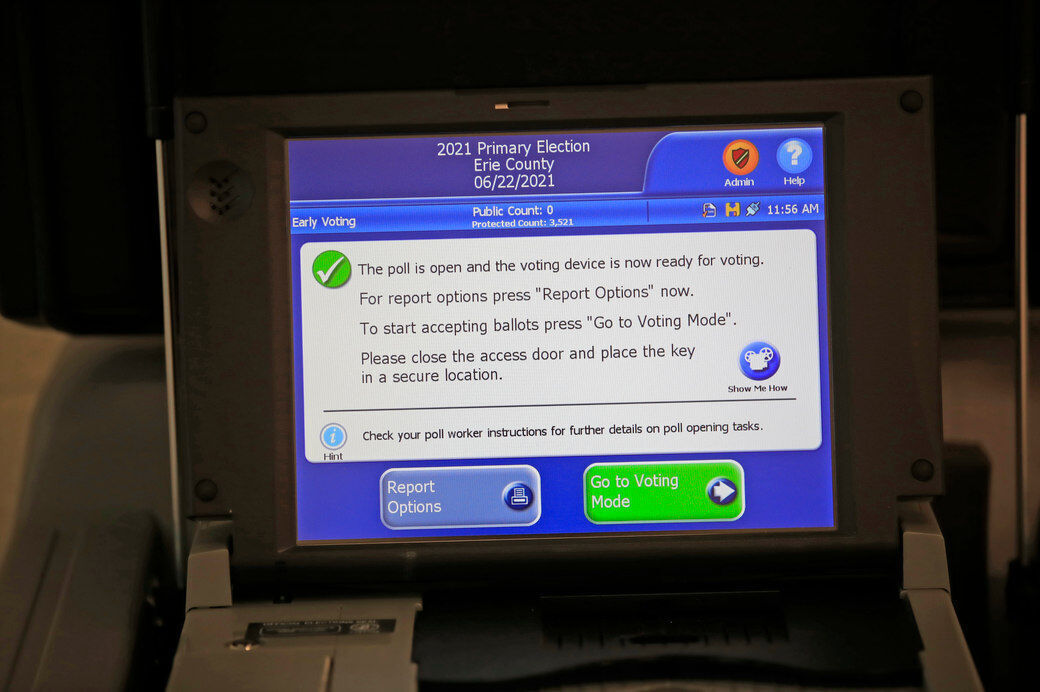
Turnout small as early voting begins for June 22 primary

Saturday was the first day of early voting for the June 22 primary election, but the scene bore little resemblance to those at early voting sites last year.

In 2020, 25.4% of Erie County registered voters – almost 168,000 people – took advantage of the nine early voting days before the presidential election. This year, with only local offices on the line, the numbers are dramatically smaller. 

Erie County Board of Elections commissioners Ralph M. Mohr and Jeremy J. Zellner announced after the polls closed at 6 p.m. Saturday that just 904 voters cast first-day ballots. 

Lines, which last year were long and common, were rare and short at the polling places The Buffalo News visited Saturday.

"I don’t know what kind of response we’re going to get. Primaries just don’t get a lot of people," said Lew James of Clarence Center, who was one of the few voters at Our Lady of Peace Catholic Church in Clarence at midafternoon.

“It’s easy but I think there should be more people out here. They should be out here voting because it’s important," said Margo Warr of Buffalo, who voted at the Delavan Grider Community Center.

“I wanted to make certain that nothing came up at the last minute and I didn’t get my vote in," said Adrienne Funderburk, who voted at the Amherst Senior Center.

In the June 2020 primary, which combined local offices, a presidential primary and a special election in the 27th Congressional District, about 3,600 people voted early in Erie County.

But this is the first time early voting has been tried for a primary in an odd-numbered year, in which federal and state offices are not on the ballot.

"It's an unknown situation, because we've never been in this cycle with early voting," said Jeremy Zellner, Democratic election commissioner in Erie County.

The civic group VOICE Buffalo tried to spur turnout with a "Souls to the Polls" block party outside the Delavan Grider Community Center.

Margaret Godson of Buffalo was among those lured in by the event, although she already knew Saturday was a voting day.

“Every day I take a walk. I didn’t even know this was going on and this is what stopped me," Godson said. "I heard music and I saw tables and people out, and saw all the signs and I said, ‘I’m going to vote.’ ”

This year, the featured races in Erie County are primaries for sheriff in both the Republican and Democratic parties, and a Democratic contest for mayor of Buffalo.

Buffalo Democrats also can weigh in on a primary for City Court judge. Hamburg has a Democratic primary for supervisor, and there's a GOP supervisor contest in Alden.

“I hope the Erie County sheriff’s race brings out a lot of people, because we’ve been under the supremacy of Tim Howard for far too long," Tanvier Peart of Buffalo said.

In Niagara County, the main event is a County Court judge primary in all four parties, including Conservative and Working Families as well as the majors. Niagara Falls also boasts a hotly contested four-party primary for City Court judge.

Both counties have kept their early voting formats from last year. Erie County offers 37 sites: one in each Buffalo Common Council district plus the Board of Elections' main office, and one site in all other towns and cities.

"It's yet to be seen how many people are going to take advantage of it," Zellner said. "I'm optimistic, because of the 37 sites. We have the most inclusive early voting program in the state. I think we're going to have a good turnout, but I do not know for a fact."

Niagara County offers only two sites: St. John De LaSalle Center, 8469 Buffalo Ave., Niagara Falls, and the Cornell Cooperative Extension at the county fairgrounds, 4487 Lake Ave., Lockport.

Registered voters may cast ballots at any early voting site in their county, regardless of whether they live in that city or town.

Early voting

A polling machine on the first day of voting at the Delavan Grider Community Center June 12, 2021.

Harry Scull Jr./Buffalo News

Early voting will continue every day through June 20. In Erie County, voting hours are noon to 6 p.m. on weekends and noon to 9 p.m. on weekdays.

In Niagara County, early voting hours are 10 a.m. to 3 p.m. on weekends; noon to 8 p.m. Monday and Tuesday; 9 a.m. to 5 p.m. Wednesday; and 7 a.m. to 3 p.m. Thursday and Friday.

Unlike last year, when absentee ballot applications were mailed to every registered voter in the state as a pandemic-fighting measure, this year the state has restored the regular system of making voters seek absentee ballots.

"It's no-excuse absentee, and anyone can go to our website, elections.erie.gov, and apply at our portal," Zellner said. "It's been slow, but steady."

Several minor parties no longer have a line on the ballot, although county boards of elections are still required to keep track of who belonged to them. Any party that couldn't muster at least 130,000 votes or 2% of the statewide total for president last year was knocked off the ballot.

GOP hopes for key win in Erie County Legislature's 4th District

Minor party primary races rarely attract much widespread attention, especially in an Erie County Legislature race.

But the Republican Party is trying to recapture the majority this year, and doing that may depend on the ability for a former foreman and restaurant employee to win the Conservative Party primary against a longtime Town of Tonawanda councilman.

Both men, Skip Kowal and John Bargnesi Jr., are running for the Legislature's 4th District seat, currently occupied by Republican-turned-Democrat Kevin Hardwick, who is now seeking election to the Erie County comptroller's seat. The 4th District encompasses the city and town of Tonawanda, as well as Grand Island.

Republican-supported legislators currently hold four seats in the 11-member county Legislature. They would need to pick up two in order to win a 6-5 majority. They are hoping one of those key wins may be Hardwick's 4th District seat, now that Hardwick is vacating it.

Some parts of the 4th District, particularly Grand Island, are more conservative leaning, which makes the seat a target in this election cycle.

If Kowal is unable to win the Conservative line in this month's Conservative primary election, the chances that he could defeat his Democratic challenger drop considerably, since the 4th District is Democratic leaning, and Kowal would carry only the Republican line, while Bargnesi would carry the Democrat, Conservative and Working Families lines.

Bargnesi is a Democrat, but has received the county's Conservative Party endorsement. Kowal is entitled to challenge him in a primary race because he's a registered Conservative.

The importance of the Conservative line is evident in past election results. Two years ago, Conservative Party line votes accounted for 29% of all votes cast for Hardwick's Republican opponent, Jacob McMahon. Hardwick still won reelection by 1,477 votes, despite switching political parties, but he had the benefit of a long incumbency and a growing overall Democratic voter base.

Bargnesi enjoys name recognition, a track record as a Tonawanda town councilman and deputy supervisor, and party support. But Kowal, a retired restaurant manager and bartender, says he has raised a competitive sum for his campaign and is presenting himself as a friend to small businesses who have been harmed by the economic restrictions related to Covid-19 over the past year. He won the Conservative primary for Tonawanda Town Board two years ago.

Here is a summary of who the two candidates are and what they stand for, based on their questionnaire responses to The Buffalo News:

Skip Kowal

Background: 64, lifelong Town of Tonawanda resident

Occupation: Retired restaurant manager and bartender, former construction labor foreman

Candidate history: Unsuccessfully ran for Tonawanda Town Board in 2019

Why he's running: "I am running for office to hold politicians accountable, rebuild our infrastructure and fight for the relief and economic opportunity the taxpayers deserve. One of the lessons learned from 2020 is how critical county government is – especially in times of crisis. ... After 12 years in construction and 37-plus years in the restaurant business, I know what it takes to make something from scratch. I want to put my experience to work for the people in my community to ensure they get the respect and attention they deserve."

Platform priorities:  

• Fully reopening Erie County after "harsh regulations and retributions" against businesses, schools and the community

• Supporting small businesses

• Holding politicians accountable

Party endorsements to date: Republican

Campaign money raised: $1,300 as of 32-day pre-primary report from May 21, but candidate says he has now raised $4,000. 

What distinguishes him from his opponent: "I'm not a politician. I'm a hardworking father and husband who believes in public service."


John Bargnesi

Background: 53, lifelong Town of Tonawanda resident

Occupation: Tonawanda deputy town supervisor, commercial landscaping business owner

Candidate history: Elected and reelected to the Tonawanda Town Board since 2005

Accomplishments in office: Kept property taxes under the state tax cap since it was first enacted, supported downsizing of the Town Board and enacted term limits, created the first suburban, townwide garbage tote program.

Platform priorities:

• Public safety and infrastructure improvements

• Working with all elected officials for the betterment of the community

• Creating economic opportunity and quality jobs

Party endorsements to date: Democratic, Conservative, Working Families

Campaign money raised: $6,400, based on latest 11-day pre-primary finance disclosure report.

What distinguishes him from his opponent: 16 years of experience on the Tonawanda Town Board as a councilman and deputy supervisor in one of the county's largest suburbs, ability to interact and collaborate with others, "finding real solutions to real problems," and understanding the challenges of running a business as a small business owner for 34 years.

'Fraud' is latest charge in Hamburg highway superintendent race

When Hamburg Highway Superintendent Ted Casey saw a record indicating his opponent, Ed Hughes – who also works for the town Highway Department – had filed for unemployment benefits, he cried fraud.

There was indeed fraud going on – but Hughes was the victim of it, not committing it, according to both Hughes and the Blasdell village administrator.

Hughes was endorsed by the Hamburg Democratic Committee for highway superintendent. He will face Casey, who is seeking reelection and had the Democratic nod four years ago, in the June 22 primary.

Casey provided The Buffalo News with a state Labor Department form disputing unemployment benefits in May 2020 to Hughes, who has been a part-time police officer for the Blasdell Police Department for 21 years. Casey accused Hughes of intentionally providing "false and inaccurate information" to the state.

"Ed Hughes has knowingly committed fraud," Casey said in a press release.

But Blasdell Village Administrator Janet MacGregor Plarr said Hughes was one of several village employees whose names were used by someone else to file false unemployment claims.

"There have been many, many cases of people getting notified they filed for unemployment. I, being one, our village prosecutor, our judge," she said. "Somehow our data was breached and people filed for unemployment."

Erie County District Attorney John J. Flynn announced last year that someone had filed an unemployment claim using his name and personal information.

“If it can happen to me, the chief law enforcement officer in the county, it can happen to anyone,” Flynn said in March 2020.

Watch now: Gov. Andrew Cuomo defends unemployment insurance

People committing unemployment insurance fraud often target those who are employed, because they are less likely to have an open unemployment claim, according to the Labor Department website. Those who work in health care, education, government and nonprofits have been particularly impacted, and the information likely came from a previous data breach, according to the Labor Department.

Hughes, an acting foreman who has worked for the Hamburg town Highway Department for nearly 27 years, also said the charge was false.

"I was getting full benefits from the town. Why would I need unemployment?" Hughes said.

Hughes has been a firefighter with the Big Tree Fire Company for 39 years, serving several stints as chief.

Casey beat the incumbent to be elected highway superintendent in 2017, and he points to a resident complaint tracking system as one of his accomplishments. The program has been recognized by the Cornell Local Roads Program's "Build a Better Mousetrap" state competition, which is entering it in a national competition. Casey said highway employees call every resident who has contacted the department with a concern or complaint to check on the complaint, and to ask them to rate the highway service. 

Supervisor James M. Shaw and a Highway Department union official questioned recent phone calls to residents, suggesting they were part of Casey's political campaign to get his name before voters. Shaw said not all calls went to people who had contacted the department, because his wife got a call from highway staff in April.

Casey said the supervisor's wife had called the highway department April 28, 2018, three years before the supervisor said she was contacted by highway workers.

"It's customer service," Casey said, denying the program is tied to his reelection efforts.

Independence and Green ballot lines are gone. So candidates are making their own

What are enterprising political candidates to do when needing another ballot line and old stand-by parties like Independence and Green have gone the way of Whigs?

They form their own party, of course.

A host of candidates throughout Erie County this week filed petitions with the Board of Elections sporting unique monikers like Integrity, Back the Blue, Public Service or Justice and Peace. For the most part, they are formed by Democrats and Republicans who hope for another minor party line to attract voters of all stripes.

And while creating "temporary" independent lines is nothing new in New York elections, their proliferation this year after former parties failed to achieve "permanent" ballot status is proving not only noteworthy but a potential factor in November, too.

"There are only four parties on the ballot now," said Jeremy J. Zellner, Erie County's Democratic elections commissioner, "so creating a line makes more sense than in the past when we had seven or eight parties on the ballot."

In his dual capacity as Erie County Democratic chairman, Zellner has overseen some in his party circulate designating petitions for the Integrity Party. The new line (like the others) features no real organization or structure but allows several Democratic candidates to offer a voting alternative on the ballot. They include comptroller candidate Kevin R. Hardwick, endorsed sheriff candidate Brian J. Gould and Family Court candidate Sharon M. Lovallo.

Republicans are using the tactic to a greater degree this year, too. John C. Garcia, vying for the GOP sheriff nomination, has submitted petitions for two parties – Back the Blue and Guardian. Democrat Kimberly L. Miller-Beaty, meanwhile, has established the Justice and Peace Party after she earlier lost a bid for the permanent Working Families line.

In Amherst, four of Chairman Brian D. Rusk's Republicans have filed for the United for Amherst line. He says many in the GOP no longer covet the Conservative nod.

"The Conservatives in Amherst have been taken over by liberal, union Democrats," he said. "The Conservative Party in Amherst has lost its compass."

A new party is surfacing in Hamburg town races, too. Stefan I. Mychajliw Jr., the county comptroller who is running for supervisor, is joining other GOP types on the Support Police line. He says the effort is to attract those not interested in "defunding the police."

"They can vote for radical progressives or true conservatives," he said, adding elimination of former alternatives like Independence makes the new lines "critical."

"The more lines you have, the better your chances," he said.

One candidate, however, has shunned the major parties and is concentrating all his efforts on a new independent line called Public Service. Theodore C. Dinoto, the Amherst detective lieutenant running for sheriff, said he received "quite a lesson in politics" after failing to gain the Republican endorsement that went to retired Buffalo Lt. Karen L. Healy-Case. He now plans an organized but independent campaign running on a six-figure budget (including $50,000 from his own funds) that will denounce "political" control of the Sheriff's Office.

"I came to realize there are political agendas involved and that's not necessarily the way I police," Dinoto said. "I didn't want any party or political boss influencing me or interfering with my job.

"The decisions will be made by me, as a 30-year law enforcement professional," he added, "and not by someone feeling they assisted in getting me there."

Former County Executive Joel A. Giambra, one of Dinoto's main supporters, personally gained many of the 750 signatures required to establish an independent line. He enlisted 43 "friends and family" to help circulate the petitions.

"We got almost 2,200 signatures, and because we did not have party backing, we didn't have all kinds of government employees working on the campaign," he said.

Giambra claims that Dinoto is running a truly independent effort unaffiliated with either Democrats or Republicans.

"These other people are trying to hedge their bets," he said.

Nevertheless, conflict is developing over the some of the independent lines. Clarence political consultant Christopher M. Grant, assisting sheriff candidate Healy-Case (already backed by the established Conservative Party and who did not establish another line), said he expects her campaign will challenge GOP rival Garcia's minor party effort.

He said she will challenge Garcia's Guardian emblem that too closely resembles the Statue of Liberty (not allowed), while a flag in Back the Blue's logo is also not permitted.

Grant said the Healy-Case challenge to Garcia's independent lines extends beyond logos. If Garcia loses the Republican primary to Healy-Case on June 22, Grant said, it will be prove virtually impossible for him to win the November general election on minor lines. And he said Garcia will then siphon Republican votes in November (though if Garcia wins, Healy-Case could also attract general election votes on Conservative).

"No one in history has won a countywide election on just two minor party lines," he said. "This clearly just a sour grapes effort in the general election to be a spoiler when Karen wins the Republican primary." 

Analysis: Erie County's surprising sheriff's race

Some thoughts and observations on politics around here:

• Who would ever believe that the election for Erie County sheriff would spark two major party primaries attracting five candidates?

Even the most veteran political observers cannot recall a Republican primary for sheriff. But this year, a major primary standoff is developing between endorsed candidate Karen Healy-Case and John Garcia. The Dems (more used to primaries) feature a contest with endorsed candidate Brian Gould plus Kimberly Miller-Beaty and Myles Carter.

The sheriff’s election – of all things – is fast becoming the marquee race of 2021.

• The primary contest for mayor of Buffalo, meanwhile, may be assuming a back seat to the hotter election for sheriff. But that’s not due to any lack of effort by challenger India Walton. She is facing incumbent Mayor Byron Brown, who is seeking an unprecedented fifth term. As The Buffalo News reported last week, Walton is raising respectable campaign funds – enough to finance a spirited effort that Brown will be unable to ignore.

Walton once again last week castigated Brown for refusing to debate her in a public forum, a move she calls a “disgrace.”

• And as long as we’re wondering out loud this Memorial Day weekend, why is the “shelf life” factor not a problem so far for Brown? Only Jim Griffin and Brown have won four mayoral elections in Buffalo’s long history, and Griffin recognized at the end of his 16-year run that the time had come to leave.

Other executives such as Gov. Mario Cuomo and Erie County Executive Dennis Gorski failed to recognize that, and lost their bids for fourth terms.

But for Brown, the “too long” argument did not work against him in 2017, and it ranks only as a quiet issue so far in 2021.

• On the judicial front, Gov. Andrew Cuomo last week nominated Nassau County District Attorney Madeline Singas to the Court of Appeals – the state’s highest court – to fill the vacancy of retiring Judge Leslie Stein. He also named Judge Anthony Cannataro, administrative judge of the New York City Civil Court, to replace the late Judge Paul Feinman. They were selected from a list submitted to the governor by the Commission on Judicial Nomination.

The selections mean that two Buffalo judges included on the list for Cuomo’s consideration – Appellate Justices Shirley Troutman and Erin Peradotto – failed to make the cut for the latest appointments.

But a Western New York appointment is usually reserved for the high court, and the governor may consider a Buffalo candidate again in 2022, following the Dec. 31 retirement of Judge Gene Fahey of Buffalo.

Peradotto, meanwhile, became a Democrat in 2020 after running for State Supreme Court as a Republican in a move that surprised the chairmen of the local Democratic, Republican and Conservative parties.

• Still on judges, a number of names have surfaced in recent weeks for consideration for three State Supreme Court seats. Republican incumbent Frank Caruso will prove a top GOP priority, sources say, while other Republican names include Family Court Judge Deanna Tripi and Orchard Park Justice Jorge de Rosas. Democratic names include Grace Hanlon of Chautauqua County, who ran unsuccessfully in 2016, and Buffalo attorney John Licata.

The Erie County Bar Association, meanwhile, has issued its annual ratings of Supreme Court candidates it has considered so far: Caruso – Outstanding; Hanlon – Well Qualified; Licata – Well Qualified.

• Some major Republican names passed through our town over the past few days. Rep. Claudia Tenney of Central New York spoke at the annual Amherst Republican dinner a few days ago, with Chairman Brian Rusk reporting the congresswoman offered a major pitch for gun rights and renewed efforts to register Republicans before the next congressional election. And sources report that Todd Ricketts, vice chairman of the Republican National Committee, also met with several party faithful a few days ago at a “friendraiser” aimed at potential donors.

Party flip-flops, loyalty to Trump dominate GOP contest for Erie County sheriff

Karen L. Healy-Case, the retired Buffalo Police Department lieutenant and endorsed Republican candidate for sheriff, is working hard this election season to label her opponent a "never Trump" newcomer to the GOP with no business running in the party's primary.

"John Garcia only switched to Republican to run this race," she said of her primary challenger, a retired Buffalo detective. "He had no interest in being a Republican all those years ... when I've actively contributed to the success of this party for 10 years."

Garcia acknowledges he switched party affiliation from Democrat to Republican only last fall, but thinks his conversion pales in comparison to Healy-Case's political allegiances. Since 2004, he points out, his opponent has changed parties seven times.

"I've never heard of a person doing that," Garcia said. "To switch over seven times is the sign of an opportunist with no strong beliefs."

John C. Garcia (copy)

John C. Garcia, who is seeking the Republican nomination for Erie County sheriff in 2021, in a file photo from Feb. 26, 2016. 

Derek Gee/News file photo

In the Republican primary for sheriff, Healy-Case and Garcia tout their law enforcement credentials just as "top cop" candidates always have. But each former Democrat is also defending their often fragile ties to the GOP. They also vie to outdo each other in proclaiming loyalty to Donald J. Trump – almost required in a Republican Party still centered around the former president.

Indeed, Healy-Case last week began mailing fliers to GOP voters claiming Garcia voted as a Democrat in 2016 to "STOP Donald Trump from being President."

"Don't be fooled by Garcia," the flier proclaims. "He's a Never-Trump Democrat in disguise."

How long each candidate has proclaimed their loyalty to the Republican Party now dominates an increasingly competitive – and negative – primary contest. Healy-Case insists that Garcia could attract no attention among Democrats as a sheriff hopeful – so he joined the Republicans.

Garcia has no history with the party, she says, and produced her own research showing he voted in the 2016 Democratic primary for president. That can only mean, she concluded, that Garcia voted for Hillary Clinton or Bernie Sanders – the two Democratic contestants.

Garcia, meanwhile, says he voted for Trump in the 2016 and 2020 general elections, and for "none of the above" in the Democratic primary – even though New York has no such option on the ballot. Though he went to the polls that April 2016 day to vote in a primary featuring only Clinton and Sanders, he says he cast his ballot for neither.

Healy-Case doesn't buy it.

"There were only two candidates – Hillary or Bernie – so he voted for one of them," she countered. "Who else did he vote for? Mickey Mouse?"

Garcia acknowledges he switched affiliation when it came time to run for office because Democrats no longer represented the "party of JFK that took care of the working person but had gone so far left."

"When I decided to run for sheriff I switched over to Republican because I identify with the conservative voter," he said. "And I was outraged by things like bail reform.

"I'm not a political person," he added. "Registering in either party did not identify who I was."

But, he said, his one-time conversion cannot compare to his opponent's registration history.

"It's not even apples to apples," he added. "I switched over once. She switched over seven times."

Indeed, Board of Election records show Healy-Case changing from Democrat to Republican in 2004, Republican to Democrat in 2005, Democrat to Republican in 2006, Republican to Democrat in 2007, Democrat to Republican in 2011, Republican to Conservative in 2013, and Conservative to Republican in 2015.

"I don't know if it is unusual or not unusual," she said. "I don't think it has any impact on this race. I've been a strong Republican for over a decade [she rejoined in 2015] and have not wavered on principle."

She ran unsuccessfully for Lancaster Town Board in 2009. That year she was a Democrat.

In 2011, she also expressed interest in the Democratic nomination for sheriff and was interviewed by party officials in a process that eventually settled on Cheektowaga Police Capt. John A. Glascott.

"I was never really considered," she said now.

Healy-Case says she does not believe her history of party flip-flops will hurt her effort in the primary and general elections. How does she explain such a complicated voting history? This week she said she was "young" during several of her party switches, and that she is a person of "strong opinions."

"I changed my voter registration freely because the Democratic Party left me behind a long time ago," Healy-Case said.

Miller-Beaty gains key backing from Burke in Democratic primary for Erie County sheriff

Democratic sheriff candidate Kimberly L. Miller-Beaty picked up her most significant endorsement to date Friday when Assemblyman Patrick B. Burke announced his support.

Burke, a Democrat from Orchard Park, broke with the leadership of his own party and its endorsement of Brian J. Gould, assistant chief of the Cheektowaga Police Department.

"As a state assemblymember I'm technically a party leader," he said of the split with officials. "But I just felt compelled to do this because I think she is the best candidate."

Miller-Beaty, former deputy commissioner of the Buffalo Police Department who now heads security for Canisius College, is challenging Gould for the party nomination in the June 22 primary. Activist Myles L. Carter is also competing.

The winner of the Democratic primary will face in the November general election either Karen L. Healy-Case, a retired Buffalo lieutenant, or John C. Garcia, a retired Buffalo detective. Both are competing in the Republican sheriff primary. 

But because Miller-Beaty has been forced to campaign apart from party regulars as a challenger to the endorsed candidate, backing from a state lawmaker now carries weight. Burke hopes it will spur others to follow his lead.

"I think most people within the party structure feel the same way," he said. "Whether they will follow or not, I don't know."

Burke, who has earned an independent label during his time serving in the county Legislature and Assembly, said the party should not overlook a candidate like Miller-Beaty. He compared her to 2020 Democratic presidential candidate Hillary Clinton as the kind of accomplished woman Democrats should embrace.

He says the party made the wrong choice by endorsing Gould.

"I just think they made a mistake," he said.

Candidates for Erie County sheriff, Buffalo mayor report fundraising

The two Republican candidates for sheriff who will face each other in their party's June 22 primary are locked in a fierce battle for campaign funds.

John C. Garcia and Karen L. Healy-Case are reporting six-digit figures as they compete in an unprecedented GOP primary.

The latest campaign finance reports to the state Board of Elections show Garcia raised about $191,000 with almost $148,000 on hand. Healy-Case, the endorsed Republican, has been unable to file because of software problems at the board, her campaign said, but disclosed she raised about $148,000 since January and has a balance of about $133,000.

And in the so far quiet Democratic primary for mayor of Buffalo, the new reports show challenger India B. Walton raised about $84,000 as she takes on incumbent Byron W. Brown.

As he promised early on, Garcia is demonstrating early strength with contributions to date.

"It's a great indication of my support," Garcia said Wednesday, "with many people from all political affiliations."

Ellen Przepasniak

He said he has since added $5,000 from a fundraiser last week in Orchard Park, with several more planned – including a June 10 event that he expects will draw 250 to 300 supporters.

Supporters of Healy-Case, meanwhile, also touted the retired Buffalo police lieutenant's ability to raise campaign funds. She did not return a phone call Tuesday, but campaign consultant Christopher M. Grant said her submitted report was unable to be registered on the board website. Already she is airing a planned $100,000 worth of television ads emphasizing her experience and opposition to what she describes as "unconstitutional mandates" imposed by New York State.

Previous records indicate she loaned her campaign $28,000, while Garcia chipped in $50,000 of his funds.

"Setting aside the loans, she has outraised him in donations," Grant said.

Stephen Felano, a gun rights advocate who had previously announced his GOP candidacy and filed a campaign finance report in January, is out of the race. Board of Elections officials say he failed to submit enough signatures on designating petitions to qualify for the primary.

Democratic filings, meanwhile, so far depict a sheriff's race far less awash in campaign funds. Brian J. Gould, the Cheektowaga assistant chief and endorsed Democrat, has raised almost $58,000, with about $21,000 on hand. He has also been on cable television and in digital media. His contributions reflect his status as the party candidate, with $3,000 from Cheektowaga Democrats, $7,000 worth of in-kind support from the Erie County Democratic Party, and $1,000 from Democratic Chairman Jeremy J. Zellner.

Gould also loaned his campaign $4,000.

His main rival in the Democratic primary, Kimberly L. Miller-Beaty, raised almost $34,000 and reported a current balance of almost $19,000. The former deputy commissioner of the Buffalo Police Department, Miller-Beaty reported mostly small contributions, with six at the $1,000 level. She received $2,500, her highest contribution, from John Hurley, president of Canisius College, where Miller-Beaty is director of security.

Myles L. Carter, who has been active in civil rights causes and is also a candidate in the Democratic primary, reported he raised about $4,600 with a balance of about $1,900.

In the contest for mayor, Brown's report also did not appear on the Board of Elections website. Jessica Smith, his treasurer, said the campaign submitted a report that did not register because of software problems at the board.

"It is a widespread issue with many campaigns across the state," she said.

Board spokesman John W. Conklin acknowledged software problems occurred on Friday, but that other campaigns were able to report by continuing to attempt filings.

"We're telling them to keep trying until they get through," he said.

Smith said the campaign reported raising about $173,000 during the last period, with $207,000 now on hand.

While nowhere near the mayor's totals, Walton noted significant strength in her campaign by raising almost $84,000, with about $53,000 on hand.

Her report featured several substantial contributions, including $5,200 from Carl Nightingale, $5,000 from Jason Katz-Brown and $5,000 from Martha McCluskey. She reported one contribution of $20,040 with no attribution.

"Not too shabby for a girl not taking money from corporate interests or developers," Walton said Tuesday. "It's all grassroots fundraising from folks all over the country."

In another mayoral development, Walton called Brown's failure to accept her challenge to debate "nothing short of a disgrace."

Democratic sheriff candidates press for change, de-escalation

Democratic candidates for Erie County sheriff agreed on this at their debate Monday: Change is needed at the Sheriff's Department.

The candidates said they would find alternatives to solitary confinement in jail, train officers in de-escalation techniques and hold deputies and officers accountable for their actions.

Sheriff's candidate: Party chairman said she's 'not what a sheriff looks like'

Sheriff's candidate: Party chairman said she's 'not what a sheriff looks like'

Party Chairman Jeremy Zellner denies he told Kimberly L. Beaty she had the wrong look.

The Democratic primary contest features Cheektowaga Assistant Chief Brian J. Gould; former Buffalo Deputy Commissioner Kimberly L. Beaty-Miller, now director of public safety at Canisius College; and activist and businessman Myles L. Carter.

They attended a debate sponsored by VOICE Buffalo at the Buffalo & Erie County Library on Monday. The non-partisan group said it reached out to all candidates running for sheriff. Republican candidate John C. Garcia, a retired Buffalo detective, declined to attend because of another engagement, and the group did not hear from the endorsed Republican Karen Healy-Case, a former Buffalo police lieutenant.

Much of the forum was focused on operations at the Erie County Holding Center and at the Erie County Correctional Facility in Alden, where inmate deaths and accusations of police misconduct have prompted criticism of the Sheriff's Office. 

Sheriff candidate stayed silent as man charged in fracas became cop who later decked his boss

Brian Gould, the Democratic Party nominee for Erie County sheriff who is heading into a party primary, has twice been suspended, once in 2014 and again in 2017, records show.

Gould, who is the endorsed Democratic candidate in the June 22 primary, said he would make decisions based on safety. Giving inmates access to activities, libraries and phone calls will improve morale and help keep inmates safer, he said. 

"We don't necessarily have to reinvent the wheel with everything we do," Gould said. "The culture of our current Sheriff's Office needs to change." 

Gould said he developed crisis intervention training for Cheektowaga police, and he would invest in properly training deputies and corrections officers.

Carter said on his first day in office he would implement Cariol's Law for the Sheriff's Department, holding deputies liable if they fail to report instances of brutality and police misconduct. 

He would have fewer deputies and hire people trained in mental and behavioral health and drug abuse counseling. 

"The No. 1 reason people are committing crimes is because of poverty," Carter said.

Buffalo resident talks of 'nasty' treatment years ago from cop who wants to be sheriff

Buffalo resident talks of 'nasty' treatment years ago from cop who wants to be sheriff

The News has been gathering disciplinary records of sheriff candidates with law enforcement backgrounds now that those records are public documents in New York.

Miller-Beaty said she would lead by example.

"Leadership starts at the top," she said.

She said de-escalation training is needed to protect civilians, inmates and officers. 

"You're better communicating with people and using your verbal skills," she said. "We need to do de-escalation training to prevent injury and to prevent deaths."

Gould, Carter and Beaty said there needs to be an alternative to solitary confinement.

"Sadly, there are times when people need to be isolated from the general population," Gould said. 

He said he would look to what leads to the behavior and work to prevent the disrupting behavior, and would look to a restorative housing model.

SAFE Act enforcement emerges as key issue in Erie County sheriff race

As several candidates spar over enforcing the strict gun control law known as the SAFE Act, a major pro-Second Amendment group is assailing endorsed Republican Karen L. Healy-Case. 

Miller-Beaty said at the onset of an arrest, a person begins to feel isolated.

"We need for people to thrive and survive in incarceration. They cannot thrive away from other people," she said. "Jail is not a walk in the park, but they need to know they are going to survive and be safe." 

Carter said he would end solitary confinement.

"We will find an alternative," Carter said.

He also wants to de-prioritize low-level marijuana infractions, devote more resources to missing persons and solving homicides and he would hire jail chaplains instead of using volunteers. 

If the Holding Center and Alden facility are consolidated, he would build on programs, particularly training inmates. 

"We need to make sure people come out with specific skills," Carter said.

SAFE Act enforcement emerges as key issue in Erie County sheriff race

It seems most appropriate in the unconventional 2021 contest for Erie County sheriff that the issues are unconventional, too.

At least seven candidates on major party and independent lines are emphasizing everything from police brutality to refusing enforcement of "unconstitutional" mandates – topics raised this year more than any previous law enforcement election.

Now, as several candidates spar over enforcing the strict gun control law known as the SAFE Act, a major pro-Second Amendment group is assailing endorsed Republican Karen L. Healy-Case. Its president says she called for tougher gun laws as a Buffalo Police Department lieutenant, while promising "non-enforcement" of certain SAFE Act mandates as a candidate.

The 1791 Society's Frank J. Panasuk has been leading the charge against Healy-Case despite her emphatic refusal to enforce SAFE Act provisions she considers unconstitutional.

"Will you believe what she is now saying to get elected or what her real feelings are that were made public long before she was running for sheriff?" he asked in a recent post to the group's Facebook page followed by 25,000 people.

Panasuk, a retired detective in the Town of Hamburg Police Department who is active in the local gun rights community, points to a 2006 Healy-Case quote after two fellow officers were shot on Elmwood Avenue. One of them, Officer Patricia Parete, later died of her wounds. At the time, Healy-Case blamed weak gun laws and a revolving-door criminal justice system in Buffalo. Too many teenagers with guns, she said then, get too many breaks.

"I'm seeing kids 13, 14 and 15 years old with guns now," she told The Buffalo News in 2006. "People in this country should be stamping their feet and demanding stronger gun laws.

"I'm sick over what happened to her," she added. "It's scary when two of your own are shot, and citizens should be scared, too. A guy who is going to shoot at police officers is going to shoot at anyone."

Panasuk says his group is backing John C. Garcia, a retired Buffalo detective and another Republican sheriff candidate, because it does not accept Healy-Case's new views as genuine.

"That's what you say when you want to get votes," he told The News this week, citing changes in gun control attitudes among other politicians. "We've seen too much bait and switch."

Healy-Case said this week that her 2006 quotes need to be put "in perspective."

"That was a long time ago and two officers had been shot," she said. "And I was not talking about going after licensed gun owners. They're trying to paint me as anti-gun, and I am a very strong supporter of the Second Amendment."

Now working in private security, Healy-Case labels a "liar" anyone who suggests she does not support strong gun rights. She says her philosophy on the issue is easily summarized.

"I want as many good people as possible to have guns so as they are not left undefended against the bad guys," she said, denying any suggestion her 2006 comments point to a lessening resolve to resist certain aspects of the SAFE Act.

"I never back down," she said. "I believe it's an unconstitutional mandate, I believe in the U.S. Constitution as it stands, and I don't believe the people in Albany should be making those decisions for us."

Garcia, meanwhile, has received a $2,500 donation from the 1791 Society. Panasuk said the group endorsed his aim to enforce the SAFE Act "as it pertains to criminal intent."

"The key is criminal misuse of firearms and not pursuing gun owners who have no criminal intent," he said. "He won't be out there looking for technical violations."

And Garcia told The News that while he sees no need to "subject law abiding citizens" to certain aspects of the law, he wants "the criminal element to answer."

"The 1791 Society is pro-Second Amendment, but they understand we can't have criminals carrying guns," he said, adding some parts of the SAFE Act remain unenforceable "because we just don't have the resources."

He differs from his opponent, he said, over how politics may shade their views.

"I'm not going to be political about this," he said. "This will be common sense enforcement."

Another Republican, Steve Felano, is also running for the nomination on a strong pro-Second Amendment platform.

The issue has not dominated the Democratic primary contest featuring Cheektowaga Assistant Chief Brian J. Gould, former Buffalo Deputy Commissioner Kimberly L. Beaty-Miller and activist Myles L. Carter.

Gould, meanwhile is slated to begin airing ads on cable television this week introducing him as the endorsed Democrat with strong credentials. He said his push is to make Erie County "proud of the Sheriff's Office again," and is not emphasizing the same issues as his GOP counterparts.

Amherst Detective Lt. Ted DiNoto is expected to file later this month for an independent line in the race.

Buffalo resident talks of 'nasty' treatment years ago from cop who wants to be sheriff


Sheriff’s candidate Kimberly Beaty has two cases of “discourtesy” on the disciplinary record created during her almost 28 years with the Buffalo Police Department.

Neither case involved the arrest of Lizzie M. Rodgers.

Because of a chance encounter with Beaty and her partner, Rodgers went from being a passenger in her husband’s car to a handcuffed defendant in a flash.

“She was really nasty,” Rodgers said of the way Beaty treated her when she was a young officer in September 1989.

Rodgers and her husband, Calvin, were returning home to Purdy Street around 5 p.m. Suddenly a police vehicle backed out of an alley near their home, and Calvin Rodgers braked to avoid it, he said.

Words were exchanged, and then-Officer Clay Twitty pulled his car up to the other vehicle to ask, “You got a problem with that?” the couple recalled.

Calvin Rodgers admits that when he was 34 years old he would freely convey his opinion. He said he told Twitty he should have activated his emergency lights when he backed out of the alley.

Lizzie Rodgers said some things, too. Soon, she said, Twitty and Officer Kimberly Miller – as Beaty was known when she had roughly three years on the job – pulled Mrs. Rodgers from her seat.

Lizzie Rodgers said she asked at least twice why she was under arrest, and each time Beaty or Twitty or both told her to “just shut up.” She complained to both officers that the handcuffs were too tight but neither seemed to care, she said. Lizzie Rodgers said that as she sat in the back of the squad car, both officers ridiculed her and even made fun of her wig.

“I do remember it,” Beaty said when asked about the arrest recently.

“I don’t want to say anything disparaging about her. I hope it is something she has been able to get past. But at the end of the day, she was rude,” Beaty said of Lizzie Rodgers.

“Officer Twitty made the arrest,” Beaty recalled, “and he didn’t do anything wrong, but she just became more and more uncooperative.” Beaty added: “If Officer Twitty had done something wrong, I absolutely would have intervened on her behalf.”

Twitty, when reached recently, said he did not remember the episode. 

Calvin Rodgers, who said Beaty followed the tone set by her partner, filed a complaint with a lieutenant but no one followed up. Beaty’s disciplinary record shows no sign that an internal affairs case was opened.

The charges of disorderly conduct, resisting arrest and harassment against Lizzie Rodgers were eventually dismissed in City Court, The Buffalo News reported in 1991 in an article revealing that the couple had filed a federal court lawsuit over the arrest. The records from the lawsuit are no longer available, but they say their case failed when the city produced a witness who reported Lizzie Rodgers had yelled at the officers.

“If there were cellphones at the time, it would have been a slam dunk case,” Lizzie Rodgers said.

The couple had been married for just a few months at the time of the arrest. She worked as a baker at Wonder Bread, and he was a cleaner at the Buffalo Psychiatric Center, she said.

Beaty said she was personally hurt, and stunned, that Calvin and Lizzie Rodgers filed a lawsuit because she and Twitty did nothing wrong.

“I would never do anything to disparage a person intentionally,” she said.

Beaty is heading into a Democratic Party contest against Brian J. Gould, Cheektowaga’s assistant police chief, and Myles Carter, an activist who has not been a police officer.

She said she wants to restore the community’s trust in the Sheriff’s Office and will focus on better training personnel for the road patrol and overseeing the Holding Center downtown and the Correctional Facility in Alden. Thirty-one county inmates have died in custody since Timothy B. Howard became sheriff in 2005.

"I believe the people of Erie County deserve a professional police department. And they need so much more, and they need it right now," she said. 

Discipline records

As the party primaries approach, The News has been gathering the disciplinary records of sheriff candidates with law enforcement backgrounds now that those records are public documents in New York.

Records obtained by The News show Gould once pushed and punched a handcuffed defendant who spit on him. As a sergeant working his way up the ladder, Gould said nothing in 2010 as his department hired a man his team had arrested one year earlier for assault during a neighborhood fight. As an officer, the man later punched out his sergeant at an off-duty event.

A Republican candidate, Karen Healy-Case, was found negligent in an on-duty car accident that cost the City of Buffalo $825,000. Another Republican, John C. Garcia, arranged a drug raid that led to the death of a dog and a $110,000 court settlement after it was alleged that his narcotics team hit the wrong residence. A judge found Garcia’s deposition testimony for a civil suit contradicted other facts that had been uncovered.

Beaty said she supports Albany’s shift to make police disciplinary records public. “I think it is important as public servants that we are open,” she said, adding later, “we can’t have rogue cops on the street. Those files reveal a picture.”

Her “disciplinary card,” an index of her cases, lists 10 incidents, but she was cleared in nearly all, including two opened for “discourtesy” and another for “poor service.” A police spokesman said the underlying records on those three, from the mid-1990s, no longer exist. But all would have involved complaints about her because a record shows letters went to each complainant stating the outcome of the investigations – “exonerated” in two and “not sustained” in the third.

Said Beaty: “I would never want someone to think I was discourteous or treated someone with less than the dignity and respect they deserve.” She added, however, that “sometimes you have to be a little bit more firm when you speak to people and when you are giving people orders – and people may be a bit put off by that. But I certainly was not disrespectful when I did, it in my manner or my tone.”

In more cases in which records are available, she was reprimanded for causing a property damage accident when backing out of a police station lot in the summer of 2010.

Political flap in 2013

Beaty rose consistently through the ranks and as a district chief in 2013 appeared in a campaign advertisement for Mayor Byron W. Brown, in uniform and with police cars as a backdrop. Brown’s Republican opponent in that race cried foul, as did the Police Benevolent Association. But state election law bars police officers from using their “official power or authority” for political advantage. No one found she had done so, and the flap died out.

Beaty doesn’t regret being part of the ad.

“I was proud that I was a part of the police administration, and identifying with the mayor’s campaign and his positive goals for the City of Buffalo was not a problem for me,” she said.

Cited in labor grievance

In 2018, as Beaty was closing out her Buffalo police career and heading to Canisius College to head its Department of Public Safety, she defended actions that had denied thousands of dollars in overtime to a captain who had been her supervisor when she was assigned to the police academy.

An arbitrator determined that the city, through Beaty, violated three articles of its contract with the PBA, including one protecting employees from “discrimination and coercion.” Beaty, as deputy police commissioner, had required staff at the shooting range to complete daily activity reports. While the arbitrator wrote that the city could require such reports to control overtime, it also appeared to be a punishment directed mainly at Capt. Patrick Mann.

The arbitrator’s decision, first reported by WKBW-TV, describes Mann testifying that Beaty told him she was unhappy with the way he performed his duties, he was “disrespectful and insubordinate” and was barred from overtime.

The arbitrator ordered the city to compensate Mann for the overtime he lost over roughly a year. A Buffalo police official said the city ended up paying Mann, who is now retired from the force, $10,202.

Beaty said the labor grievance has been dug up now to damage her candidacy.

“I have no ill feelings toward Capt. Mann,” she said, but explained, as she did to the arbitrator, she had issues with his job performance.

“Overtime is not an entitlement program,” she said.

Convoluted Erie County sheriff race spawns rare Democrat-Working Families rift

It's always seemed a good bet that Western New York's left-leaning Workers Family Party would back Democratic candidates each election.

But it's different this spring in the crowded and convoluted contest for Erie County sheriff.

Leaders of both parties are trading jabs at each after failing to agree on a sheriff candidate, leaving the Working Families line blank for the election in November and eliminating a place for those looking to vote elsewhere than the Democratic line.

It all stems from this week's move by Erie County Democrats to oppose designating petitions for sheriff filed at the Board of Elections for Joshua Goldfine, a Greene County attorney acting as a Working Families "placeholder" after the minor party temporarily passed on any of the Democratic contenders: Brian J. Gould, who's endorsed by Democratic leaders, as well as Kimberly L. Miller-Beaty or Myles L. Carter.

Working Families spokesman Dave Chudy explained earlier in the week that the minor party wished to make no choice in the Democratic field, especially after the confusion created by the withdrawal and then re-entrance of Miller-Beaty into the race.

"We don't want to be a spoiler," Chudy said then, explaining Working Families aimed to preserve its option of replacing Goldfine on the ballot with the eventual winner of the June Democratic primary, as well as attempting to avoid splitting votes against the eventual Republican opponent in November. He also said Gould "did not have the votes" among the Working Families Party executive committee, and the party offered only a placeholder because any other candidate would have weakened Gould on the Democratic line.

But on Monday the board rejected Goldfine's placeholder candidacy because his petitions lacked enough valid signatures, according to Democratic Elections Commissioner Jeremy J. Zellner, who is also county Democratic chairman.

"We at the Democratic Party are not going to run with the Working Families Party," Zellner said. "We designed, carried, filed and numbered their petitions ... but they didn't do anything.

"They were completely inept," he added, "and now their line is dead in the fall for sheriff." 

Gould on Tuesday issued a statement separating himself from Working Families and echoing the Democratic message. The endorsed Democrat and assistant chief of the Cheektowaga Police Department said his Working Families interviews established no sense of "trust."

"It was clear their vision and goals for law enforcement differ dramatically from mine," Gould said. "I was pressed on whether I would agree to cuts in spending for the Sheriff's department, and it was suggested that I not pursue arrests for certain low-level drug offenses.

"I will not pick and choose which laws to enforce, as my predecessor has and my opponents have vowed to do," he added.

Gould also said he is not interested in "defunding" the Sheriff's Office and that the Working Families selection process aimed to undermine the Democratic primary. He acknowledged the disadvantage of a single ballot position, but said he will soon establish an independent line for the November general election.

"What Jeremy did does not help Democrats whether it's Gould or Beaty," Chudy said.

Democrats endorse Brian Gould of Cheektowaga police for Erie County sheriff

The Erie County Democratic Committee unanimously endorsed Cheektowaga Assistant Police Chief Brian J. Gould as its candidate for Erie County sheriff Saturday and wasted no time bashing the outgoing Republican sheriff and GOP candidates seeking the office.

Gould, a 24-year veteran of the town police department, looks to consolidate his support by gaining the Working Families committee endorsement, which activist Myles L. Carter is also seeking. Myles has until March 25 to file petitions should he seek a Democratic primary challenge.

"The problem with the Erie County Sheriff's Office is not with the overwhelming majority of its members who do their work with courage and integrity," Gould said Saturday. "The problem resides at the top, where gross mismanagement has led to tragedy and the squandering of millions in hard-earned tax dollars.”

The sheriff’s Jail Management Division has faced scrutiny and criticism because of numerous inmate suicides, other questionable deaths, and relationships between male corrections officers and former female inmates during Sheriff Timothy B. Howard’s tenure.

"The scandals that have made our jail a national shame would not have taken place under a watchful eye, which frankly we have not had with an administration that too often sacrificed professionalism in favor of politics," Gould said.

Erie County Democratic Chair Jeremy J. Zellner criticized GOP endorsed candidate Karen Healy-Case, as well as Republican candidate John C. Garcia, who has announced plans to run in that party's primary.

“There is no question neither of the Republican candidates can bring the necessary leadership that is required to bring change to that office,” Zellner said.

Both Republican candidates are retired from the Buffalo Police Department. Healy-Case served in the civil service rank of lieutenant and was appointed as a district chief. Garcia was a detective.

“I know the Working Families do not want to be a spoiler in this race," Zellner said. "They want a new sheriff, a sheriff that is going to bring integrity back to the Sheriff’s Office.”

Working Families chair Louisa Pacheco could not be reached Saturday.

Gould, 44, began his career with the Cheektowaga Police Department as a dispatcher in 1997. He moved to the patrol division as a police officer in 2000 and by 2011 was promoted to lieutenant. In 2018, he was promoted to captain and last year was named assistant chief of police.

He developed a crisis intervention program during his seven years as a lieutenant, the first of its kind in the region, and trained hundreds of officers in intervention techniques.

Since 2010, he has earned degrees in criminal justice and criminal justice administration from Hilbert College and has taught there in the criminal justice department. He also served as a volunteer firefighter, including as chief of the Bellevue Fire Department.

Gould’s community service also includes an appointment in 2002 to the Cheektowaga Central School District’s Board of Education and two subsequent elections to five-year terms through 2014, including election as the board’s president.

Protester tackled by police on camera announces run for Erie County sheriff

One of Buffalo's best known protesters against law enforcement excesses now wants to make his point while wearing a law enforcement uniform.

Myles Carter, who while marching in last summer's protests against police brutality was tackled by officers as television cameras rolled, said Monday that he will run for Erie County sheriff. He was slated to officially launch his bid during a late afternoon news conference.

The last available records at the Board of Elections listed Carter as a Democrat. Early on Monday, he unveiled a platform built on attacking poverty, which he labeled the "root cause" of most local crime. 

"Myles has a strategic plan, one that places the focus of corrections from supervision to one of reform," his campaign said. "He plans to focus jail spending on programs in the way of drug abuse/addiction, mental health, social work and skills training."

He also launched a campaign that is expected to focus on changing the practices and culture established under incumbent Republican Timothy B. Howard.

"We are dealing with a County Jail system that has been found to be guilty of murder and multiple counts of rape of sexual misconduct," he said in an early press release. "We must put an end to this insidious culture that has been allowed to fester under current Sheriff Howard and begin working towards restoring incarcerated individuals back into our community."

Carter, 30, was part of a July protest on Bailey Avenue, during which he was interviewed by a WIVB-TV news crew. That's when the camera caught him being suddenly tackled from behind by police. Carter was arrested and charged with obstruction and disorderly conduct, though the charges were later dropped.

Mayor Byron W. Brown later called Carter “an agitator" who was trying to incite the crowd. Carter then convened a press conference to question how protesters’ stories, motivations and actions are portrayed by political and law-enforcement leaders and through the media.

During a July interview with The Buffalo News, Carter acknowledged run-ins with the law as a youth. But he also noted that he graduated from Amherst High School and Medaille College, became a father of five and started his own business.

Carter, who did not return a call for comment, becomes the 10th candidate among Democrats and Republicans for the sheriff's post that will be vacated at year's end when Howard retires. He is also the second candidate with no law enforcement experience to announce for the post while espousing several political or policy goals.

Republican Steve Felano, a gun rights activist, said in announcing his candidacy that he would not enforce "unconstitutional" laws or edicts as sheriff.

Sheriff candidate stayed silent as man charged in fracas became cop who later decked his boss

Brian J. Gould, the assistant police chief in Cheektowaga who wants to be the next Erie County sheriff, supervised a half-dozen cops who broke up a fight between feuding neighbors one summer night in 2009. 

A man had sworn at the woman across the street, and her son chased after him. When it was over, Sean Trapper, 22, was charged with assault, and a man 30 years older was bleeding from an eye.

The following year, without objection from then-Sgt. Gould, the Cheektowaga Police Department hired Trapper as an officer.

Trapper's story doesn’t end there. While Trapper’s supporters say his police career features examples of valor, the police chief wanted Trapper fired last year because he punched and tackled a supervisor at an off-duty gathering, inflicting a chipped tooth, a black eye and a cut needing stitches. An arbitrator deemed termination too harsh and put Trapper back in the job.

Police executives must decide how heavy a hand to use in disciplining the ranks, and how fine a filter to apply in screening applicants. Gould said that if elected in November, he will insist on a "rigorous standard of professionalism" for a Sheriff's Office that employs over 1,000 people.

Days ago, Gould explained why he raised no warning in 2010 as his agency considered whether to pin a badge on Trapper, a man he and his officers charged with assault one year earlier.

Gould said there was no need.

The department’s hiring panel had access to the police report about the fracas on Woodland Terrace, he told The Buffalo News. So did the people who would conduct the background investigation required on all prospective hires, he said.

“I made sure that the patrolman who arrested both parties made a thorough report of the incident,” Gould said. “When one of the individuals involved was later considered for employment in the Cheektowaga Police Department, I was confident the report would provide the information the hiring committee required.”

If elected sheriff, however, Gould said he would want his deputies to feel as though they could take a different course than he took more than a decade ago.

He said that as he insists on a “thorough vetting of high-quality candidates,” he will “establish a culture that encourages deputies to step forward with information and concerns that might be important to that process.”

A 'mutual altercation'

To Jason DiPasquale, nothing about the incident from 2009 should have precluded Trapper's hiring. DiPasquale, a lawyer, spoke to The News on Trapper’s behalf.

DiPasquale called the incident a "mutual altercation" with a "problem neighbor." And despite Trapper’s punch to Sgt. Garrett Slawatycki in January 2020, Trapper has turned out to be a good officer, DiPasquale said.

See the video of Officer Sean Trapper punching his sergeant:

"The decision to hire Mr. Trapper as a Cheektowaga police officer has beared out well," DiPasquale said, pointing out that Trapper has served on the town's SWAT team and received commendations for saving lives and helping de-escalate a tense situation.

Trapper, DiPasquale continued, has no complaints from citizens about an abuse of authority, which is confirmed by department records obtained by The News. The attack on Slawatycki is the only disciplinary case in his file.

Theodore Szymecki does not agree he was ever a “problem neighbor.”

Szymecki admits he hurled coarse words at the woman across the street as he drove off to return some library books on the evening of July 9, 2009, but he felt she had provoked him.

As Szymecki neared the end of his street, he looked in his rearview mirror and saw Trapper chasing him, barefoot and shirtless, Szymecki said.

Szymecki got out of his car, he said, and Trapper quickly put him in a headlock. Szymecki, 52 at the time, recalled he then wriggled free to get Trapper in a headlock. But the tide turned. Szymecki said he ended up on the pavement and lost the fight. A picture taken soon after shows blood flowing from his puffy right eye.

Gould, according to Szymecki and the police report, decided both men should be charged. Szymecki was cited with the violation of harassment. Trapper faced a more serious count, intentional assault, a misdemeanor that could have brought jail time. But as the months passed and the temporary orders of protection given to both men expired, the cases were dismissed and the records sealed – before Trapper completed his job application.

Szymecki said no one conducting Trapper’s background check ever asked him about the clash. To him, the department should have viewed it as a sign Trapper lacked the temperament for police work.

“Look what happened last year,’’ Szymecki said of Trapper punching his sergeant – an event that came to light because state leaders in the summer of 2020 decided police disciplinary files should be open to the public.

Asked Szymecki: “How did he get hired as a police officer just months after he jumped me?”

Gould’s record

The decision by state leaders to open police disciplinary files to public view changes the landscape for New York’s police personnel and adds a dimension to the race for sheriff. The News has been gathering records on the candidates with law enforcement backgrounds who want to head the Sheriff’s Office now that Timothy B. Howard has decided not to run again.

One candidate was a Buffalo police narcotics investigator who supervised a flawed drug raid that led to a dog's death and a $110,000 settlement. Another was a Buffalo police officer whose negligence led to an on-the-job auto accident that cost the city $825,000. 

Gould, the Democratic Party nominee who is heading into a party primary, has twice been suspended, once in 2014 and again in 2017, records show.

After town police had a difficult time with crowd control at an Independence Day event, Gould posted on Facebook in July 2014: “I really wish that the town leaders would consider cancelling the 4th of July next year. I’m glad we all made it home safe.” With the post, Gould violated an order banning communication about police matters with outsiders, the police chief at the time told him in a letter.

In 2017, Gould shoved and punched a handcuffed defendant who had spit on him in the town’s lockup. “Your right closed hand gave a glancing strike to the offender’s jaw,” the chief’s letter said.

Both cases, first reported this year by WKBW-TV, led to two-day suspensions. Gould was debited four accumulated vacation days to satisfy his penalties.

He said he learned from both incidents.

“I regret that they ever happened,” Gould said. “They were learning experiences for me. And I think it speaks to the way our Cheektowaga Police Department operated in holding our officers to high expectations.” He added: “There’s much more to the story of Brian Gould than just those two incidents.”

Cheektowaga Police have not yet released to The News all of the internal investigative reports related to the cases against Gould.

FOI requests

Gould said he has no problem with police disciplinary records being public documents in New York.

“The expectations of our community have changed. What they expect out of policing has changed,” he said. “If we are running a professional police agency, the fact our personnel files are open to the public shouldn’t be something we fear.”

Still, the Cheektowaga department has been slow to fill Freedom of Information requests for discipline files from The News. The News first asked the agency in October for the electronically stored records it has on hand for dozens of cases. While the request could involve hundreds of pages, other suburban departments, such as Amherst and the Town of Tonawanda, have turned over the same range of records.

In Cheektowaga, Town Attorney John Dudziak said in February that the police agency would need another 30 days to provide the records. Then on April 1, Dudziak said the town would need another 60 days “at a minimum.”

Defending the department, Gould said providing the records isn’t as simple as opening a drawer, copying the contents and mailing them off. Each page must be read to allow for the redaction of private information that can legally be withheld. Those redactions must then be checked by a second person.

Meanwhile, police agencies must meet new requirements in state law to provide prosecutors and defense lawyers more records in the early stages of a criminal case. The Cheektowaga department has promised the town board that it will meet these burdens without adding more staff to its records department, Gould said.

“We are doing our best,” he said.

Sheriff's candidate: Party chairman said she's 'not what a sheriff looks like'

Kimberly L. Beaty has more than 30 years in law enforcement and believes she has credentials to make a strong push for the Erie County sheriff's seat as former deputy commissioner for the Buffalo Police Department. But according to her recount of conversations with the Erie County Democratic Party chairman, there was one thing Beaty didn't have.

The right look.

"He said, 'You're not what a sheriff looks like, and what people are used to,' " she recalled.   

Beaty, an African American woman, was considered a serious Democratic contender for the Erie County Sheriff's seat, abruptly dropped out of the race in February, but rejoined in March after she said she was strongly encouraged by community members. 

Party Chairman Jeremy Zellner denies he told Beaty she had the wrong look. He pointed out that four years ago, the party endorsed Bernie Tolbert for sheriff in a very close race, and Vanessa Glushefski for county comptroller, both of whom are Black. 

"We ran the most diverse ticket countywide in the history of our party," he said.

When The Buffalo News asked Beaty to detail her reasons for dropping out and re-entering the race, she said she felt discouraged by Zellner. She said he and others repeatedly told her that she didn't stand a chance.

"He told me it was nearly impossible for me to win, and that I would never be the party's nominee," Beaty said. "He told me that credentials and experience and qualifications did not always matter. I believe the people of Erie County beg to differ on that."

Beaty and her supporters highlighted instances that they said point to political manipulation and vindictiveness by Zellner, and racial and geographic stereotyping of voters in the push to promote Democratic-endorsed candidate Brian Gould, assistant chief of the Cheektowaga Police Department, to succeed Republican Sheriff Timothy Howard, who is retiring.

Greg Olma, a former deputy parks commissioner and county legislator, said Democratic Committee members were told that voters who were white men from the suburbs would determine who would be the next sheriff. And former Erie County Legislator Betty Jean Grant said her granddaughter, who worked for the Board of Elections for a decade, was fired from the Board of Elections after Grant helped Beaty collect signatures to challenge Gould in the primary. 

"I've seen the vindictiveness," Grant said.

Zellner said he never told Beaty her experience didn't matter or that she couldn't win. When she called him in December to ask if she could still be considered as a candidate, Zellner said he told her she was welcome to join.

"If I didn't want her in this race, No. 1, I would have told her back in December to take a hike, right?" he said. "Because when she asked me that day, 'Is this thing closed up?' I said, 'No.' If I thought this thing was wrapped up, I would have told her, 'Yeah, we've got five people, and I'm trying to recruit a heavy hitter. You know, it's not going to work.' But I didn't."

The party then embarked on a thorough endorsement process, he said. Beaty was interviewed multiple times and referred to people in the office and in the community who would work with her and support her campaign, Zellner said.

"At no point did I discourage Kim Beaty from running, period," Zellner said.

When it was clear the party endorsement would come down to either her or Gould, assistant chief of the Cheektowaga Police Department, Zellner said he commissioned a $30,000 poll that included Beaty as a candidate. Neither candidate was told in advance, but their key supporters were, he said. Zellner said that he would throw his support behind whichever candidate was seen as a favorite by the pollster.

Why, Zellner said, would he have "gone through that process, to spend that kind of money, to get that those kinds of answers if I didn't have any interest in her candidacy?"

Beaty, whose legal last name is Miller-Beaty, said he was never interested in her as a candidate but didn't want to be called a racist if he didn't choose her.

"He said it was nearly impossible for me to win. He told me this early on, and he continued to tell me this throughout the process," she said. "With my qualifications and experience, I can smell a rat. If I don't look like a sheriff, who does?"

Deck stacking alleged

Olma, a Democratic committee member, said it was clear early on that Zellner preferred Gould even though "they made pains to pretend to be fair."

In a series of slides breaking down likely voting patterns in this year's race, committee members were shown a slide stating that it would be white men from the first-ring suburbs who would choose the next sheriff, he said. That bothered some committee members, who asked questions about that analysis.

Olma said that given her ability to drive city turnout in the sheriff's race and her thoughtful responses to interview questions, he thought she was the better candidate, but the tone of the voter analysis was clearly meant to favor Gould.

When candidates began seeking endorsements, Beaty said, Zellner did not interfere until Beaty's campaign gained momentum and endorsements started being given to her. Then, she said, Zellner discouraged other Democratic officials to offer endorsements to anyone.

Zellner said he didn't shut down endorsements, but he did ask that community endorsements wait until the party completed its own endorsement process to avoid hard feelings. That position was evenly applied, he said, pointing out that he discouraged the Cheektowaga Democratic Party from endorsing Gould while the party was still deliberating.

In regard to the voter breakdown slide that Olma referred to, Zellner said that was an analysis of residents likely to vote this fall.

"That analysis shows that nearly 80% of the vote in the fall comes from outside of the City of Buffalo," Zellner said. "Only 5% of the vote in November will be minority votes. So that's just showing a snapshot of the demographic."

When asked if that analysis would predispose Zellner to supporting a white, male, suburban police candidate, over a Black woman whose experience is most closely tied to the City of Buffalo, Zellner said no. But Zellner said he did repeatedly ask Beaty about how she would communicate her message to the 80% of voters in the suburbs. He recalled her saying that she shops at the Wegmans on Dick Road in Depew and is well-known there.

"It was simply a pathetic answer," he said.

Beaty noted she raised her family in Cheektowaga and is now a resident of Lancaster, but Zellner said that's not a strong enough answer for someone trying to win countywide office. When she announced on social media that she was dropping out of the race, he said, she took many of her own supporters by surprise.

"Kim Beaty just was not able to handle this political process," he said.

Getting back in

Supporters said Beaty was misled about the endorsement process and that Zellner's continued discouragement of Beaty "broke her spirit." She said supporters and family encouraged her to mount a primary challenge, even though Beaty had originally told the Democratic Committee she would not.

Zellner said Beaty was not forthcoming about her discipline record with the Democratic Committee, compared to Gould. He described a case involving a $10,000 arbitration award as a "harassment case" not mentioned by Beaty.

The case involved a union contract dispute and a lost arbitration for the Buffalo Police Department, based on actions taken by Beaty, according to the arbitrator's decision Beaty provided. It was not part of her discipline record. The police union described the matter in the documents as unwarranted and punitive treatment of a captain who was training director at the police academy and denied years of overtime work.

Beaty said she's running to reverse years of failed leadership in the Sheriff's Office. Training, community policing and reform are needed, she said.

"I don't owe that to a party boss," she said.

Healy-Case starts sheriff's race ad war by attacking 'socialist' mandates

Republican sheriff candidate Karen L. Healy-Case launches the first ad of the 2021 political season Tuesday, and it is expected to set the tone for contentious primary and general elections to follow.

Healy-Case launches Erie County sheriff bid with blast at 'radical left'

Karen Healy-Case, a retired Buffalo Police lieutenant and district chief, said she will seek the Republican and Conservative endorsements to succeed retiring Sheriff Timothy B. Howard.

Healy-Case, a retired Buffalo police lieutenant and the endorsed Republican, is slated to begin about $100,000 worth of television ads with a conservative angle on three conservative-leaning stations. In her new offering, she starts with scenes from Grant and Lafayette avenues on Buffalo's West Side and 30-year-old news clippings outlining her physical struggle with a suspect at the intersection along with a promise to "never back down" as sheriff.

"As sheriff, I'll never back down from defund the police radicals, or let deputies be used to shut down your business, stop families from gathering or enforcing Andrew Cuomo's unconstitutional mandates," she tells the camera. "I won't back down from criminals, and I won't back down from the socialist mob. I'll keep Erie County safe – and free."

Healy-Case has made it clear since joining the race earlier this year that she will echo much of the message of current Sheriff Timothy B. Howard, who has often promised not to enforce what he considers unconstitutional laws such as the strict gun-control measure known as the SAFE Act. She says she will apply the same promise to recent efforts by County Executive Mark C. Poloncarz to enforce some Covid-19 safety rules via the Sheriff's Office.

"Erie County Sheriff's deputies are not @markpoloncarz (or any elected official's) personal police force," she tweeted last week. "The Sheriff's job is to protect our families, not accompany unelected bureaucrats on witch hunts designed to punish free citizens. As Sheriff, I'll end this practice on day 1."

Sheriff's candidate: Party chairman said she's 'not what a sheriff looks like'

Sheriff's candidate: Party chairman said she's 'not what a sheriff looks like'

Party Chairman Jeremy Zellner denies he told Kimberly L. Beaty she had the wrong look.

Christopher M. Grant, media consultant for the candidate, said Healy-Case offers a "powerful personal story" about her career as a Buffalo police officer and the resulting perspective she brings to the campaign.

"A lot of frustrated people think law enforcement is getting a raw deal," he said Sunday. "And there's a lot of anger about the Poloncarz administration using deputies to enforce their bureaucratic ideals. It's a very important issue for Republican voters.

"The ad tells her story and where she is on the issues (voters) care about," Grant added. "She will fight the folks that want to defund the Sheriff's Department."

Healy-Case faces two other Republicans in a primary for sheriff that veteran political observers call unprecedented. One other GOP candidate, gun rights activist Steve Felano, has been expressing sentiments similar to hers. Last week, he convened a press conference to point out instances of "government overreach" and promised to resist such efforts if elected.

But John C. Garcia, also retired from the Buffalo Police Department, is expected to mount a strong and well-financed Republican primary effort against the others. The former detective said Sunday he will also begin advertising soon, but will avoid the kind of themes introduced by Healy-Case in her new ad.

Garcia launches GOP primary campaign for Erie County sheriff

A rare Republican primary is taking shape for this year's Erie County sheriff contest.

"By her comments, she should be running for a whole different office. She should be a legislator," Garcia said, pointing to the responsibility of sheriff's deputies to enforce orders signed by elected officials like judges whether they agree with them or not.

"As the next Erie County sheriff I will take an oath of office to uphold the Constitution of the United States and enforce the laws of New York State," he said.

Garcia said he will instead highlight plans to interdict drug traffic, rid the streets of illegal guns and introduce programs to fight opioid addiction.

Grant said the new Healy-Case ads will debut on cable channels affiliated with the Fox, OAN and Newsmax networks, but will eventually be viewed on broadcast stations as well.

Garcia launches GOP primary campaign for Erie County sheriff

A rare Republican primary is taking shape for this year's Erie County sheriff contest, and with it the potential for a November ballot packed with as many as five candidates.

The convoluted scenario began unfolding Wednesday morning when retired Buffalo Detective John C. Garcia said he will challenge endorsed Republican Karen Healy-Case in the June primary. Though Garcia has lined up several influential Republicans and built a substantial campaign treasury, GOP leaders remain committed to electing Healy-Case as the county's first woman sheriff.

Nevertheless, Garcia said he is prepared to buck party leaders and mount a Republican primary that is also expected to include Steve Felano, a gun rights activist. 

"After a 25-year career with the Buffalo Police Department, now is the right time to seek this office," Garcia said this morning. "I was not the endorsed candidate, but I'll let the Republican voters decide who is the best candidate.

"I was disappointed," he said of failing to win the party nod, "but I respect the process."

Garcia also said he will ask Erie County Conservative Chairman Ralph C. Lorigo to reconsider after his party also backed Healy-Case earlier this month.

"I will reach out to the Conservative Party chairman and respectfully request he allow me to run a primary on the Conservative side," he said.

Lorigo rejected Garcia's request, and criticized him for recently joining the GOP, seeking its endorsement, and then running against it.

"If you want to be part of a political machine you need to work within the framework of that political machine," he said. "This is the exact opposite."

Nevertheless, Garcia said he has about $170,000 in his campaign fund now and expects to have $250,000 for the June primary.

Garcia's decision now opens a host of ballot possibilities that could diffuse the vote. They include:

• If Garcia wins the GOP contest, Healy-Case would remain as the Conservative candidate. That could split the normally united Republican-Conservative vote against the Democrat.

• Democrats are expected to endorse Cheektowaga Assistant Police Chief Brian Gould when they meet on Saturday.

• The Working Families Party postponed its sheriff endorsement that been slated for Tuesday evening after some party members hoped to coax back into the race former Buffalo Deputy Commissioner Kimberly L. Beaty, who withdrew last week. 

Beaty, the current director of public safety at Canisius College, said Wednesday she had been asked to rejoin the contest by many supporters but will not because of family considerations.

"I need the Democratic Party line to win this race," she said. "And when I make a commitment, I stick to it and will not go back on my word."

Now, the Working Families committee is expected to choose between Gould and activist Myles L. Carter. If Carter gets the endorsement, that could further diffuse the vote against Republican or Conservative candidates.

• Amherst Police Detective Lt. Ted DiNoto, is hoping to take advantage of possible split votes on an independent line.

Erie County Democratic Chairman Jeremy J. Zellner said his party is poised to back Gould on Saturday.

"Our one candidate who has gone through the process is Brian Gould, and I expect him to be endorsed Saturday morning," he said.

Still, Zellner noted the possibility for myriad candidates and reiterated his disapproval of the "fusion voting" process that allows major party contenders to run on minor party ballot lines.

"That's the way it should be," he said, adding he hopes Working Families will not adopt a "spoiler" role by endorsing Carter.

Zellner's Republican counterpart, Karl J. Simmeth Jr., said he also recognizes the possibility of a crowded ballot, and continued an apparent "anti-team" theme aimed at Garcia.

"Sure I'm concerned about that, but sometimes a person's ambition gets in the way of the team," he said. "Our mission statement from Erie County headquarters is that we will have a law and order candidate for the law and order taxpayers of Erie County."

DiNoto, Amherst police veteran, launches independent bid for Erie County sheriff

Ted DiNoto not only officially declares his candidacy for Erie County sheriff on Thursday, he also injects an entirely new dimension into the contest by running on an independent line.

A 30-year Amherst Police Department veteran and detective lieutenant commanding the Narcotics Squad, DiNoto told The Buffalo News on Wednesday that he will no longer pursue the GOP nomination to succeed retiring Republican Timothy B. Howard. Instead, he will launch his campaign on the "Public Service Over Politics" line in a contest assuming more and more unconventional overtones.

"My job is to survey the lay of the land and I can see that certain things have already been decided," he said. "I believe 100% that the Sheriff's Department, along with being the warden of corrections, is a law enforcement agency. To do it properly, there can't be politics."

As a result, he said he also will not seek the nomination of any other minor party and will emphasize "independence" on his own line.

"I believe they were intent on me falling into whatever mold they have," he said of the Erie County GOP. "If I have to be part of that agenda, I'm not going to fit into that box."

In a normal sheriff election, a third-party candidate running an independent campaign against the powerful Democratic and Republican organizations would face overwhelming odds. But 11 candidates have so far this year declared for the post or are exploring a run, often espousing political positions, and presenting myriad possibilities for split tickets and diffused votes.

As an Italian American from the county's largest suburb, combined with what he presents as credentials and experience, DiNoto believes he faces a unique opportunity in 2021.

"With what went on at the Capitol, I think Democrats and Republicans alike are just sick of the parties," he said. "They feel nobody is in it for them. So, now is the time."

Nevertheless, DiNoto appears to be including at least some of his own politics in his campaign by promising not to enforce the controversial SAFE Act gun control law. Like at least two GOP contenders – Steve Felano and Karen Healy-Case – DiNoto said he would not enforce the 2013 law championed by Gov. Andrew M. Cuomo that restricts criminals and the mentally ill from buying guns, while banning some assault weapons.

"As sheriff, I believe I am a guardian of the Constitution and will go along with the Constitution," he said. "I look at it as a restrictive law more than a public safety law."

DiNoto added he will enforce most other laws that he does not view as "restrictions."

Erie County Republican Chairman Karl J. Simmeth Jr. said he treated DiNoto the same as several other candidates seeking the GOP nod, even taking them all to lunch.

"I've given them all the same respect," he said, adding he understands DiNoto's view.

"If that's what he chooses to do, God bless him," he added. "But we have a process, we interview, and then pick the best candidate for the job."

Simmeth said his party's Executive Committee will interview sheriff candidates on Saturday and endorse on Feb. 13. But he also acknowledged that DiNoto is correctly reading the signs pointing to a possible free-for-all with several candidates on several lines.

"I agree 100%," he said. "I've talked to several individuals who take me down a couple of different rabbit holes and I can absolutely see that playing out."

DiNoto, meanwhile, now kicks off a campaign he believes will be sufficiently funded and staffed. He says he will emphasize credentials gained from holding a host of Amherst Police Department positions including in the patrol and traffic/accident divisions as well as the Detective Bureau. Over the last seven years, he has also taught every new police recruit in Erie County as a Police Academy instructor.

The new candidate also referred to a recent story in The Buffalo News detailing the disciplinary record of a sheriff's deputy convicted of insurance fraud, falsifying timesheets, and damaging department vehicles but who remained on the job.

“There will be zero tolerance when it comes to any employee who breaks the law," he said. "We are going to end the rampant mismanagement and the toxic culture, which perpetuates low morale and loss of trust and confidence from the community.”

Healy-Case launches Erie County sheriff bid with blast at 'radical left'

A Buffalo Police Department veteran with a decade of private sector experience became the 11th candidate for Erie County sheriff Tuesday in a 2021 race increasingly serving as a platform for political ideologies.

Karen Healy-Case, a retired Buffalo Police lieutenant and district chief, said she will seek the Republican and Conservative endorsements to succeed retiring Republican Sheriff Timothy B. Howard.

Healy-Case said she will emphasize her "education, resume and years of private sector experience," but also serve as a voice for "the forgotten people" ignored by Albany lawmakers enacting strict gun control laws such as the SAFE Act.

"Politicians are doing things beyond their scope," she said. "I'm going to fight that."

As a result, Healy-Case said she will follow Howard's precedent and refuse to enforce the SAFE Act championed by Gov. Andrew M. Cuomo in 2013. It restricts criminals and the mentally ill from buying guns, while banning some assault weapons.

"It penalizes the good people of this state," she said. "Crime is not happening (at the hands of) legal gun owners, and certainly not the crime in the City of Buffalo."

The new candidate said she will use the Sheriff's Office to "stand up to stop the unjust laws passed by Albany politicians that threaten our liberty."

“Like so many residents of Erie County, I am tired of watching the radical left attack our Constitution, the rule of law and our courageous law enforcement officers,” she added. “We cannot let the defund the police mob take over our Sheriff’s Office – keeping this office in Republican hands is the only way we can end the chaos and keep Erie County citizens safe."

She added she did not envision any other laws she would not enforce "at this point."

Other candidates are also using the contest to espouse views on law enforcement and beyond. Gun rights advocate Steve Felano has entered the GOP competition for sheriff with a similar promise to refuse SAFE Act enforcement as well as other "unconstitutional" edicts.

On the Democratic side, Myles Carter declared his candidacy on Monday. During last summer's Buffalo protests against police brutality, he was tackled by officers as television cameras rolled. On Monday, he unveiled a platform built on attacking poverty, which he labeled the "root cause" of most local crime.

But while party leaders are not expected to back Felano or Carter with their endorsement, Healy-Case is viewed a major contender for the Republican and Conservative nods in her bid to become Erie County's first woman sheriff. Erie County Conservative Chairman Ralph C. Lorigo has expressed enthusiasm for her candidacy. His Republican counterpart, Karl J. Simmeth Jr., also lists Healy-Case as a contender for the party nod.

Decisions on endorsements from the Conservatives and Republicans are expected in coming days.

Healy-Case emphasized on Tuesday the importance of a unified sheriff ticket on the Republican and Conservative lines, and sidestepped questions about her intentions should she fail to secure either.

"I'll wait on that question," she said.

Healy-Case began a 22-year Buffalo Police Department career in 1988, and became the second woman in department history to serve as a district chief. The mother of two children, she earned a master’s degree from Buffalo State College and taught at Erie Community College.

For the last decade, Healy-Case has worked as a private sector security expert for Allied Universal (formerly AlliedBarton), the Albright-Knox Art Gallery and M&T Bank.

Some Republicans involved in the process have expressed concerns about Healy-Case's ability to raise the hundreds of thousands of dollars needed for a countywide campaign. Another Republican contender, John Garcia (also a Buffalo Police retiree), has told party officials he has about $160,000 on hand, according to party sources. But Healy-Case said she has now raised about $100,000 with the potential for more, and believes she will prove competitive against any other opponents.

Healy-Case is married to Erie County Judge Kenneth F. Case, whose court often handles criminal cases referred by the Sheriff's Office. But she labeled as "very, very minimal" the possibility of any conflict.

Related to this collection

Democratic challengers for Buffalo mayor's seat steeped in the community

Democratic challengers for Buffalo mayor's seat steeped in the community

India Walton, a nurse with a background in community activism and City Hall employee Le’Candice Durham are challenging Mayor Byron W. Brown in the Democratic primary.

Increasing Black jurors, courtroom experience are issues in Niagara County judge race

Increasing Black jurors, courtroom experience are issues in Niagara County judge race

The county courts are in Lockport, while most of the county's Black population is in Niagara Falls.

Early voting turnout matches expectations

Early voting turnout matches expectations

The numbers are roughly on pace for what election officials expected, although this is the first time early voting has been used in a June primary where only local offices are being contested.

Kara Buscaglia wins GOP primary for town justice in Amherst

Kara Buscaglia wins GOP primary for town justice in Amherst

Buscaglia also won the Conservative and Working Families party primaries

Voters slow to the polls on primary day in Western New York

Voters slow to the polls on primary day in Western New York

Even hotly contested primaries for Erie County sheriff were failing to draw crowds to polls. Many polling places were reporting voters numbering in the double digits through the morning and even into mid-afternoon.

Photos: Primary day in Erie County

Photos: Primary day in Erie County

The voters of Erie County participate in the primary election process on Tuesday, June 22, 2021.

Arizona Daily Star
  • Facebook
  • Twitter
  • Bluesky
  • YouTube
  • Instagram
  • Arizona Daily Star Store
  • This is Tucson
  • Saddlebag Notes
  • Tucson Festival of Books

Sites & Partners

  • E-edition
  • Classifieds
  • Events calendar
  • Careers @ Lee Enterprises
  • Careers @ Gannett
  • Online Features
  • Sponsored Blogs
  • Get Healthy

Services

  • Advertise with us
  • Register
  • Contact us
  • RSS feeds
  • Newsletters
  • Photo reprints
  • Subscriber services
  • Subscription FAQ
  • Licensing
  • Shopping
© Copyright 2026 Arizona Daily Star, PO Box 26887 Tucson, AZ 85726-6887
Terms of Use | Privacy Policy | Advertising Terms of Use | Do Not Sell My Info | Cookie Preferences
Powered by BLOX Content Management System from bloxdigital.com.
  • Notifications
  • Settings
You don't have any notifications.

Get up-to-the-minute news sent straight to your device.

Topics

News Alerts

Breaking News