

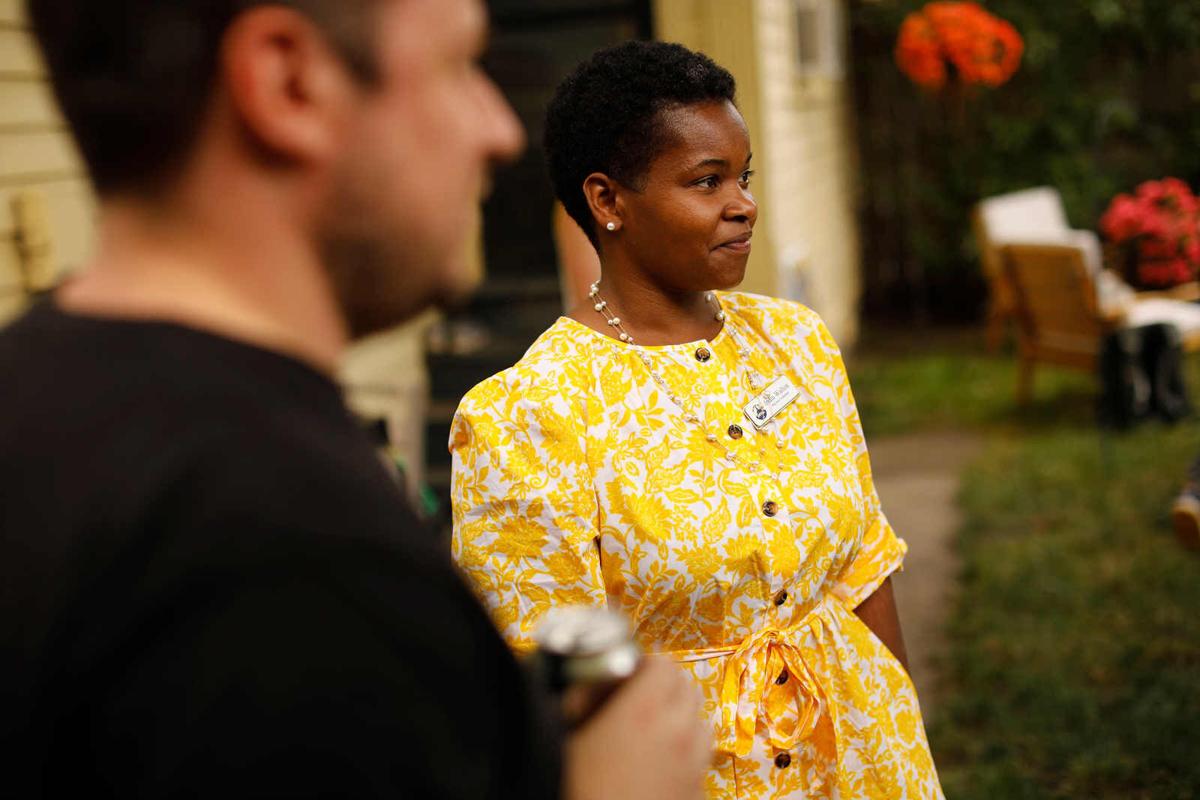
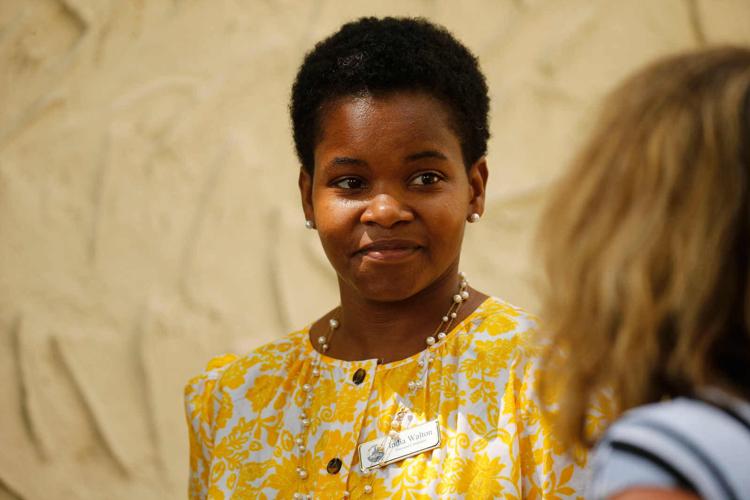
India Walton always knew she would seek public office.
But the defining moment came in June 2020 when 20-year-old Courtland M. Renford threw a burning laundry basket into City Hall during what began as a peaceful protest at Niagara Square over the killing of George Floyd during a violent arrest by police in Minneapolis.
“And our mayor got on … television. ‘We have you on camera, you idiot.’ That’s not leadership. Everything doesn’t have to be punitive,” Walton said. “I’m not saying what he did was right, but I’m saying for a person that is the top executive of our city to get on ... television and disparage a young person in that way, I thought where’s the love? Where’s the care?”
People are also reading…
Walton’s petite stature belies a Titanic-sized drive to organize people to help themselves. It's rooted in her background in nursing and community activism.
"My experience is rising to the occasion, working with people and building coalitions," Walton said.
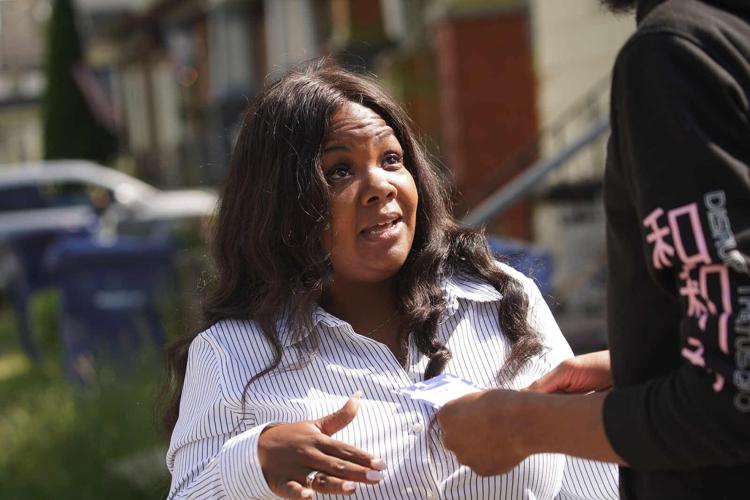
City Hall employee Le’Candice Durham, the other challenger to Mayor Byron W. Brown in the Democratic primary, cites her connection to the city based on her position as a 311 complaint call taker.
“I’m more than qualified. I listen to calls for the entire city,” Durham said from her Clinton Street campaign headquarters.
But in their first try at public office, both women face daunting odds. Over about three decades in politics, Brown has constructed a powerful organization with experience in the main objective of politics – winning elections. Again this year he commands an army of City Hall-based volunteers with contacts on virtually every block of the city.
Brown also lists dozens of major endorsements from unions, other politicians including Lt. Gov. Kathy Hochul and County Executive Mark C. Poloncarz, as well as newspapers like the Buffalo Criterion and The Buffalo News.
Still, Walton has also scored significant backing, including the powerful Buffalo Teachers Federation. Donations of about $83,000, while paling in comparison to the mayor’s, have proved competitive – enough to finance a series of slick mailers and television ads.
Durham has been largely inactive in fundraising.
In contrast, the incumbent has amassed a huge advantage in campaign contributions from a largely supportive political and business establishment – about $400,000 in all.
But Walton, whose left-leaning campaign has emphasized its working-class roots compared to Brown’s “establishment,” sees the disparity as an advantage. Campaign spokesman Seamus Gallivan points to an influx over the past few days of high end donations of around $5,000 – some from the Jacobs family associated with Delaware North Cos.
“Our average donation is $44, and that stark contrast should be drawn,” Gallivan said.
'You lift everyone'
Walton, a 39-year-old mother of four, had her first child when she was a freshman at Leonardo da Vinci High School.
As a senior, she was about three credits shy of graduating, but she had a son she had to care for.
“I couldn’t spend a full day in school so I elected to get my GED instead so that I could work,” she said.
Walton worked for a while at low-wage jobs, but better opportunities were on the horizon.
“I’ve always been a straight-A student, very bright," she said. "I just have not always made the best decisions, but you know when you’re a teenager you think that you know everything, and I thought that I knew everything. I did know, though, that it was not acceptable for me to rely on social services or my mother to take care of my child."
She was inspired to become a nurse after her twins were born “extremely premature” in 2001 and spent six months in Children’s Hospital, where a lot of the patients looked like her, but a lot of the nurses did not, she said.
After Walton got her nursing degree from Erie Community College in 2007, she worked at Children’s Hospital for about 10 years, she said.
Then she took her nursing skills to the Buffalo Public Schools, where she felt she could do more to help children and families overcome inequalities and disparities, she said.
“A lot of the kids they weren’t sick necessarily, but they were sad,” she said. “They just wanted someone to talk to. They were hungry. We had children who were chronically tardy and absent, and when you dig a little deeper it’s things like mom works until 8 a.m. She doesn’t get home until 8:30, 9 o'clock and some of the older siblings are caring for the younger siblings and are consistently late – just things that come with concentrated poverty and disadvantage.”
After two years, Walton wanted to do more to effect policy and do broader scale work. The next step was community organizing with Open Buffalo.
She calls her work with Community First Alliance and the Fruit Belt Community Land Trust her proudest accomplishment.
The alliance, a coalition of 19 organizations both inside and outside the Fruit Belt, achieved a parking permit system in 2016, authorized by the state, that sets aside half of the on-street parking for residents in the neighborhood that borders the Buffalo Niagara Medical Campus. The legislation came after workers at the growing campus began monopolizing the free parking spots.
Walton then became executive director of the land trust that was created in 2017 to ensure residents – not outsiders and elected officials – control the vacant city land near the campus.
“It was a vision, a tiny little seed that we planted that grew to success," she said. "I know that when there is a need you can learn the things that you need to make the change. And that’s what we did,” she said.
“The first year of our organization I was able to raise almost $1 million in grants and grassroots funding," she said. "I’m a nurse, never been a nonprofit executive. I’ve never been an affordable housing developer, but I was able to do that for my community because that’s what my community wanted. I don't have all the answers, and that is the great thing about that type of leadership is that it's transformative. You lift everyone up along with you."
Walton lives near the Peace Bridge in the Niagara District.
Her campaign priorities include defusing community violence, expanding opportunities for home ownership, neighborhood community development and planning and getting rid of wasteful spending.
'Full of resources'
Unlike Walton, Durham did not have long-held ambitions to run for public office.
“But God called me to run,” said Durham, 35, a member of Friendship Baptist Church on Hickory Street.
Her father, Leonard Lane, president of Fathers Armed Together to Help, Educate, Restore and Save (FATHERS), a “good friend” of Brown’s, advised her to wait four more years, she said.
But working at 311, the city's complaint line, she’s “heard it all” firsthand, and she knows what needs to be done, she said.
Durham started working for the city in 2016 in central booking at Buffalo Police Headquarters and then as a call taker for the past three years for the city's complaint line.
She graduated from Bennett High School and has an associate degree in criminal justice from Bryant and Stratton.
She does a lot of community outreach, especially in the Riverside neighborhood where she and her husband purchased a house and moved in with their six children in 2018. She has hosted two Night Out events in the community, including one last October during the pandemic as well as a food giveaway, a pop-up shop and a Love Thy Neighbor event with free coffee and donuts, also during the pandemic and socially distanced, she said.
Residents call to complain about everything from overgrown grass in vacant lots to drug traffic on their blocks. Many complain about speed camera enforcement, but some support them. She hears from landlords who are not getting paid by their tenants and fed-up residents who say they’re going to move out of the city, she said.
People also call for referrals for mental health programs even though 311 is not a referral line, and some call asking how to start a business, she said.
“Residents call 311 for everything,” she said. “I’m so full of resources. When I speak with residents I give them all the tools they need to be successful.”
Her campaign priorities include crime reduction with more community policing and building relationships with police and improving the condition of the city’s roads.


